Book guide and evaluation
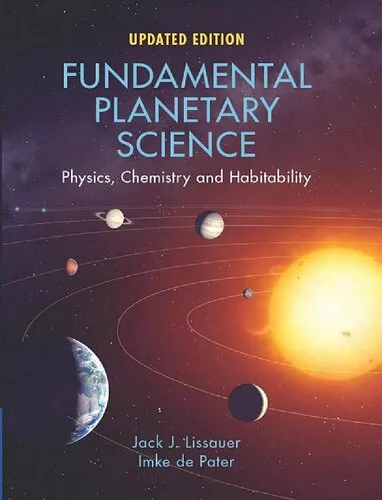
Fundamental Planetary Science, Updated Edition: Physics, Chemistry and Habitability
Jack J. Lissauer
English
Beginner
Physics
4.5 / 5
0 reviews
2019
Published
651
pages
521
views
Introduction to Fundamental Planetary Science, Updated Edition: Physics, Chemistry and Habitability The universe is vast, intricate, and awe-inspiring, full of mysteries yet to be unraveled. Planetary science stands at the heart of this exploration, connecting phys
Before you read
What will you get from this book?
Introduction to Fundamental Planetary Science, Updated Edition: Physics, Chemistry and Habitability
The universe is vast, intricate, and awe-inspiring, full of mysteries yet to be unraveled. Planetary science stands at the heart of this exploration, connecting physics, chemistry, and the search for life in the cosmos. Fundamental Planetary Science, Updated Edition serves as an indispensable guide for those eager to journey into this field, combining foundational knowledge with cutting-edge updates on recent discoveries. Written with the precision of a scholar and the accessibility needed for a broader audience, this book bridges the gaps between scientific disciplines and their applications to planetary exploration and habitability.
Detailed Summary of the Book
This updated edition broadens the scope of planetary science by delivering an integrated overview of the physical, chemical, and biological processes that govern planet formation, evolution, and habitability. Designed for advanced undergraduates, graduate students, and anyone with a general scientific curiosity, the book begins with the fundamental principles of planetary motion, gravitational interactions, and the laws of thermodynamics.
Subsequent chapters delve into the essential processes that create and shape planets, including accretion, differentiation, and geological activity. The book carefully examines planetary atmospheres, magnetospheres, and climates, as well as the interaction of planets with their parent stars. More importantly, with growing interest in habitable exoplanets and the search for extraterrestrial life, the book provides detailed discussions on what makes a planet hospitable for life and how its habitability can be sustained over time.
Throughout the text, sidebars and examples contextualize abstract principles, linking them to space missions, ongoing research, and phenomena observable in our own Solar System and beyond. The inclusion of exercises and problems at the end of each chapter equips readers with the tools to interpret data and apply theories to real-world scenarios. This is planetary science presented not just as a body of knowledge but as a vibrant, evolving field of inquiry.
Key Takeaways
- Comprehensive coverage of planetary physics, chemistry, and biology, with a focus on understanding planetary systems in the context of their habitability.
- Explanation of the formation, structure, and evolution of the solar system and exoplanetary systems.
- Insights into the methodologies used to study planets, from theoretical models to observational techniques and space missions.
- A framework for evaluating planetary habitability, with an emphasis on the conditions required for life as we know it to emerge and persist.
- Interdisciplinary connections between planetary science, astrophysics, atmospheric science, and astrobiology.
Famous Quotes from the Book
"Planetary science bridges the realms of the infinitely large and the invisibly small, connecting the forces that created worlds to the molecules that sustain life."
"Understanding the habitability of a planet requires not just identifying where life could arise, but also the intricate balances that keep a planet livable over billions of years."
Why This Book Matters
With rapid advancements in technology and mounting interest in exoplanet discovery, this book is more relevant than ever. It offers a cohesive framework for understanding planetary systems, one that intertwines rigorous scientific principles with keen insights into the search for life. The habitability of planets is not merely an academic question; it touches on humanity’s deepest existential ponderings.
Furthermore, as space exploration ventures further into the unknown, this book prepares readers to engage critically with emerging discoveries, whether they involve the icy moons of our Solar System or potentially Earth-like exoplanets light-years away. For students, researchers, and enthusiasts, Fundamental Planetary Science, Updated Edition is not just a textbook—it is a gateway to understanding the cosmos and our place within it.
Ask this book
Your question is answered in the context of this title and author. Each answer uses 2 points.
Sign in to ask the book assistant.
Reader reviews
0 reviews, 4.5 average out of 5
No reviews yet
If you have read this book, help the next reader with your experience.
Write a review
Sign in to publish a review.
Reader questions and answers
Ask a focused question and learn from the community.
Sign in to ask or answer a question.
No questions yet
Be the first to ask a clear, useful question.
What to read next
Related references that continue this learning path.