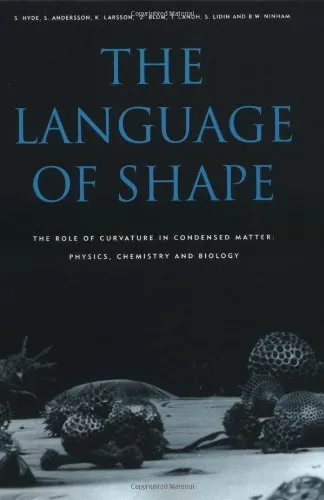
The Language of Shape: The Role of Curvature in Condensed Matter: Physics, Chemistry and Biology
S. Hyde,Z. Blum,T. Landh,S. Lidin,B.W. Ninham,S. Andersson,K. Larsson
1997
View book
Book guide and evaluation
Lissauer J.J.,Pater I.d.
0 reviews
Published
pages
views
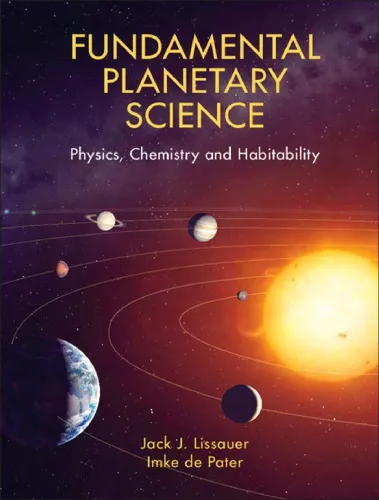
Introduction to "Fundamental Planetary Science: Physics, Chemistry and Habitability" Written by experts in the field of planetary science, "Fundamental Planetary Science: Physics, Chemistry and Habitability" by Lissauer J.J. and Pater I.d. offers a comprehensive explor
Before you read
Written by experts in the field of planetary science, "Fundamental Planetary Science: Physics, Chemistry and Habitability" by Lissauer J.J. and Pater I.d. offers a comprehensive exploration of the fundamental principles governing planets, their chemistry, and the conditions that make them habitable. This book is an essential text for students, researchers, and anyone curious about the scientific processes that shape not only our own planet but also the countless other worlds scattered across the universe.
The book provides clear, rigorous, and engaging explanations of the core topics in planetary science, blending theoretical physics, experimental chemistry, and observational astronomy. It introduces its readers to the mechanisms of planetary formation, the dynamic interaction of celestial bodies, and the essential ingredients for life to emerge. Covering both the solar system and exoplanetary systems, the book ensures that readers gain a scientific foundation and a sense of wonder for the vastness of space and the complexity of planetary systems.
At its core, this book delves deeply into the physics and chemistry underlying planetary phenomena as well as the conditions that could foster habitability. The early chapters guide readers through fundamental concepts such as gravity, thermodynamics, and orbital mechanics. These principles serve as the backbone for understanding the processes that govern the formation and evolution of planets.
The book then transitions seamlessly into discussions of planetary geology, atmospheres, magnetospheres, and the physics of planetary interiors. Through these detailed descriptions, readers develop a layered understanding of how planets interact within their respective systems. A significant portion of the book also focuses on exoplanets and the rapidly advancing field of their detection, providing insight into modern techniques such as transit observations and radial velocity measurements.
Finally, the book explores the cutting-edge realm of astrobiology and habitability, discussing the chemical processes essential for life and the potential for habitable environments beyond Earth. This section ties together the physical and chemical concepts addressed in earlier chapters, leaving readers with a holistic understanding of planetary science and its implications for finding life elsewhere in the universe.
"Understanding the physics and chemistry of planets is not merely about knowing how they work — it's about deciphering the cosmic narrative of how life, as we know it, becomes possible."
"Every exoplanet discovered is a testament to the diversity and ingenuity of nature in crafting worlds. They challenge our assumptions and open entirely new realms of questions."
"The study of habitability is our attempt to ask: Are we alone? But it is also a reflection on Earth, the only known habitable planet, and the need to protect what we have."
"Fundamental Planetary Science" is not just a textbook; it is a critical resource for anyone deeply curious about planetary systems and their ability to harbor life. In an age where space exploration is becoming increasingly ambitious, the book provides the tools essential for understanding the foundational science that underlies missions to Mars, Europa, and beyond.
With advancements in telescope technologies and missions like the James Webb Space Telescope, planetary science has entered an era of unprecedented discovery. This book equips readers with the scientific framework necessary to interpret these findings, encouraging them to think critically about the nature of planets and the potential for life in the cosmos.
Moreover, the book underscores the importance of Earth as our home, emphasizing how understanding other planets enhances our ability to protect and sustain our own. It inspires readers to see planetary science not merely as an academic pursuit but as a vital lens through which we can understand our place in the universe.
Your question is answered in the context of this title and author. Each answer uses 2 points.
0 reviews, 4.5 average out of 5
Sign in to publish a review.
Ask a focused question and learn from the community.
Related references that continue this learning path.
S. Hyde,Z. Blum,T. Landh,S. Lidin,B.W. Ninham,S. Andersson,K. Larsson