
Book guide and evaluation
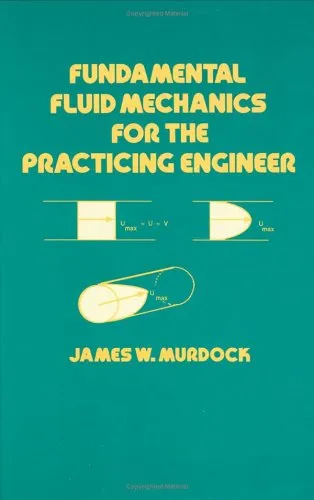
Fundamental Fluid Mechanics for the Practicing Engineer (Mechanical Engineering (Marcell Dekker))
James W. Murdock
English
Beginner
Classical Mechanics
4.2 / 5
0 reviews
1993
Published
439
pages
385
views
Introduction to 'Fundamental Fluid Mechanics for the Practicing Engineer' 'Fundamental Fluid Mechanics for the Practicing Engineer' is a cornerstone text designed to bridge the gap between theoretical fluid mechanics and real-world applications. This book stands ou
Before you read
What will you get from this book?
Introduction to 'Fundamental Fluid Mechanics for the Practicing Engineer'
'Fundamental Fluid Mechanics for the Practicing Engineer' is a cornerstone text designed to bridge the gap between theoretical fluid mechanics and real-world applications. This book stands out in the field by offering practical solutions to engineers confronted with fluid systems in various industries. Whether dealing with water treatment, HVAC systems, or aerodynamic designs, this text provides the insights and tools necessary to tackle complex fluid dynamics problems with confidence and efficiency.
Detailed Summary of the Book
In 'Fundamental Fluid Mechanics for the Practicing Engineer,' James W. Murdock brings his extensive experience to bear, crafting a resource that is both comprehensive and accessible. The book starts by elucidating the basics of fluid mechanics principles, such as fluid properties and fluid statics, before diving into more complex topics like fluid dynamics, boundary layer theory, and turbulence. Unlike conventional textbooks, this reference focuses on practical applications, demonstrating how theoretical concepts apply to everyday engineering challenges.
Each chapter is thoughtfully sequenced to build on previous concepts, ensuring that readers not only learn but understand how to apply key principles. With plenty of worked examples and real-world case studies, the book illustrates the use of fundamental equations and computational tools necessary for analyzing fluid flow in pipelines, ducts, and open channels. The inclusion of industry standards and codes further solidifies its place as an essential guide for practicing engineers.
Key Takeaways
'Fundamental Fluid Mechanics for the Practicing Engineer' imparts several key takeaways critical for anyone involved in fluid mechanics. These include:
- Comprehensive Understanding: Gain a thorough grasp of both the foundational and advanced concepts in fluid mechanics.
- Application-Oriented: Learn to apply theoretical knowledge to practical engineering problems for effective solutions.
- Problem-Solving Skills: Develop robust skills for analyzing and solving fluid dynamics problems using industry-standard tools.
- Real-World Cases: Benefit from numerous examples and case studies that illustrate the relevance of fluid mechanics in various industries.
Famous Quotes from the Book
Here are some memorable and poignant quotes from the book that capture its essence:
"In engineering, the elegance of theories is often judged by their utility in practicality."
"The beauty of fluid mechanics lies not in the complexity of its equations, but in its ability to simplify the complexities of the world around us."
Why This Book Matters
The importance of 'Fundamental Fluid Mechanics for the Practicing Engineer' cannot be overstated. In fields where fluid mechanics play a crucial role, having a reliable resource for understanding and predicted fluid behavior is essential. This book matters because it not only educates but empowers engineers to innovate and improve systems that are vital to our everyday lives. It provides the bridge necessary to translate theoretical learning into practical, applicable solutions, fostering a deeper understanding of the mechanics that drive the world.
Whether you are a student, an emerging engineer, or a seasoned practitioner looking to refresh your knowledge, this book remains an indispensable resource. It combines theory with application, making it particularly useful in rapidly evolving industries where the ability to adapt and apply fundamental principles is crucial. Ultimately, Murdock's book is more than just a textbook; it's an experiential guide that matters significantly for shaping how engineers approach and solve problems in fluid mechanics.
Ask this book
Your question is answered in the context of this title and author. Each answer uses 2 points.
Sign in to ask the book assistant.
Reader reviews
0 reviews, 4.2 average out of 5
No reviews yet
If you have read this book, help the next reader with your experience.
Write a review
Sign in to publish a review.
Reader questions and answers
Ask a focused question and learn from the community.
Sign in to ask or answer a question.
No questions yet
Be the first to ask a clear, useful question.
What to read next
Related references that continue this learning path.

Mathematical methods of classical mechanics: with 269 illustrations
Arnolʹd, Vladimir Igorevich;Weinstein, Alan;Vogtmann, Karen
2010
View book
Mechanics of the 21st Century
Tomasz A. Kowalewski (Editor) Witold Gutkowski (Editor)
2005
View book