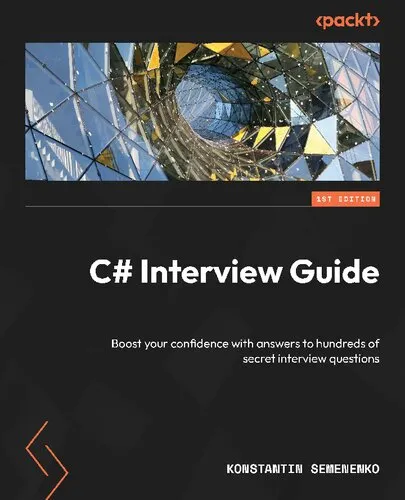
C# Interview Guide: Boost your confidence with answers to hundreds of secret interview questions
KONSTANTIN. SEMENENKO
2024
View book
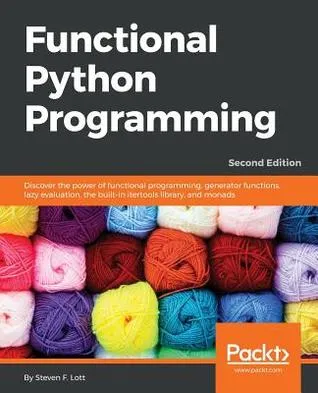
Book guide and evaluation
Steven F. Lott
0 reviews
Published
pages
views
Introduction to Functional Python Programming Welcome to Functional Python Programming, a comprehensive guide designed to help Python enthusiasts unlock the full potential of functional paradigms in one of the most versatile programming languages today. This book e
Before you read
Welcome to Functional Python Programming, a comprehensive guide designed to help Python enthusiasts unlock the full potential of functional paradigms in one of the most versatile programming languages today. This book explores the modern techniques, principles, and practices that emphasize declarative programming over procedural or imperative styles. By diving deep into concepts like generator functions, lazy evaluation, the itertools library, and even monads, this book becomes an essential resource for programmers who want to embrace the functional approach in Python.
Functional programming in Python isn't just about following trends—it's about building robust, maintainable, and scalable software. Python, as a language, offers incredible versatility, blending object-oriented and procedural styles effortlessly. However, Python also integrates functional programming elements, providing tools that can simplify complex problems and reduce side effects in your software. This book takes you step-by-step through integrating functional paradigms into your Python toolkit while providing practical examples and actionable insights to bridge the gap between theory and application.
At its core, Functional Python Programming is about transforming how you approach problem-solving through Python's functional capabilities. The book begins with a concise explanation of functional programming principles, laying the groundwork for readers unfamiliar with this paradigm. It explores vital concepts like higher-order functions, pure functions, immutability, and referential transparency, ensuring clarity even for those new to these ideas.
Throughout the chapters, you'll find clear guidance on utilizing Python's tools for functional programming. The book delves into essential topics, including:
map(), filter(), and reduce().Additionally, the book emphasizes the tradeoffs of using functional paradigms in Python, offering practical advice on when and where to employ these techniques in your projects.
By the time you finish reading Functional Python Programming, you will have gained a deep understanding of:
itertools and generator expressions for elegant solutions."In functional programming, we write solutions that focus less on 'how' and more on 'what'—letting abstraction take center stage to reduce complexity."
"Generator functions in Python are a perfect marriage of laziness and practicality, giving us unlimited data with limited memory."
"While Python is not inherently a functional programming language, its richness allows us to embrace and blend functional programming paradigms into our code seamlessly."
In a tech landscape that is increasingly leaning towards declarative programming and functional paradigms, understanding the functional programming concepts and techniques has never been more critical. Python developers, in particular, are often caught in a dilemma, juggling object-oriented principles with functional opportunities. This book shines as a beacon to bridge these paradigms.
Functional Python Programming not only equips programmers with the tools needed to master functional programming in Python but also allows them to write more concise, readable, and efficient code. By focusing on practical implementation, this book encourages readers to adopt functional techniques in their everyday programming tasks, revolutionizing how they write and think about Python code.
Regardless of whether you're an experienced developer looking to expand your skill set or a beginner eager to absorb future-proof programming techniques, this book delivers invaluable insight into the functional capabilities of Python. By the end, you will be confident in applying functional programming tools and creating Python applications that are not only elegant but scalable and reliable.
Your question is answered in the context of this title and author. Each answer uses 2 points.
0 reviews, 4.4 average out of 5
Sign in to publish a review.
Ask a focused question and learn from the community.
Related references that continue this learning path.
KONSTANTIN. SEMENENKO