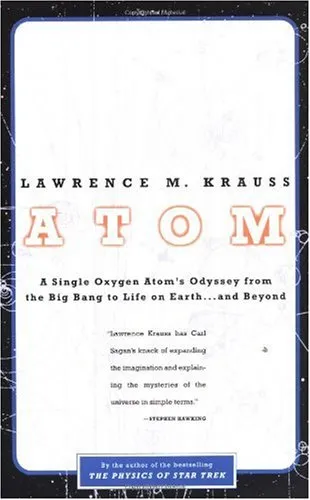
Atom - A Single Oxygen Atoms Journey from the Big Bang to Life on Earth...and Beyond
Lawrence M. Krauss
2001
View book
Book guide and evaluation
Norbert Schulz
0 reviews
Published
pages
views
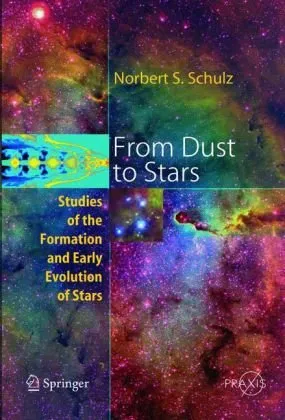
Introduction to "From Dust To Stars: Studies of the Formation and Early Evolution of Stars" The stellar journey from dust to stars is one of the most captivating narratives in the universe, a process that merges the realms of physics, chemistry, and cosmic history. "From D
Before you read
The stellar journey from dust to stars is one of the most captivating narratives in the universe, a process that merges the realms of physics, chemistry, and cosmic history. "From Dust To Stars: Studies of the Formation and Early Evolution of Stars" delves into this fascinating story, guiding readers through the intricacies of star formation and the transformative stages that forge the very elements essential for life. This book serves not only as a robust resource for students and researchers in astrophysics but also as an inviting gateway for anyone with a deep curiosity about the origins and evolution of stars.
With advancements in observational astronomy, theoretical modeling, and computational simulations, our understanding of star formation has seen unprecedented growth in recent decades. Yet, the journey from cosmic clouds of gas and dust to fully formed stars remains an intricate puzzle, layered with complexity. In crafting this book, I aimed to present not only the physical processes and scientific discoveries behind star formation but also the inherent beauty and interconnectedness of celestial phenomena.
This work is designed for a diverse audience, offering clear explanations of foundational concepts while remaining rich in detail and scientific rigor for advanced readers. By integrating historical perspectives, recent findings, and future outlooks, "From Dust To Stars" attempts to provide a holistic and enlightening perspective on the earliest stages of stellar evolution.
"From Dust To Stars" unfolds in a structured journey, starting from the cosmic origins of gas and dust to the magnificent emergence of stars. The book begins with a discussion of interstellar medium properties, the raw material from which stars are born. From here, it transitions into the concepts of gravitational collapse, molecular cloud dynamics, and the pivotal role of turbulence and magnetic fields in star-forming regions.
Subsequent chapters explore the physical and chemical processes that dominate during the early protostellar phases. From accretion disks to bipolar outflows, readers will uncover the fundamental mechanisms shaping stars and their surrounding systems. Stellar feedback, the influence of high-energy radiation, and episodic accretion events are examined in depth. The book also dedicates discussions to binary star formation, clustering, and the impact of environment on stellar evolution.
Finally, the book closes with a look at young stellar objects (YSOs) and pre-main sequence stars, carefully connecting theory, observation, and simulation. Throughout the narrative, the focus remains on connecting the microphysics of star formation to cosmological implications, shedding light on the cycle of stellar birth, death, and rebirth that defines our universe.
"The process by which stars emerge from cosmic darkness symbolizes the universe’s inherent ability to transform chaos into order, simplicity into grandeur."
"In every star's birth shines the memory of countless generations of cosmic recycling, where dust from ancient stars lays the foundation for new beginnings."
"The interplay between gravity and light forms the symphony of star formation, a cosmic ballet that is both deterministic and serendipitous."
Understanding the birth of stars is crucial for grasping the broader context of the universe's evolution. Stars are the engines of cosmic transformation, producing the elements that make up planets, life, and ultimately, us. By unraveling the complexities of star formation, this book offers profound insights into how celestial processes shape the universe and our place within it.
Additionally, the book bridges a vital gap in scientific literature by providing a comprehensive yet accessible resource on one of astronomy's most dynamic and rapidly evolving fields. It synthesizes theoretical developments, observational data, and computational models, making it a valuable tool for anyone—be they professional astrophysicists or passionate enthusiasts—seeking to deepen their understanding of how stars form and evolve.
Through its interdisciplinary approach and focus on the universal relevance of stellar processes, "From Dust To Stars" aspires to inspire a greater appreciation for the vast, interconnected tapestry of the cosmos.
Your question is answered in the context of this title and author. Each answer uses 2 points.
0 reviews, 4.5 average out of 5
Sign in to publish a review.
Ask a focused question and learn from the community.
Related references that continue this learning path.
Lawrence M. Krauss