

Book guide and evaluation
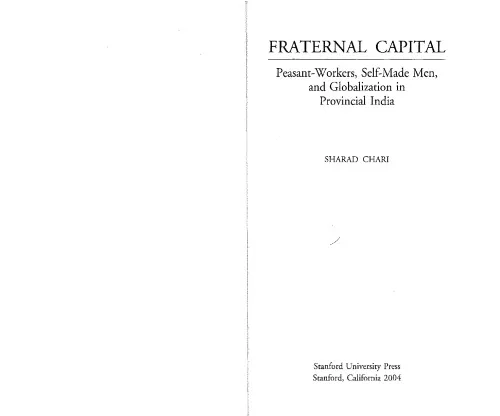
Fraternal Capital: Peasant-Workers, Self-Made Men, and Globalization in Provincial India
Sharad Chari
English
Beginner
Data Science
4.9 / 5
0 reviews
2004
Published
205
pages
181
views
Introduction to 'Fraternal Capital: Peasant-Workers, Self-Made Men, and Globalization in Provincial India' "Fraternal Capital: Peasant-Workers, Self-Made Men, and Globalization in Provincial India" is an in-depth and anthropological exploration of how global capitalism int
Before you read
What will you get from this book?
Introduction to 'Fraternal Capital: Peasant-Workers, Self-Made Men, and Globalization in Provincial India'
"Fraternal Capital: Peasant-Workers, Self-Made Men, and Globalization in Provincial India" is an in-depth and anthropological exploration of how global capitalism intertwines with local socio-economic structures, identities, and histories in Coimbatore, a secondary industrial city in southern India. In this thought-provoking book, I examine the social fabric and economic transformations of Coimbatore, demonstrating how the forces of globalization and cultural ties have shaped its unique historical trajectory of industrialization. By using the lens of masculinity, fraternity, labor, and entrepreneurship, I delve into the dynamic interaction between tradition and modernity in a region often overlooked in broader discussions of Indian economic development.
The book investigates the lived experiences and struggles of those who navigate the world of "fraternal capital"—a concept I use to describe networks of trust, kinship, and competition that define Coimbatore's socio-economic realities. Drawing on rich ethnographic research, "Fraternal Capital" situates Coimbatore within local and global contexts, ultimately presenting a nuanced critique of how neoliberal globalization refracts through particular histories and identities.
Detailed Summary of the Book
At its core, the book centers on Coimbatore as an industrial hub whose development is deeply tied to the social organization of Tamil peasant-workers, elite "self-made" entrepreneurs, and shifting gender roles. Through detailed ethnographic accounts, I explore the city's cotton mills, foundries, and engineering workshops, highlighting how these industries are sites of complex relationships between labor, caste, and family.
The structure of the book moves through various facets of Coimbatore's transformations. It starts by charting the historical growth of industrial capital in the region, tied intricately to agrarian change. The narrative then expands to engage with the lives of workers and entrepreneurs whose everyday realities reflect both class solidarity and internal divisions. I analyze how caste and kinship networks play a significant role in shaping entrepreneurial practices, often fostering collaborative yet competitive relations I term as "fraternal."
Additionally, "Fraternal Capital" critically discusses masculinity as a key theme that underpins the workforce and entrepreneurial identity. From the hyper-masculine cultures of labor to the self-fashioning of business leaders as patriarchs, gender is shown as a constitutive force of economic life. Ultimately, the book sheds light on the paradoxical ways in which Coimbatore reconciles its "provincial" past with its aspirations to be part of a globalized future.
Key Takeaways
- Industrial development in provincial India does not simply mimic urban centers; it follows its unique trajectory shaped by local histories and social structures.
- Globalization operates within the framework of existing inequalities, such as caste, class, and gender, often exacerbating them while offering new opportunities for transformation.
- The role of masculinity and fraternity is central to understanding how capital is accumulated and reproduced in Coimbatore's industrial economy.
- Local kinship ties and trust-based relations enable industrialization in Coimbatore, but they also create competitive dynamics within tightly-knit communities.
- Ethnographic studies are indispensable for understanding the nuanced realities of globalization in non-metropolitan regions.
Famous Quotes from the Book
- "Fraternity is never neutral: it simultaneously binds and divides, creating ties of obligation and mechanisms of control."
- "Coimbatore’s industrial capitalists thrive in the spaces between tradition and modernity, sustaining their enterprise through a distinct fusion of individual ambition and communal ties."
- "The peasant-worker carries the tensions of rural backwardness and industrial modernity, embodying the contradictions of a globalizing economy."
- "Globalization does not erase inequality; it emerges through it, shapes it, and is reshaped by it."
Why This Book Matters
"Fraternal Capital" stands out as a significant contribution to the fields of economic anthropology, development studies, and South Asian studies. By centering Coimbatore, the book offers a rare, ground-level understanding of how globalization intersects with local economic and social structures in a provincial Indian context. This nuanced analysis challenges popular narratives that often portray globalization as a monolithic force of homogenization or progress.
Furthermore, the book's focus on fraternity and masculinity highlights critical, but often overlooked, dimensions of how labor and capital operate in regions beyond metropolitan centers. This perspective enables readers to see the laboring and entrepreneurial classes not just as economic actors but as social beings shaped by intricate networks of identity, obligation, and aspiration.
For scholars, policymakers, and anyone interested in the complexities of globalization, "Fraternal Capital" provides an invaluable lens to understand the uneven contours of economic development in India’s industrializing provinces. It is a call to critically engage with the diverse ways regional economies sustain themselves while participating in—and resisting—the global economy.
Ask this book
Your question is answered in the context of this title and author. Each answer uses 2 points.
Sign in to ask the book assistant.
Reader reviews
0 reviews, 4.9 average out of 5
No reviews yet
If you have read this book, help the next reader with your experience.
Write a review
Sign in to publish a review.
Reader questions and answers
Ask a focused question and learn from the community.
Sign in to ask or answer a question.
No questions yet
Be the first to ask a clear, useful question.
What to read next
Related references that continue this learning path.



Modern Computer Vision with PyTorch: A Practical Roadmap From Deep Learning Fundamentals to Advanced Applications and Generative AI, 2nd Edition
V Kishore Ayyadevara,Yeshwanth Reddy
2023
View book