Book guide and evaluation
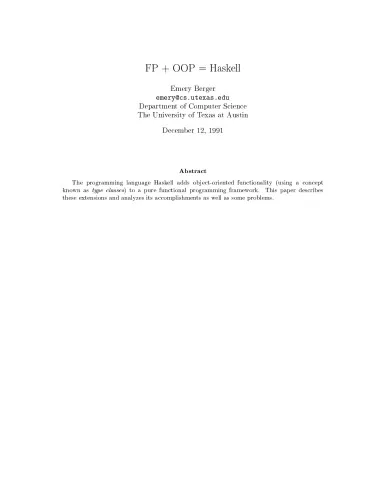
FP+OOP=Haskell
Berger E.
English
Unordered
Computer Science and Theory
4.0 / 5
0 reviews
1991
Published
11
pages
526
views
Introduction Welcome to the fascinating world of Haskell—where Functional Programming (FP) meets Object-Oriented Programming (OOP) to bring you the best of both paradigms. In 'FP+OOP=Haskell', we embark on a journey through the innovative features of Haskell, a language th
Before you read
What will you get from this book?
Introduction
Welcome to the fascinating world of Haskell—where Functional Programming (FP) meets Object-Oriented Programming (OOP) to bring you the best of both paradigms. In 'FP+OOP=Haskell', we embark on a journey through the innovative features of Haskell, a language that challenges traditional programming norms. The goal of this book is not only to provide you with the tools and knowledge to master Haskell but also to enrich your understanding of programming paradigms.
Detailed Summary of the Book
'FP+OOP=Haskell' starts by setting a strong foundation in the core principles of Functional Programming. The opening chapters focus on immutability, first-class functions, and pure computations, providing readers with a comprehensive understanding of how FP principles can lead to more predictable and maintainable code. As we navigate through each chapter, Haskell’s distinct features such as algebraic data types, monads, and type classes emerge as the stars of the programming universe.
The book then takes you through the world of Object-Oriented Programming under the lens of Haskell. It demonstrates how encapsulating behavior using type classes and handling side-effects through monads can resemble the modularity and abstraction offered by OOP while avoiding pitfalls like mutable state. Each section is designed to blend the functional ideology with object-oriented practices, illustrating how Haskell embodies a unique synthesis of these programming paradigms.
In later chapters, the focus shifts to advanced topics like concurrency and parallelism, leveraging Haskell's strong type system to write robust, concurrent programs. The book concludes by exploring real-world applications, showing how Haskell’s expressive syntax and powerful abstractions make it a great fit for tasks ranging from web development to data analysis.
Key Takeaways
- Understand the core concepts and benefits of Functional Programming.
- Learn how Haskell implements Object-Oriented constructs without sacrificing its functional purity.
- Gain proficiency in advanced Haskell topics such as type classes, monads, and concurrency.
- Explore real-world applications and case studies illustrating the efficient use of Haskell.
Famous Quotes from the Book
"In the world of programming, Haskell stands out not only for its elegant syntax but for its ability to unite the principles of FP and OOP into a singular, powerful paradigm."
"A function in Haskell is more than a mapping from inputs to outputs; it's a promise of purity, a beacon of predictability in a chaotic digital world."
Why This Book Matters
In today's software development landscape, understanding multiple programming paradigms is an invaluable skill. As mainstream languages continue to borrow features from both FP and OOP, mastering a language like Haskell not only enhances your technical expertise but also broadens your conceptual thinking. 'FP+OOP=Haskell' provides a unique perspective that challenges conventional wisdom and encourages innovative thinking.
This book matters because it breaks down the complexity of Haskell into accessible concepts without diluting the richness of its features. It’s an invitation to rethink how we approach software design and a toolkit for navigating the evolving technological environment.
Whether you are a software engineer looking to expand your skill set, a student of computer science, or a coding enthusiast eager to explore new territories, 'FP+OOP=Haskell' holds the promise of a rewarding intellectual journey.
Ask this book
Your question is answered in the context of this title and author. Each answer uses 2 points.
Sign in to ask the book assistant.
Reader reviews
0 reviews, 4.0 average out of 5
No reviews yet
If you have read this book, help the next reader with your experience.
Write a review
Sign in to publish a review.
Reader questions and answers
Ask a focused question and learn from the community.
Sign in to ask or answer a question.
No questions yet
Be the first to ask a clear, useful question.
What to read next
Related references that continue this learning path.