

Book guide and evaluation
Fourier Analysis of time series an introduction
Peter Bloomfield
English
Beginner
Mathematics
4.5 / 5
0 reviews
2000
Published
275
pages
161
views
Introduction to Fourier Analysis of Time Series: An Introduction Time series data is everywhere—from the rhythms of natural phenomena to the ticking of economic indicators. Understanding the structure and dynamics of such data requires powerful analytical tools, one of which i
Before you read
What will you get from this book?
Introduction to Fourier Analysis of Time Series: An Introduction
Time series data is everywhere—from the rhythms of natural phenomena to the ticking of economic indicators. Understanding the structure and dynamics of such data requires powerful analytical tools, one of which is Fourier analysis. Fourier Analysis of Time Series: An Introduction offers a comprehensive and accessible guide to using this mathematical technique effectively. Authored for researchers, students, and professionals alike, this book introduces Fourier methods tailored to the specific needs of analyzing time-dependent data.
Detailed Summary of the Book
In this book, I aimed to demystify Fourier analysis for those who work with time-series data but may not have extensive backgrounds in advanced mathematics. The book begins by laying the groundwork with a clear explanation of the Fourier transform and its relationship to time and frequency domains. This foundational knowledge bridges the gap for newcomers to the subject and provides the mathematical rigor appreciated by more advanced readers.
A key focus of the text is the practical application of Fourier techniques to real-world time-series problems. Chapters cover topics such as spectral density, periodogram analysis, and windowing techniques designed to make sense of noisy or complex data sets. The reader is walked through step-by-step examples, with explanations of how to interpret results and avoid common pitfalls in Fourier analysis.
The latter chapters delve deeper into advanced concepts such as the limitations and computational challenges of the Discrete Fourier Transform (DFT) and Fast Fourier Transform (FFT). These sections are enriched with discussions on filtering, smoothing, and sampling issues, connecting theoretical insights with practical challenges faced by analysts in diverse fields.
Ultimately, the book aims to empower the reader to think critically about their data and apply Fourier methods effectively. As such, this work serves as both a tutorial and an enduring reference for time-series analysis.
Key Takeaways
- Comprehensive understanding of Fourier transforms and their applications in time-series analysis.
- Practical examples of using periodograms and spectral analysis to uncover hidden patterns in data.
- Explanation of the strengths and limitations of Fourier methods, including their application to non-stationary data.
- Detailed exploration of computational methods, including the Fast Fourier Transform (FFT) algorithm.
- Insights into how Fourier analysis bridges the gap between time domain and frequency domain representations.
Famous Quotes from the Book
"The Fourier transform is not merely a mathematical tool; it is a lens through which we perceive the symmetries and frequencies shaping time-dependent phenomena."
"Analyzing time-series data without considering its spectral composition is akin to studying music without acknowledging the notes."
"Fourier analysis teaches us that even the most chaotic time series conceal systematic patterns, waiting to be uncovered."
Why This Book Matters
Fourier analysis plays a crucial role in many scientific and applied fields, including economics, meteorology, engineering, and biology. This book provides readers with the tools to decompose complex, time-dependent patterns into understandable frequency components, allowing for better insights and decision-making. By balancing theory with practical examples, Fourier Analysis of Time Series: An Introduction makes an otherwise daunting subject approachable, even for those with a limited mathematical background.
Moreover, as technology continues to generate massive streams of time-stamped data, the ability to analyze and make sense of such data is becoming increasingly important. This book equips readers with time-tested analytical techniques necessary for navigating the ever-expanding world of data science and analytics.
Whether you're a student venturing into the world of time-series analysis for the first time or a seasoned professional looking to fine-tune your analytical expertise, this book provides a solid foundation for unlocking the potential of Fourier methods. Its clear explanations, practical examples, and rigorous approach make it an essential resource for understanding time-series data in depth.
Ask this book
Your question is answered in the context of this title and author. Each answer uses 2 points.
Sign in to ask the book assistant.
Reader reviews
0 reviews, 4.5 average out of 5
No reviews yet
If you have read this book, help the next reader with your experience.
Write a review
Sign in to publish a review.
Reader questions and answers
Ask a focused question and learn from the community.
Sign in to ask or answer a question.
No questions yet
Be the first to ask a clear, useful question.
What to read next
Related references that continue this learning path.
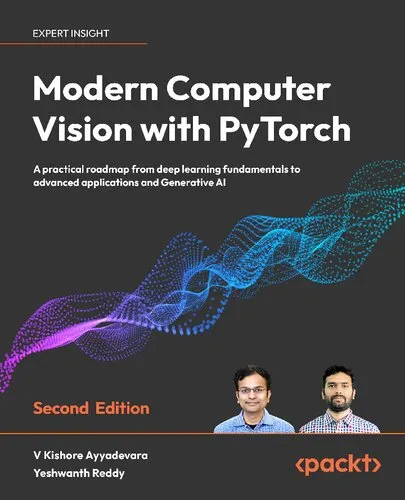
Modern Computer Vision with PyTorch: A Practical Roadmap From Deep Learning Fundamentals to Advanced Applications and Generative AI, 2nd Edition
V Kishore Ayyadevara,Yeshwanth Reddy
2023
View book