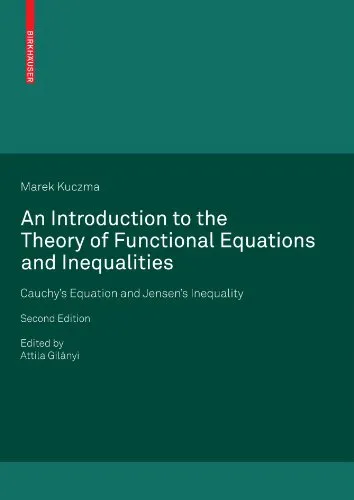
An introduction to the theory of functional equations and inequalities
Marek Kuczma,Attila Gilányi
2008
View book
Book guide and evaluation
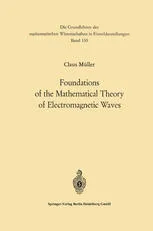
Prof. Dr. Claus Müller (auth.)
0 reviews
Published
pages
views
Introduction to "Foundations of the Mathematical Theory of Electromagnetic Waves" The book Foundations of the Mathematical Theory of Electromagnetic Waves is a monumental effort in bridging the classical theory of electromagnetic waves with a rigorous mathematical framework. A
Before you read
The book Foundations of the Mathematical Theory of Electromagnetic Waves is a monumental effort in bridging the classical theory of electromagnetic waves with a rigorous mathematical framework. Authored by Prof. Dr. Claus Müller, this text is tailored for advanced students, researchers, and professionals who strive to uncover the exact mathematical underpinnings of Maxwell's equations and electromagnetic phenomena.
Throughout the chapters, the book delves into key mathematical tools and methods that form the bedrock of electromagnetic wave theory, such as functional analysis, complex variables, and Green's functions. These are harmonized with physics concepts to address both fundamental questions in electromagnetic theory and its real-world applications. Whether you're an applied mathematician, physicist, or electrical engineer, this book is designed to guide you through the intricacies of the subject with clarity and precision, empowering you to apply mathematical rigor to solve challenging problems in the field of electromagnetism.
The text is methodically structured to build understanding from basic mathematical preliminaries to advanced applications in electromagnetic wave theory. It begins with an extensive overview of Maxwell's equations, the cornerstone of classical electromagnetism, emphasizing their mathematical formulation and implications. The book progresses to derive wave equations, explore boundary-value problems, and apply principles of symmetry and uniqueness. Topics such as spherical waves, plane waves, and their solutions in various domains are meticulously discussed.
One of the highlights of the book is its comprehensive exploration of Green's functions. By connecting these powerful mathematical tools with the solution of partial differential equations, particularly those arising in electromagnetic systems, Müller illuminates their practicality and elegance. Furthermore, the book covers intricate topics like scattering theory, dyadic Green's functions, and the radiation properties of electromagnetic waves.
The rigorous mathematical treatment is balanced with physical intuition, making the book not just a theoretical treatise but also an applied guide. Complex geometries, variable material properties, and real-world conditions are all addressed, ensuring that readers appreciate the practical utility of the underlying mathematical principles.
"Mathematics is the language through which nature's laws reveal their perfection, and nowhere is this clearer than in the study of electromagnetic waves."
"The elegance of electromagnetic wave theory lies not only in its predictive power but also in its mathematical structure, which connects seemingly disparate physical phenomena."
This book holds a significant place in the literature on electromagnetic theory because it provides a much-needed mathematical foundation for a field originally rooted in classical physics. While there are numerous texts on electromagnetic waves, few approach the subject with the same level of mathematical rigor and systematic analysis as this one. By tackling this niche in the subject matter, Prof. Dr. Claus Müller ensures that readers develop a deep and nuanced understanding of the topic.
Furthermore, this book empowers scientists and engineers to handle complex problems more effectively, thanks to its in-depth treatment of advanced mathematical tools. The explanations are precise yet accessible to those willing to engage with the mathematical depth. In research contexts where accuracy and analytical proficiency are paramount, this book serves as an invaluable reference.
Finally, the interdisciplinary appeal of the book cannot be overstated. By connecting advanced mathematics with theoretical and applied electromagnetism, it reinforces the idea that true mastery requires crossing the boundaries of individual disciplines. This synthesis of knowledge makes Foundations of the Mathematical Theory of Electromagnetic Waves a timeless resource for anyone serious about understanding the field at its core.
Your question is answered in the context of this title and author. Each answer uses 2 points.
0 reviews, 4.0 average out of 5
Sign in to publish a review.
Ask a focused question and learn from the community.
Related references that continue this learning path.
Marek Kuczma,Attila Gilányi

Palaniappan Kannappan (auth.)