

Book guide and evaluation
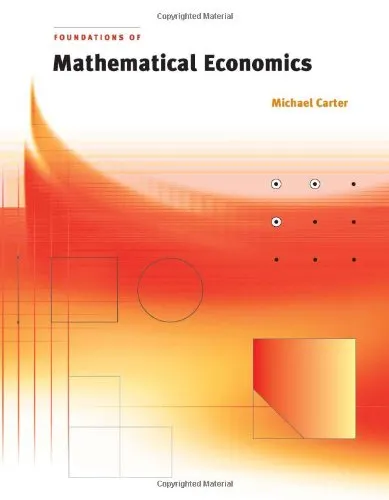
Foundations of mathematical economics
Michael Carter
English
Beginner
Economics
4.3 / 5
0 reviews
2001
Published
666
pages
327
views
Introduction to 'Foundations of Mathematical Economics' Welcome to Foundations of Mathematical Economics, a comprehensive text designed to bridge the gap between abstract economic theory and formal mathematical applications. This book serves as a unified guide to understan
Before you read
What will you get from this book?
Introduction to 'Foundations of Mathematical Economics'
Welcome to Foundations of Mathematical Economics, a comprehensive text designed to bridge the gap between abstract economic theory and formal mathematical applications. This book serves as a unified guide to understanding how mathematical principles are applied to solve complex economic problems. Whether you're an aspiring economist, a student navigating the intersection of mathematics and economics, or a professional looking to deepen your understanding, this book is designed to provide practical insights and foundational knowledge.
Detailed Summary of the Book
At its core, Foundations of Mathematical Economics explores how mathematical tools enable us to address modern economic theories systematically and rigorously. The book covers a diverse range of topics, including optimization, equilibrium theory, linear systems, and dynamic analysis. Each chapter is structured to first lay down the theoretical framework, followed by detailed examples and practical problems to enhance comprehension.
The journey begins with an introduction to fundamental concepts like sets, functions, and relations, providing the building blocks for more advanced topics. Readers are then guided through critical subjects such as linear algebra and calculus, with applications explicitly tied to economic modeling. Key chapters delve into constrained and unconstrained optimization, a vital area in understanding consumer behavior, market equilibrium, and production theory. Towards the end, dynamic systems and their role in long-term economic planning and growth are discussed.
This text’s emphasis is on clarity, providing intuitive explanations for even the most complex models. The integration of theory with application makes this book not just a reference but a working manual for anyone aspiring to excel in the field of mathematical economics.
Key Takeaways
- Master the basic mathematical principles that form the foundation of economic theory.
- Learn how to construct, analyze, and interpret economic models using mathematics.
- Understand critical concepts like optimization, equilibrium, and dynamics through practical examples.
- Develop problem-solving skills to tackle real-world economic challenges.
- Gain insights into how mathematical tools enable predictions and informed decision-making in economics.
Famous Quotes from the Book
“Mathematics provides the vocabulary through which economics can find rigor, clarity, and universal applicability.”
“The elegance of economics lies in its ability to frame complex real-world problems within the simplicity of mathematical structures.”
“Optimization is not just a mathematical concept—it reflects the very essence of rational economic behavior.”
Why This Book Matters
Economic theory in the modern world leans heavily on the precision and analytical strength that mathematics provides. Foundations of Mathematical Economics is not merely a textbook—it is a toolkit that equips you with the necessary skills to think critically, model realistically, and solve effectively.
In an era driven by data, algorithms, and predictive analytics, understanding the mathematical backbone of economics opens doors to innovation and policy formulation. This book matters because it empowers readers to bridge theoretical understanding with practical application. Furthermore, its accessible and structured approach ensures that both novices and seasoned readers can unlock its wealth of knowledge.
As the interplay between economics and technology deepens, competency in mathematical economics becomes increasingly indispensable. This book stands as a testament to the importance of embracing quantitative rigor to address the challenges and opportunities of a rapidly evolving global economy.
Ask this book
Your question is answered in the context of this title and author. Each answer uses 2 points.
Sign in to ask the book assistant.
Reader reviews
0 reviews, 4.3 average out of 5
No reviews yet
If you have read this book, help the next reader with your experience.
Write a review
Sign in to publish a review.
Reader questions and answers
Ask a focused question and learn from the community.
Sign in to ask or answer a question.
No questions yet
Be the first to ask a clear, useful question.
What to read next
Related references that continue this learning path.


Modern Computer Vision with PyTorch: A Practical Roadmap From Deep Learning Fundamentals to Advanced Applications and Generative AI, 2nd Edition
V Kishore Ayyadevara,Yeshwanth Reddy
2023
View book