Book guide and evaluation
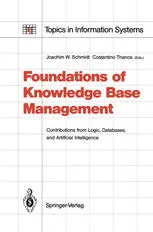
Foundations of Knowledge Base Management: Contributions from Logic, Databases, and Artificial Intelligence Applications
Wolfgang Bibel,Jean-Marie Nicolas (auth.),Joachim W. Schmidt,Constantino Thanos (eds.)
English
Unordered
Artificial Intelligence (AI)
3.8 / 5
0 reviews
1989
Published
565
pages
301
views
Introduction to "Foundations of Knowledge Base Management" "Foundations of Knowledge Base Management: Contributions from Logic, Databases, and Artificial Intelligence Applications" is a seminal text designed for researchers, academics, and professionals working at the inte
Before you read
What will you get from this book?
Introduction to "Foundations of Knowledge Base Management"
"Foundations of Knowledge Base Management: Contributions from Logic, Databases, and Artificial Intelligence Applications" is a seminal text designed for researchers, academics, and professionals working at the intersection of computer science disciplines. Authored by Wolfgang Bibel and Jean-Marie Nicolas, and meticulously edited by Joachim W. Schmidt and Constantino Thanos, this book explores the theoretical and practical underpinnings of knowledge base management systems (KBMS). It integrates insights from logic, database theory, and artificial intelligence (AI) applications to pave new pathways for efficient and intelligent data management.
As the world increasingly relies on intelligent systems to process and manage vast amounts of information, this book offers the foundational knowledge required for building robust, scalable, and intelligent KBMS. With contributions from leading experts, this volume is not merely a technical text—it is an intellectual roadmap for those seeking to bridge the gap between traditional database systems and AI-driven insights.
Detailed Summary of the Book
The book is divided into multiple sections that systematically explore the interplay between logic, database systems, and artificial intelligence. It begins with a detailed examination of logical theories as a framework for data representation and reasoning. Here, core concepts such as predicate logic, model theory, and deduction mechanisms are discussed to highlight their applicability to knowledge base design.
Moving forward, the text delves into database architectures, emphasizing relational databases and optimization techniques for large-scale data processing. Readers are guided through topics such as query languages, semantics, and indexing methods, offering pragmatic solutions for handling complex datasets effectively.
In its concluding sections, the book bridges the gap between database theory and AI, showcasing how principles of machine learning, heuristic reasoning, and intelligent algorithms can enrich contemporary KBMS. There is significant focus on method integration, creating systems that are not only functional but adaptive and self-evolving.
Together, these discussions yield a cohesive treatise on how databases can transcend their traditional roles, evolving into knowledge bases powered by advanced AI methodologies.
Key Takeaways
- Understanding the foundational role of logic in data modeling and reasoning.
- Efficient methods for query optimization and semantic clarity in database systems.
- How AI principles can transform static databases into adaptive, intelligent knowledge bases.
- A holistic approach to integrating logic, databases, and AI into unified KBMS.
Famous Quotes from the Book
"The synergy between logic, databases, and artificial intelligence heralds a new era for knowledge management, where systems do not just store information—they understand it."
"Knowledge bases are not repositories of facts; they are engines of inference, driven by intelligence and adaptability."
Why This Book Matters
In an era dominated by data, the ability to manage and derive knowledge efficiently is paramount. This book is more than a technical manual; it is a conceptual framework that addresses the foundational challenges in knowledge base management. Knowledge bases, augmented by AI and strengthened by logical rigor, are the backbone of progress in fields as diverse as healthcare, finance, and scientific research.
By bridging traditional database systems with cutting-edge AI approaches, the authors provide insights that address both present and future needs. Whether you are a researcher seeking to advance theoretical foundations or a practitioner aiming to solve complex real-world problems, this book equips you with the tools and methodologies needed to succeed.
Its importance lies not only in the depth of technical knowledge but also in its vision for enabling systems that are intelligent, adaptable, and ultimately transformative for society.
Ask this book
Your question is answered in the context of this title and author. Each answer uses 2 points.
Sign in to ask the book assistant.
Reader reviews
0 reviews, 3.8 average out of 5
No reviews yet
If you have read this book, help the next reader with your experience.
Write a review
Sign in to publish a review.
Reader questions and answers
Ask a focused question and learn from the community.
Sign in to ask or answer a question.
No questions yet
Be the first to ask a clear, useful question.
What to read next
Related references that continue this learning path.