
Book guide and evaluation
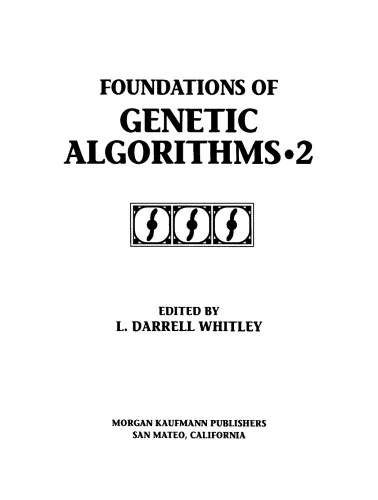
Foundations of genetic algorithms 2
L Darrell Whitley
English
Beginner
Software Engineering
4.3 / 5
0 reviews
1993
Published
316
pages
137
views
Introduction to 'Foundations of Genetic Algorithms 2' The book Foundations of Genetic Algorithms 2 builds upon the foundational principles explored in the first volume, further advancing the theory and practice surrounding genetic algorithms (GAs). As a key text in the e
Before you read
What will you get from this book?
Introduction to 'Foundations of Genetic Algorithms 2'
The book Foundations of Genetic Algorithms 2 builds upon the foundational principles explored in the first volume, further advancing the theory and practice surrounding genetic algorithms (GAs). As a key text in the evolutionary computation field, this volume deeply examines the intersection of algorithmic design, mathematical theory, and real-world problem-solving applications. By uniting researchers and practitioners in exploring the capabilities and boundaries of GAs, the book serves as a beacon for those eager to innovate and refine optimization techniques in complex problem domains.
GAs, inspired by Darwinian evolution, are a cornerstone of artificial intelligence and computational optimization. This second volume of the series delves into the advanced workings of GAs, focusing on their theoretical underpinnings while shedding light on practical applications in various domains, including scheduling, logistics, and even artificial life. Whether you're an academic exploring new territory in evolutionary computation or a practitioner solving unique problems, this book offers a wealth of insights to propel your understanding of GAs to the next level.
Detailed Summary of the Book
This book compiles research findings and discussions contributed by leaders in the field of genetic algorithms. Essential topics such as selection mechanisms, mutation strategies, crossover techniques, and schema theory are examined in detail. Additionally, the book introduces overarching themes such as maintaining genetic diversity throughout the population, balancing exploration and exploitation during the optimization process, and identifying the biases that can emerge in various genetic operators.
The volume also ventures into innovative applications of GAs, demonstrating their utility in tackling real-world optimization challenges. From solving intricate combinatorial problems to designing adaptive systems, the book highlights how genetic algorithms act as versatile tools. Through rigorous theoretical analyses and practical examples, readers are equipped to utilize GAs more effectively in diverse contexts.
Overall, Foundations of Genetic Algorithms 2 serves as a bridge between theory and application, helping readers to critically understand the "why" and "how" behind each component and strategy within GAs.
Key Takeaways
- Comprehensive insight into the theoretical foundations of genetic algorithms.
- Detailed exploration of critical GA components such as selection, crossover, and mutation.
- Guidance on designing and implementing GAs for real-world optimization problems.
- Strategies for maintaining diversity and preventing premature convergence.
- Discussions on schema theory and its implications for understanding GA behavior.
- Examples of advanced applications in areas like manufacturing, scheduling, and artificial intelligence.
By focusing on these elements, the book empowers readers to create more robust, efficient, and adaptable genetic algorithm designs.
Famous Quotes from the Book
"Genetic algorithms do not solve problems directly; rather, they evolve solutions through a collaborative struggle between survival and reproduction."
"The balance between exploration and exploitation is not merely a design choice; it is the essence of intelligent optimization."
Why This Book Matters
As genetic algorithms continue to influence fields ranging from artificial intelligence to industrial optimization, the importance of understanding their theoretical foundations cannot be overstated. Foundations of Genetic Algorithms 2 contributes significantly to this understanding, offering a comprehensive view of GAs' evolutionary mechanisms and their potential applications. By prioritizing both mathematical rigor and practical usability, the book appeals to a broad audience, from computer scientists and engineers to business analysts and researchers.
Moreover, this volume addresses key challenges that practitioners face when applying GAs to real-world problems, including scalability, parameter sensitivity, and convergence. It offers best practices and guiding principles for designing more efficient and versatile algorithms, making it an indispensable resource for anyone seeking to push the boundaries of optimization in science and industry.
Ask this book
Your question is answered in the context of this title and author. Each answer uses 2 points.
Sign in to ask the book assistant.
Reader reviews
0 reviews, 4.3 average out of 5
No reviews yet
If you have read this book, help the next reader with your experience.
Write a review
Sign in to publish a review.
Reader questions and answers
Ask a focused question and learn from the community.
Sign in to ask or answer a question.
No questions yet
Be the first to ask a clear, useful question.
What to read next
Related references that continue this learning path.


Modern Computer Vision with PyTorch: A Practical Roadmap From Deep Learning Fundamentals to Advanced Applications and Generative AI, 2nd Edition
V Kishore Ayyadevara,Yeshwanth Reddy
2023
View book