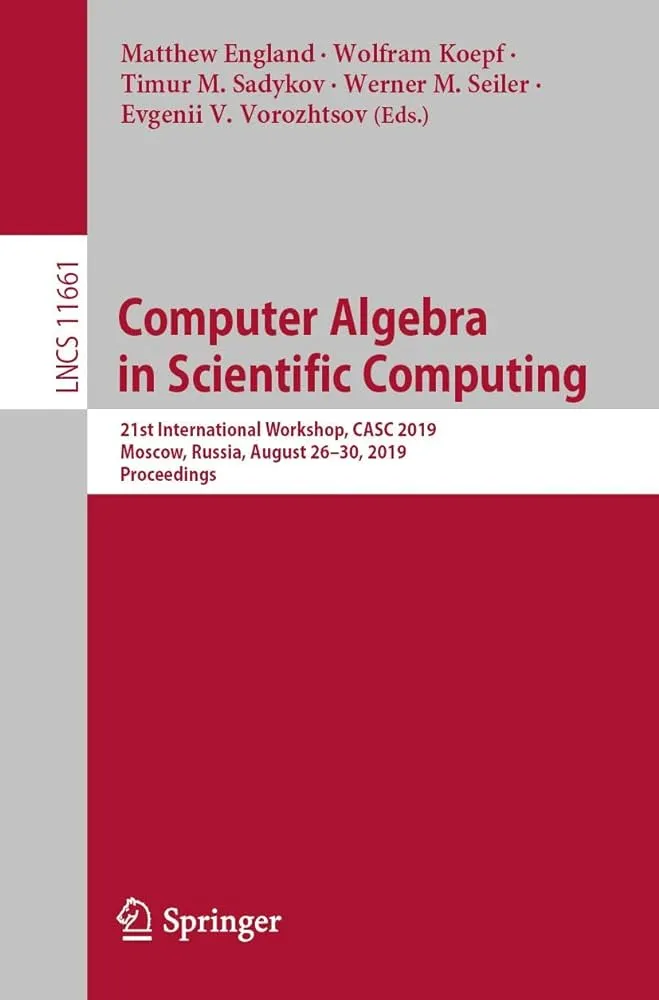
Computer Algebra in Scientific Computing: 21st International Workshop, CASC 2019, Moscow, Russia, August 26–30, 2019, Proceedings
Matthew England,Wolfram Koepf,Timur M. Sadykov,Werner M. Seiler,Evgenii V. Vorozhtsov
2019
View book
Book guide and evaluation
Wu, Nicolas; Simpson, Andrew
0 reviews
Published
pages
views
Formal Aspects of Computingpp.1231—1269 formal methods in computer science, computational logic Explore Formal Aspects of Computingpp.1231—1269, a deep dive into formal methods and logic for advanced computing research. Analytical Summary The book Formal Aspects of Computin
Before you read
The book Formal Aspects of Computingpp.1231—1269 stands as a meticulously structured contribution to the academic and professional discourse surrounding formal methods within computational theory. Authored by Wu, Nicolas and Simpson, Andrew, this work distills complex mathematical and logical frameworks into accessible scholarly narratives without compromising on technical rigor. Its coverage spans the application of formal verification, model-checking techniques, and specification languages, offering a bridge between theoretical foundations and real-world computation challenges.
Within these pages, readers encounter in-depth exploration of computational logic and its role in ensuring correctness in software and hardware systems. The book's analytical structure promotes layer-by-layer comprehension, starting from basic formalism to advanced proofs and verifications. Carefully selected case studies illustrate the application of abstract concepts, making the material highly relevant for those crafting robust computing systems in sectors such as safety-critical engineering, distributed systems, and algorithm design.
Information regarding the exact publication year is unavailable; no reliable public source confirms the detail. Nonetheless, the relevance of this work endures, as the topics discussed continue to influence research and development across formal aspects of computing.
The lessons embedded in Formal Aspects of Computingpp.1231—1269 are invaluable for academic researchers, computer scientists, and engineers seeking a deepened understanding of formalism in computational contexts.
First, the book reinforces the necessity of precise formal specifications to prevent ambiguity in system design. Second, it demonstrates how formal verification processes can identify inefficiencies or potential failures before deployment, saving resources and averting risks. Third, the authors emphasize that the successful integration of formal methods in industrial projects requires collaboration between theoreticians and practitioners. Fourth, readers are reminded that computational logic offers not just problem-solving pathways but also a lens through which the core principles of computer science can be clarified. Finally, this work encourages a mindset of rigor and discipline, underscoring that reliable computing rests on validated formal foundations.
“The robustness of a system lies not in its complexity, but in the precision of its specification.”Unknown
“Formal methods are the scaffolding upon which reliable computation is constructed.”Unknown
Formal Aspects of Computingpp.1231—1269 holds a distinguished place among resources dedicated to formal techniques in computation because it marries precision with applicability.
In a technological landscape where systems grow increasingly complex, the ability to formally reason about their behavior becomes indispensable. This book equips readers with a vocabulary and methodology for such reasoning, reducing risks and bolstering confidence in system reliability. For educators, it serves as a definitive text in advanced computer science curricula; for professionals, it offers tools to elevate best practices in design and verification.
Reading Formal Aspects of Computingpp.1231—1269 is more than an academic exercise—it is an invitation to engage deeply with the bedrock principles that make reliable computing possible.
For those committed to excellence in software and hardware development, the insights shared by Wu, Nicolas and Simpson, Andrew offer pathways to mastering formal methods and computational logic without losing sight of practical application. The natural next step is to delve into this work with an analytic mindset, discuss its implications within your professional community, and share the benefits of its rigorous approach. By doing so, you will not only internalize essential principles but also contribute to the collective advancement of computing as a precise, dependable discipline.
Your question is answered in the context of this title and author. Each answer uses 2 points.
0 reviews, 4.8 average out of 5
Sign in to publish a review.
Ask a focused question and learn from the community.
Related references that continue this learning path.
Matthew England,Wolfram Koepf,Timur M. Sadykov,Werner M. Seiler,Evgenii V. Vorozhtsov