Book guide and evaluation
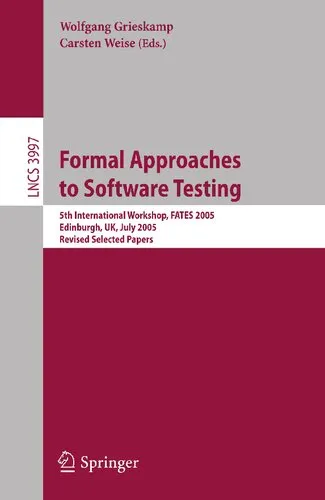
Formal Approaches to Software Testing: 5th International Workshop, FATES 2005, Edinburgh, UK, July 11, 2005, Revised Selected Papers (Lecture Notes in Computer Science, 3997)
Wolfgang Grieskamp (editor),Carsten Weise (editor)
English
Beginner
Integration Testing
4.3 / 5
0 reviews
2006
Published
229
pages
340
views
Welcome to an in-depth exploration of the "Formal Approaches to Software Testing: 5th International Workshop, FATES 2005". This work is an essential volume that delves into the intricate world of software testing through formal methods, providing insights into the latest resear
Before you read
What will you get from this book?
Welcome to an in-depth exploration of the "Formal Approaches to Software Testing: 5th International Workshop, FATES 2005". This work is an essential volume that delves into the intricate world of software testing through formal methods, providing insights into the latest research developments and innovative strategies used in the field.
Summary of the Book
This collection of revised selected papers emerged from the 5th International Workshop on Formal Approaches to Testing of Software, held in Edinburgh in 2005. The editorial team, Wolfgang Grieskamp and Carsten Weise, have curated contributions from leading experts in formal approaches to software testing. The book addresses the challenges faced in improving software reliability and quality, laying a focus on harnessing the power of formal methodologies in the testing processes.
The core emphasis of the workshop and consequently this book is on utilizing mathematical and logical models to rigorously test software systems. It highlights methodologies like model-based testing, test case generation, and formal verification, each presented with methodology frameworks, real-world applications, and outcomes. Each paper included contributes significantly to a deeper understanding of how these formal methods can be applied to identify defects, validate complex system behaviors, and ensure high software reliability.
Key Takeaways
- Understanding the integration of formal mathematical techniques with traditional testing practices improves efficiency and accuracy in detecting software defects.
- The book encapsulates diverse methodologies in model-based testing, proving their effectiveness in real-time applications.
- It also explores the challenges of scalability and applicability of these methods to real-world systems and suggests innovative solutions.
- The practical and detailed studies offer insight into adapting and implementing these techniques into current software development processes.
Famous Quotes from the Book
"Formal methods in software testing allow us to explore the boundaries of reliability and functionality in complex systems with mathematical precision."
"The growing complexity of software requires innovative testing methodologies - a fusion of formal verification and traditional testing to ensure uncompromising quality."
Why This Book Matters
In today's rapidly evolving tech landscape, the demand for reliable and quality software products has never been higher. This book is crucial as it bridges the gap between theoretical frameworks and practical applications in software testing. It provides not just theoretical insights but also practical guidance on employing formal methods in real-world scenarios. For researchers, developers, and practitioners alike, this book offers a rich resource for understanding and implementing cutting-edge, formal testing strategies to enhance software quality and performance.
Moreover, by emphasizing formal approaches, it sets a foundation for future technological advancements and underscores the potential of rigorous, mathematically-driven testing techniques to transform the software industry. Whether you are a student venturing into the field, an academic focused on software engineering research, or a professional software tester, this compilation serves as an indispensable guide to formal methodologies in software testing.
Ask this book
Your question is answered in the context of this title and author. Each answer uses 2 points.
Sign in to ask the book assistant.
Reader reviews
0 reviews, 4.3 average out of 5
No reviews yet
If you have read this book, help the next reader with your experience.
Write a review
Sign in to publish a review.
Reader questions and answers
Ask a focused question and learn from the community.
Sign in to ask or answer a question.
No questions yet
Be the first to ask a clear, useful question.
What to read next
Related references that continue this learning path.
Testing Software and Systems: 33rd IFIP WG 6.1 International Conference, ICTSS 2021, London, UK, November 10–12, 2021, Proceedings (Lecture Notes in Computer Science)
David Clark (editor),Hector Menendez (editor),Ana Rosa Cavalli (editor)
2022
View book
Formal Approaches to Software Testing and Runtime Verification: First Combined International Workshops FATES 2006 and RV 2006, Seattle, WA, USA, ... (Lecture Notes in Computer Science, 4262)
Klaus Havelund (editor),Manuel Núnez (editor),Grigore Rosu (editor),Burkhart Wolff (editor)
2006
View book