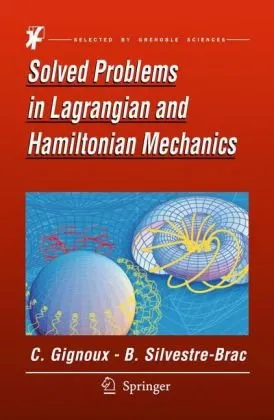
Solved Problems in Lagrangian and Hamiltonian Mechanics
Dr. Claude Gignoux,Dr. Bernard Silvestre-Brac (auth.)
2009
View book
Book guide and evaluation
K. Subramanya
0 reviews
Published
pages
views
Introduction to "Fluid Mechanics and Hydraulic Machines: Problems and Solutions" "Fluid Mechanics and Hydraulic Machines: Problems and Solutions" is a comprehensive resource aimed at students, engineering professionals, and enthusiasts striving to master the pivotal concep
Before you read
"Fluid Mechanics and Hydraulic Machines: Problems and Solutions" is a comprehensive resource aimed at students, engineering professionals, and enthusiasts striving to master the pivotal concepts of fluid mechanics and hydraulic machinery. Authored with a pragmatic approach, this book deviates from conventional textbooks by focusing on problem-solving techniques and practical applications. It serves as a perfect guide for building critical foundations, enabling readers to connect theoretical knowledge with real-world engineering scenarios.
Within the pages of this book, you will discover an extensively detailed approach to understanding fluid mechanics and hydraulic machines, intertwined with an array of problems designed to enhance your analytical abilities. From basic principles to advanced concepts, the material is structured to cater to learners of all levels. Whether you are preparing for competitive exams, pursuing an academic career, or looking to refine your technical expertise, this book is an indispensable tool.
Let's dive deeper into the different aspects of the book, its content, and why it is considered a standout resource in the field of engineering education.
The book is systematically divided into chapters that cover the fundamental principles of fluid dynamics and their applications in hydraulic machines. Each chapter begins with an introduction to core concepts, followed by an array of solved examples and exercises. Problems are thoughtfully categorized as introductory, intermediate, and advanced, to encourage progressive learning.
Topics range from fluid properties, kinematics, and dynamics, to viscous flow, boundary layers, and computational fluid dynamics (CFD). Additionally, the book delves into the intricate mechanisms of hydraulic machines, including turbines, pumps, and hydroelectric systems, backed by relevant problems and solution strategies.
Unlike traditional guides, this book integrates theoretical explanations with practical problem-solving exercises, making it an ideal self-study material. It also includes precise diagrams, charts, and mathematical formulations to supplement text comprehension.
"Fluid mechanics is not just a branch of science; it is the lifeline of countless innovations—from the wings of an airplane to the water flowing through your tap."
"An engineer who understands fluid mechanics unlocks the potential to shape the world one solution at a time."
Engineers across industries often encounter challenges that require a deep understanding of fluid behavior and the operation of machines built to interact with those fluids. This book bridges the knowledge gap by equipping readers with tools to address practical problems confidently. Its problem-centric approach renders it invaluable for professionals working in fields as diverse as mechanical, civil, aerospace, and environmental engineering.
Furthermore, the format of the book ensures clarity and promotes logical thinking. By methodically solving problems, readers gain the confidence and expertise required to excel in academia, competitive exams, and professional practice. Additionally, the book serves as an enduring reference for advanced learners exploring fluid mechanics at a research or industrial level.
"Fluid Mechanics and Hydraulic Machines: Problems and Solutions" reflects the author's dedication to demystifying complex engineering concepts and making them accessible to a global audience. By doing so, it empowers engineers and learners worldwide to tackle practical challenges with skill and precision, defining the book’s place as a cornerstone of engineering education.
Your question is answered in the context of this title and author. Each answer uses 2 points.
0 reviews, 4.5 average out of 5
Sign in to publish a review.
Ask a focused question and learn from the community.
Related references that continue this learning path.
Dr. Claude Gignoux,Dr. Bernard Silvestre-Brac (auth.)
Clayton T. Crowe,Donald F. Elger,John A. Roberson