

Practical Statistics for Data Scientists: 50 Essential Concepts
Peter Bruce,Andrew Bruce
2017
View book
Book guide and evaluation
A. J. Smits,T. T. Lim (Eds.)
0 reviews
Published
pages
views
Introduction to "Flow Visualization: Techniques and Examples" "Flow Visualization: Techniques and Examples" provides an authoritative and visually stunning exploration of the fascinating world of fluid dynamics, combining scientific rigor with compelling imagery. Authored
Before you read
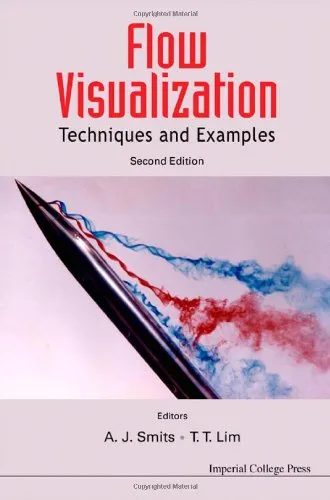
"Flow Visualization: Techniques and Examples" provides an authoritative and visually stunning exploration of the fascinating world of fluid dynamics, combining scientific rigor with compelling imagery. Authored by A. J. Smits and T. T. Lim, this book is an insightful resource for students, professionals, and enthusiasts eager to understand and apply visualization techniques to comprehend fluid flows better.
Flow visualization plays a crucial role in understanding fluid mechanics, providing a direct window into the otherwise invisible motion of gases and liquids. This book begins with a comprehensive discussion of the importance of visualization, touching on its history and progression over the years. It outlines the principles behind flow visualization techniques and how these methods reveal the intricate movements within fluid systems.
Each chapter delves into specific visualization methods such as smoke flow, dye injection, particle image velocimetry, and other advanced techniques. The authors take a descriptive yet accessible approach, blending technical details with vivid illustrations and photographs. By examining practical examples from both experimental and computational studies, the text bridges the gap between theory and application.
Moreover, the book highlights how flow visualization has significantly impacted various scientific and engineering fields, from aerodynamics to oceanography. Real-world applications are illuminated, providing readers with an understanding of how visualization has advanced technology, research, and even artistic expression.
By integrating theoretical knowledge with practical insights, this book equips readers with a profound understanding of visualization techniques and their applications in fluid mechanics.
“Flow visualization allows us to transform the intangible into a tangible canvas, revealing the hidden beauty and complexity of fluid mechanics.”
“The art of flow visualization lies not merely in observing a phenomenon but in understanding the intricacies that govern it.”
“By making the invisible visible, we gain the power to innovate, to engineer, and to dream.”
These profound insights capture the essence of the book and underscore its impact on the reader's understanding of fluid dynamics.
In a world where understanding the behavior of fluids is critical for advancements in engineering, environmental sciences, and technology, "Flow Visualization: Techniques and Examples" stands as a cornerstone reference. It matters because it enables professionals, researchers, and learners to push the boundaries of innovation by providing them with the tools to observe, analyze, and predict fluid behavior accurately.
The book fosters a deeper appreciation for the artistic and practical dimensions of flow visualization, serving as a bridge between science and art. It inspires creativity while maintaining high technical integrity, which makes it invaluable for both academic and industrial research.
Furthermore, by focusing on both traditional and cutting-edge techniques, the book ensures that readers are prepared to address current and future challenges in a variety of fields, from aerospace engineering to climate modeling.
Your question is answered in the context of this title and author. Each answer uses 2 points.
0 reviews, 4.5 average out of 5
Sign in to publish a review.
Ask a focused question and learn from the community.
Related references that continue this learning path.
Peter Bruce,Andrew Bruce



Andreas Spillner,Tilo Linz,Hans Schaefer