
Book guide and evaluation
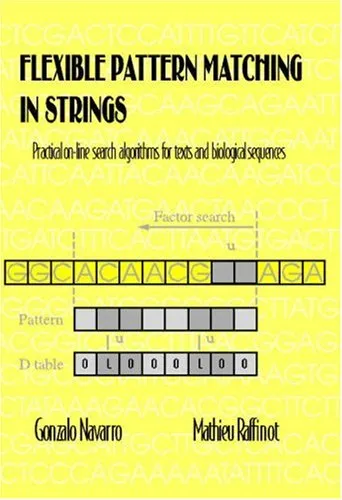
Flexible Pattern Matching in Strings: Practical On-line Search Algorithms for Texts and Biological Sequences
Gonzalo Navarro,Mathieu Raffinot
English
Beginner
Software Engineering
4.7 / 5
0 reviews
2002
Published
232
pages
475
views
Introduction to "Flexible Pattern Matching in Strings" Welcome to "Flexible Pattern Matching in Strings: Practical On-line Search Algorithms for Texts and Biological Sequences." This book is a comprehensive exploration into the fascinating and highly practical realm of strin
Before you read
What will you get from this book?
Introduction to "Flexible Pattern Matching in Strings"
Welcome to "Flexible Pattern Matching in Strings: Practical On-line Search Algorithms for Texts and Biological Sequences." This book is a comprehensive exploration into the fascinating and highly practical realm of string processing and pattern matching, a cornerstone of modern computational science. Authored by Gonzalo Navarro and Mathieu Raffinot, this guide seeks to bridge the gap between theoretical computer science and real-world applications, particularly in fields as diverse as text processing and bioinformatics.
The art and science of searching for meaningful patterns in sequences, whether natural language or biological data, has evolved significantly over the years. Our book not only delves deep into online search algorithms but also equips readers with powerful, flexible tools to handle complex structures and irregularities in data. By coupling theoretical rigor with practical insights, we provide a roadmap to mastering this essential skill set.
Detailed Summary of the Book
In this book, we explore the rich landscape of flexible pattern matching, an advanced topic in string algorithms with applications spanning numerous domains. Unlike traditional exact pattern matching, where a query string must exactly match a substring, flexible pattern matching introduces tolerances or rules for "approximate" matches—making it highly relevant in real-world scenarios.
We begin by building foundational knowledge, introducing core concepts of string manipulation, coding schemes, and data structures like suffix trees, suffix arrays, and automata. The subsequent chapters dive into the heart of flexible pattern matching, explaining algorithms for approximate matching, regular expressions, and matching with "don't care" symbols.
You will also find detailed discussions on online versus offline pattern matching strategies, highlighting their strengths and trade-offs. Special emphasis is given to string matching in biological sequences, where approximate matching is particularly useful due to the inherent variability in DNA, RNA, and protein sequences.
This book balances theoretical depth with practical implementation advice. Numerous algorithms are described both conceptually and with pseudocode, enabling readers to translate them into working software. We also include performance analyses, comparisons, and use cases to help readers select the most suitable approach for their specific problems.
Key Takeaways
- Learn the fundamentals of string processing and how to construct essential data structures like suffix trees and arrays.
- Explore cutting-edge algorithms for flexible pattern matching, including approximate matching and regular expression techniques.
- Understand real-world applications in fields such as text retrieval, natural language processing, and bioinformatics.
- Gain practical insights and pseudocode implementations for adapting these algorithms to your unique requirements.
- Develop an appreciation for the balance between theoretical rigor and computational efficiency.
Famous Quotes from the Book
"Pattern matching is not merely a computational challenge but a window into understanding the complexities of structured data."
"Flexibility in string matching algorithms mirrors the flexibility and variability of the data itself, allowing us to find meaningful connections where rigid methods fail."
Why This Book Matters
"Flexible Pattern Matching in Strings" is more than just a guide to algorithms—it is a vital resource for anyone working with data. The methods outlined in this book address some of the most pressing challenges in modern computing, from efficiently searching vast databases to analyzing genomic sequences. As data science continues to grow, the ability to search, compare, and interpret data becomes even more crucial.
What sets this book apart is its focus on flexibility. By embracing approximate matching and other advanced techniques, readers can solve a broader range of problems. Whether you're a student of computer science, a professional software developer, or a researcher in bioinformatics, this book will empower you to tackle challenges that rigid algorithms cannot handle.
Ultimately, this book is a celebration of problem-solving in its purest form, providing the tools you need to make sense of the complex and unpredictable world of strings.
Ask this book
Your question is answered in the context of this title and author. Each answer uses 2 points.
Sign in to ask the book assistant.
Reader reviews
0 reviews, 4.7 average out of 5
No reviews yet
If you have read this book, help the next reader with your experience.
Write a review
Sign in to publish a review.
Reader questions and answers
Ask a focused question and learn from the community.
Sign in to ask or answer a question.
No questions yet
Be the first to ask a clear, useful question.
What to read next
Related references that continue this learning path.


Modern Computer Vision with PyTorch: A Practical Roadmap From Deep Learning Fundamentals to Advanced Applications and Generative AI, 2nd Edition
V Kishore Ayyadevara,Yeshwanth Reddy
2023
View book