

Book guide and evaluation
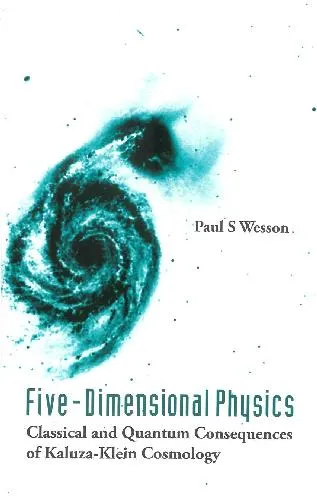
Five-Dimensional Physics: Classical and Quantum Consequences of Kaluza-Klein Cosmology
Wesson P.S.
English
Beginner
Physics
4.3 / 5
0 reviews
2006
Published
233
pages
166
views
Introduction to "Five-Dimensional Physics: Classical and Quantum Consequences of Kaluza-Klein Cosmology" "Five-Dimensional Physics: Classical and Quantum Consequences of Kaluza-Klein Cosmology" offers a transformative perspective on modern physics, expanding upon t
Before you read
What will you get from this book?
Introduction to "Five-Dimensional Physics: Classical and Quantum Consequences of Kaluza-Klein Cosmology"
"Five-Dimensional Physics: Classical and Quantum Consequences of Kaluza-Klein Cosmology" offers a transformative perspective on modern physics, expanding upon the foundational principles of spacetime, gravity, and quantum theory. Written by Paul S. Wesson, this book explores the profound implications of Kaluza-Klein cosmology, which elegantly unifies general relativity and electromagnetism within the framework of a fifth-dimensional hypothesis. Designed for physicists, cosmologists, and curious thinkers alike, this work delves into both the conceptual beauty and mathematical richness of five-dimensional theories, carefully bridging classical physics and modern quantum dynamics.
By challenging conventional four-dimensional interpretations, Wesson forges a compelling case for a five-dimensional paradigm, inviting readers to explore the deeper frameworks underpinning the cosmos. Marked by clear explanations, mathematical rigor, and a focus on both academic and philosophical implications, this book offers powerful insights for both seasoned researchers and inquisitive learners.
Detailed Summary of the Book
"Five-Dimensional Physics" meticulously develops the concept of extending our understanding of spacetime to include a fifth dimension, inspired by Kaluza-Klein cosmology. The book begins with an accessible historical introduction to Einstein’s theory of general relativity and Maxwell’s electromagnetism, providing readers with the foundational tools needed to grasp the reasoning behind unification theories. Wesson presents Kaluza's hypothesis of a fifth dimension, which brought both gravity and electromagnetism under a single theoretical roof, and Klein’s subsequent work that added dimensional compactification to the discussion.
The book progresses into the intricacies of five-dimensional (5D) metrics while carefully balancing mathematical generalizations and physical applications. Wesson critically examines how 5D models address key cosmological puzzles, such as the nature of dark energy, quantum behavior, and higher-dimensional solutions consistent with classical theory. Further, the work demonstrates how five-dimensional models naturally generate observable effects in the four-dimensional universe we perceive.
A unique highlight is the exploration of the "induced-matter" theory that reinterprets ordinary matter as a projection of higher-dimensional structure. The book also delves into quantum mechanical implications, touching upon the wave-particle duality, probabilistic behavior, and how 5D physics offers a framework for addressing these phenomena. Through rigorous derivation and conceptual insights, the book serves as a bridge between classical theoretical physics and contemporary quantum cosmology.
Key Takeaways
- The fifth dimension provides a unified framework that incorporates both general relativity and electromagnetism.
- Five-dimensional cosmology addresses fundamental questions surrounding dark energy, the expansion of the universe, and spacetime geometry.
- The concept of "induced matter" redefines traditional interpretations of matter and energy in four-dimensional spacetime.
- Five-dimensional physics establishes pathways for reconciling classical mechanics with quantum dynamics, providing insights into quantum gravity.
- Kaluza-Klein theory introduces a compelling philosophical dimension to cosmology, challenging our understanding of the nature of reality.
Famous Quotes from the Book
"Nature hints at its comprehensive unity through dimensions that transcend our direct perception." - Paul S. Wesson
"The fifth dimension is not merely a mathematical curiosity; it is a gateway to understanding the deeper structure of reality." - Paul S. Wesson
"Induced matter is a striking reminder that what we perceive as physical reality may be a projection of a higher-dimensional truth." - Paul S. Wesson
Why This Book Matters
At its core, "Five-Dimensional Physics" is a bold and revolutionary contribution to the fields of theoretical physics and cosmology. By bringing Kaluza-Klein cosmology into focus, Wesson challenges traditional assumptions about the universe, presenting an innovative approach to unifying gravity and electromagnetism while simultaneously addressing key aspects of quantum mechanics. The book not only enriches academic discourse but also provides a thought-provoking perspective for anyone intrigued by the mysteries of the cosmos.
As research into higher-dimensional theories continues to evolve, Wesson’s insights remain profoundly relevant, shaping our understanding of reality and potentially guiding future advancements in physics. Whether you are a student, scholar, or enthusiast, this book offers unparalleled depth, intellectual stimulation, and avenues for exploring the boundaries of scientific thought.
Ask this book
Your question is answered in the context of this title and author. Each answer uses 2 points.
Sign in to ask the book assistant.
Reader reviews
0 reviews, 4.3 average out of 5
No reviews yet
If you have read this book, help the next reader with your experience.
Write a review
Sign in to publish a review.
Reader questions and answers
Ask a focused question and learn from the community.
Sign in to ask or answer a question.
No questions yet
Be the first to ask a clear, useful question.
What to read next
Related references that continue this learning path.


Modern Computer Vision with PyTorch: A Practical Roadmap From Deep Learning Fundamentals to Advanced Applications and Generative AI, 2nd Edition
V Kishore Ayyadevara,Yeshwanth Reddy
2023
View book