

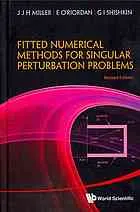
Book guide and evaluation
Fitted numerical methods for singular perturbation problems : error estimates in the maximum norm for linear problems in one and two dimensions
John J H Miller;E O'Riordan;G I Shishkin
English
Beginner
Mathematics
4.9 / 5
0 reviews
2012
Published
191
pages
192
views
Introduction to "Fitted Numerical Methods for Singular Perturbation Problems" "Fitted Numerical Methods for Singular Perturbation Problems: Error Estimates in the Maximum Norm for Linear Problems in One and Two Dimensions" is a groundbreaking contribution to numerical anal
Before you read
What will you get from this book?
Introduction to "Fitted Numerical Methods for Singular Perturbation Problems"
"Fitted Numerical Methods for Singular Perturbation Problems: Error Estimates in the Maximum Norm for Linear Problems in One and Two Dimensions" is a groundbreaking contribution to numerical analysis, focusing on the development of robust techniques for solving singular perturbation problems. Authored by John J. H. Miller, E. O'Riordan, and G. I. Shishkin, the book is a resource for mathematicians, engineers, and scientists working on computational methods for challenging boundary-layer-type problems. Singular perturbation problems are complex mathematical issues that arise in various fields, including fluid mechanics, quantum mechanics, and chemical kinetics. This book provides a systematic and methodical approach to addressing these challenges using fitted numerical methods.
The work emphasizes error estimates in the maximum norm, which plays a critical role in ensuring the precision and reliability of numerical solutions. Through meticulous explanations and carefully crafted examples, the authors guide readers in understanding how to approach linear singular perturbation problems in one and two dimensions. The book employs fitted piecewise-uniform meshes and other advanced techniques to offer accurate solutions even when small perturbation parameters create steep gradients in the solution profile.
Detailed Summary of the Book
The book is divided into several cohesive sections, each of which tackles critical aspects of singular perturbation problems and their numerical solutions:
It begins with an introduction to singular perturbation problems, elucidating their significance in mathematics and their applications. The authors describe the challenges inherent in solving these problems, particularly the formation of boundary layers—regions where the solution changes rapidly over a small spatial extent. Next, the text focuses on fitted numerical methods, which are specially designed to deal with the difficulties posed by such problems.
Central to the discussion are the error estimates in the maximum norm, which allow researchers to evaluate the accuracy of numerical solutions comprehensively. These estimates give insight into how small perturbation parameters influence the numerical methods' overall performance. The authors explore different types of linear problems encountered in one-dimensional and two-dimensional domains, ensuring the theory is applicable to a variety of real-world scenarios. Moreover, their use of fitted piecewise-uniform meshes addresses the inherent challenges posed by steep gradients or localized phenomena in the solution domain.
Each chapter includes mathematically rigorous derivations, illustrative numerical examples, and thorough error analyses. This integration of theory and practical application strikes a balance, making the book valuable to both researchers and practitioners.
Key Takeaways
- Singular perturbation problems frequently arise in various disciplines involving differential equations with small parameters in their highest derivatives.
- Fitted numerical methods and piecewise-uniform meshes are vital tools for solving these problems effectively.
- Error estimates in the maximum norm provide critical insights into the reliability of numerical solutions.
- Detailed explorations of linear problems in one and two dimensions ensure the applicability of the techniques to diverse contexts.
- The book offers a blend of theoretical rigor and hands-on examples that make it accessible to readers with varying levels of expertise in numerical analysis.
Famous Quotes from the Book
Throughout the text, the authors articulate profound insights and principles that resonate deeply with mathematicians and computational scientists. Below are a few notable excerpts:
"The success of numerical algorithms for singular perturbation problems depends critically on the correct resolution of boundary layers, which necessitates suitably crafted meshes."
"Error estimates in the maximum norm not only quantify the precision of a numerical method but also serve as a guiding principle in the design and refinement of computational approaches."
Why This Book Matters
The importance of "Fitted Numerical Methods for Singular Perturbation Problems" lies in its comprehensive approach to addressing one of the most challenging classes of differential equations. Singular perturbation problems are notorious for their difficulty, requiring specialized numerical techniques to ensure accurate solutions. The fitted methods outlined in this book offer a proven path forward, balancing computational efficiency with precision.
For researchers, the book provides a foundation in the mathematical theory underpinning singular perturbation problems and error analysis. For practitioners, it delivers practical tools and techniques that can be directly applied to real-world computational problems. By focusing on error estimates in the maximum norm, the authors highlight a critical aspect of numerical accuracy that is often overlooked in other texts, making this book a unique and invaluable resource.
Whether you are a graduate student delving into numerical analysis for the first time or an experienced scientist seeking advanced methodologies for engineering applications, this book offers insights and tools that are both deep and practical. Its rigorous treatment of fitted numerical methods ensures it will remain a cornerstone in the field for years to come.
Ask this book
Your question is answered in the context of this title and author. Each answer uses 2 points.
Sign in to ask the book assistant.
Reader reviews
0 reviews, 4.9 average out of 5
No reviews yet
If you have read this book, help the next reader with your experience.
Write a review
Sign in to publish a review.
Reader questions and answers
Ask a focused question and learn from the community.
Sign in to ask or answer a question.
No questions yet
Be the first to ask a clear, useful question.
What to read next
Related references that continue this learning path.



Modern Computer Vision with PyTorch: A Practical Roadmap From Deep Learning Fundamentals to Advanced Applications and Generative AI, 2nd Edition
V Kishore Ayyadevara,Yeshwanth Reddy
2023
View book