Book guide and evaluation
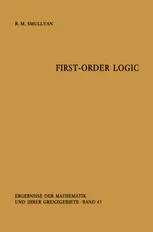
First-Order Logic
Raymond M. Smullyan (auth.)
English
Beginner
Mathematical Logic
4.5 / 5
0 reviews
1968
Published
166
pages
537
views
Introduction to First-Order Logic Welcome to the fascinating world of 'First-Order Logic,' a foundational piece by Raymond M. Smullyan that delves into the intricacies and structures of logical reasoning. This seminal work is instrumental in understanding the principles that u
Before you read
What will you get from this book?
Introduction to First-Order Logic
Welcome to the fascinating world of 'First-Order Logic,' a foundational piece by Raymond M. Smullyan that delves into the intricacies and structures of logical reasoning. This seminal work is instrumental in understanding the principles that underpin mathematical logic and formal systems, providing readers with both theoretical insights and practical applications.
Detailed Summary of the Book
The book 'First-Order Logic' explores the depths of logical arithmetic, offering a comprehensive investigation into the elements that form the base of first-order logic. Smullyan systematically introduces the reader to the syntax and semantics of first-order languages, ensuring a thorough understanding of logical structures.
Smullyan begins with an exploration of the fundamental building blocks of logical expressions and progressively delves into more complex territory, including the completeness, incompleteness, and compactness theorems. The text serves as both an introductory guide for newcomers and a profound exploration for experienced logicians.
The depth and clarity presented in the treatment of logical systems make this book not just an academic text but a journey through the philosophical and practical questions that logic seeks to address. Smullyan’s keen insights and engaging style ensure that the reader remains captivated while navigating through potentially abstruse material.
Key Takeaways
- Understanding the syntax and semantics of first-order languages, providing a solid foundation for further study in logic and mathematics.
- Exploring the theorem-proving abilities of first-order logic systems, highlighting both their power and limitations.
- Insight into the completeness and incompleteness theorems, which represent significant milestones in mathematical logic and philosophy.
- The ability to comprehend and construct logical proofs, a skill essential to mathematicians, philosophers, and computer scientists alike.
- The relationship between logical consistency, compactness, and decidability, further enhancing the reader's analytical abilities.
Famous Quotes from the Book
"The more one studies logical mechanisms, the more one realizes how subtle and complex the interplay between truth and proof really is."
"Logic is the key to understanding many philosophical and practical aspects of life, revealing the essence of consistency and rationality."
Why This Book Matters
This book is more than a tutorial on logical constructs; it is a pivotal resource that bridges the gap between abstract theory and tangible application. Raymond Smullyan’s 'First-Order Logic' is indispensable for students of mathematics, philosophy, and computer science, as it equips them with the tools needed to navigate and construct logical arguments with precision and confidence.
Furthermore, the insights gained from studying this book transcend academic boundaries, influencing problem-solving techniques, decision-making processes, and enhancing critical thinking – skills that are invaluable in today's data-driven and algorithm-based environments.
In a world increasingly governed by algorithms and automated decision-making processes, a solid grounding in the fundamentals of logic as presented in this text is not just beneficial but essential. Smullyan's clear exposition and insightful analysis ensure that this book remains a timeless classic, continually influencing new generations of logicians and thinkers.
Ask this book
Your question is answered in the context of this title and author. Each answer uses 2 points.
Sign in to ask the book assistant.
Reader reviews
0 reviews, 4.5 average out of 5
No reviews yet
If you have read this book, help the next reader with your experience.
Write a review
Sign in to publish a review.
Reader questions and answers
Ask a focused question and learn from the community.
Sign in to ask or answer a question.
No questions yet
Be the first to ask a clear, useful question.
What to read next
Related references that continue this learning path.
An Algebraic Introduction to Mathematical Logic
Donald W. Barnes,John M. Mack (auth.)
1975
View book