
Book guide and evaluation
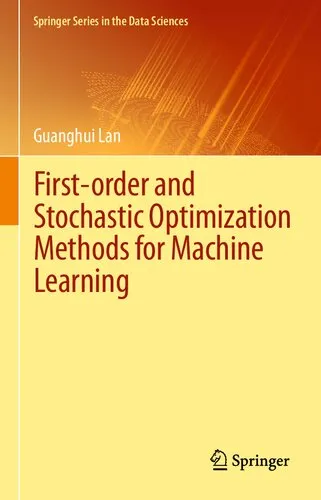
First-Order and Stochastic Optimization Methods for Machine Learning
Guanghui Lan
English
Beginner
Mathematics
4.0 / 5
0 reviews
2020
Published
591
pages
168
views
Introduction to "First-Order and Stochastic Optimization Methods for Machine Learning" Optimization is the lifeblood of machine learning, forming the backbone of algorithms that power decision-making, predictions, and problem-solving in modern data-driven applications. My
Before you read
What will you get from this book?
Introduction to "First-Order and Stochastic Optimization Methods for Machine Learning"
Optimization is the lifeblood of machine learning, forming the backbone of algorithms that power decision-making, predictions, and problem-solving in modern data-driven applications. My book, "First-Order and Stochastic Optimization Methods for Machine Learning," is an exploration of the foundational optimization techniques that drive machine learning advancements. The principles outlined in this book are instrumental for both researchers and practitioners seeking to enhance their understanding of how optimization works in real-world AI systems.
This book serves as a robust resource for delving deep into the theory and practical applications of first-order and stochastic optimization methods. While the mathematical rigor ensures a solid intellectual foundation, the practical illustrations make these fairly abstract concepts more accessible. Here, I aim to bridge the gap between abstract theory and rich applications in machine learning, empowering readers to tackle both classical challenges and emerging optimization problems.
Summary of the Book
"First-Order and Stochastic Optimization Methods for Machine Learning" is divided into carefully structured sections that gradually build the reader's knowledge. The book begins by laying down a strong foundation in first-order optimization techniques. These methods, such as gradient descent and its various modifications, are explained in a step-by-step process, making the theoretical concepts tangible.
The middle sections of the book transition to stochastic optimization methods, which are vital for addressing the scalability challenges inherent in machine learning. Techniques like stochastic gradient descent (SGD) and its variants are explored in detail, with particular emphasis on their convergence properties and practical implementation strategies for large-scale optimization problems.
The latter parts of the book integrate theoretical discussions with case studies and practical illustrations. Complex scenarios such as saddle point problems, non-convex optimization, and variance reduction techniques are unpacked. Special attention is given to optimization challenges in modern neural networks and deep learning frameworks, where stochastic optimization plays a defining role.
Through this comprehensive journey, readers will gain both an in-depth understanding of mathematical foundations and practical guidance for applying these optimization methods to advance the performance and understanding of machine learning models.
Key Takeaways
- Understand the core principles of first-order optimization techniques and why they are fundamental to machine learning.
- Learn critical methods like gradient descent, stochastic gradient descent (SGD), and their various enhancements.
- Grasp advanced stochastic optimization methods and their roles in solving large-scale machine learning challenges.
- Explore practical applications of optimization in neural networks, deep learning, and real-world AI scenarios.
- Analyze the convergence and performance properties of optimization algorithms to design better machine learning systems.
- Bridge the gap between theoretical understanding and practical implementation through examples and case studies.
Famous Quotes from the Book
"Optimization is the bridge between abstract theory and the engineering realities of building intelligent systems."
"The power of stochastic methods lies not only in their scalability but in their resilience to uncertainty."
"In machine learning, optimization is not just a tool but a philosophy that guides every decision."
Why This Book Matters
The explosive growth of machine learning has brought with it a surge in demand for scalable, efficient, and reliable optimization methods. As the complexity of predictive models continues to increase, the need for optimization techniques that can handle diverse and large-scale datasets becomes ever more critical. This is where "First-Order and Stochastic Optimization Methods for Machine Learning" fills a crucial gap.
Unlike other books on the market that often cater only to advanced mathematicians or practitioners, this work is designed to cater to a wide audience. Whether you are a researcher focused on theoretical advancements or a practitioner deploying real-world machine learning models, this book offers something of value. It cuts through the intimidating jargon and mathematical complexity where possible, aiming for clarity without sacrificing rigor.
Moreover, the insights presented in this text help readers design better algorithms and understand the limitations of commonly used optimization techniques. These optimizations lie at the heart of breakthroughs in image recognition, natural language processing, and countless other machine learning applications that define modern AI systems.
In a rapidly evolving field, staying grounded in the fundamentals while learning cutting-edge methods is key. This book equips readers with the tools necessary to contribute meaningfully to the field of optimization and, ultimately, to the future of machine learning.
Ask this book
Your question is answered in the context of this title and author. Each answer uses 2 points.
Sign in to ask the book assistant.
Reader reviews
0 reviews, 4.0 average out of 5
No reviews yet
If you have read this book, help the next reader with your experience.
Write a review
Sign in to publish a review.
Reader questions and answers
Ask a focused question and learn from the community.
Sign in to ask or answer a question.
No questions yet
Be the first to ask a clear, useful question.
What to read next
Related references that continue this learning path.

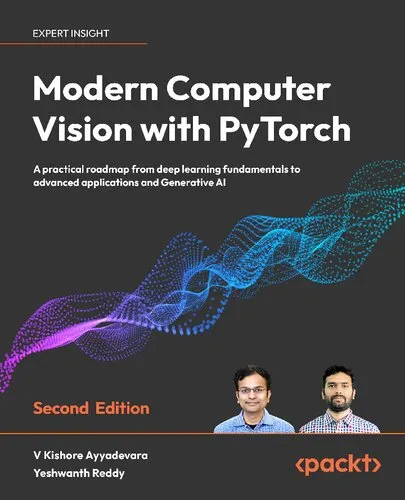
Modern Computer Vision with PyTorch: A Practical Roadmap From Deep Learning Fundamentals to Advanced Applications and Generative AI, 2nd Edition
V Kishore Ayyadevara,Yeshwanth Reddy
2023
View book