Book guide and evaluation
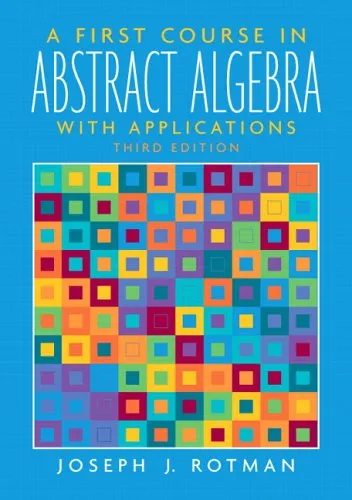
First Course in Abstract Algebra, A
Joseph J. Rotman
English
Beginner
Algebra
4.0 / 5
0 reviews
2005
Published
629
pages
545
views
Introduction to "First Course in Abstract Algebra, A" Welcome to the world of abstract algebra, where the elegance of mathematics meets the complexity of abstraction, setting the foundations for profound mathematical exploration and understanding. "First Course in Abstract A
Before you read
What will you get from this book?
Introduction to "First Course in Abstract Algebra, A"
Welcome to the world of abstract algebra, where the elegance of mathematics meets the complexity of abstraction, setting the foundations for profound mathematical exploration and understanding. "First Course in Abstract Algebra, A" by Joseph J. Rotman serves as a quintessential guide for students venturing into the realm of algebraic structures, equipping them with robust knowledge and analytical skills to thrive in advanced mathematical studies.
Detailed Summary of the Book
This book unfolds the intricate world of abstract algebra through a comprehensive yet digestible approach, perfect for those embarking on their first journey into this essential branch of mathematics. Joseph J. Rotman meticulously introduces a myriad of concepts foundational to algebra, such as groups, rings, fields, and modules, each explored with clarity and depth.
The text is organized to first establish foundational principles, beginning with an exploration of group theory, where readers will delve into topics like cyclic groups, permutation groups, and group homomorphisms. As students progress, they encounter the rich theory of rings and fields, learning about integral domains, field extensions, and polynomial rings.
Methods of proof and problem-solving are interwoven throughout the chapters, encouraging active engagement and fostering a deeper appreciation of abstract algebra's inner workings. Each section aims to build not just understanding but also the analytical skills necessary to navigate more complex mathematical landscapes.
Key Takeaways
- Comprehensive introduction to groups, rings, fields, and modules.
- Emphasis on proof-based learning to enhance logical reasoning.
- Numerous exercises designed to reinforce theoretical concepts.
- Clear, concise exposition making complex topics accessible.
The book equips students with the foundational knowledge and skills that are not only essential for advanced studies in mathematics but also for applications in other scientific disciplines.
Famous Quotes from the Book
"Abstract algebra is not merely an esoteric formalism, but a way of thinking about mathematics and its interconnectedness."
"The study of algebra is about understanding patterns and structures that transcend specific mathematical domains."
These quotes encapsulate the essence of what it means to study abstract algebra — to see beyond mere numbers and equations, into the relationships and principles that govern mathematical logic and structure.
Why This Book Matters
"First Course in Abstract Algebra, A" stands out for its ability to make abstract algebra accessible to newcomers while remaining rigorous and comprehensive. It is a pivotal resource for undergraduate students of mathematics, providing a springboard for future study in algebra and other mathematical disciplines.
Furthermore, in a world increasingly reliant on mathematics for technological advancement, understanding abstract algebra provides foundational insights necessary for developing new algorithms and systems, particularly in computer science and cryptography.
The book continues to be a staple in academic curriculums worldwide, valued not only for its content but for its pedagogical approach that marries accessibility with depth. As such, it is an indispensable resource for anyone serious about mastering the art of abstract mathematics.
Ask this book
Your question is answered in the context of this title and author. Each answer uses 2 points.
Sign in to ask the book assistant.
Reader reviews
0 reviews, 4.0 average out of 5
No reviews yet
If you have read this book, help the next reader with your experience.
Write a review
Sign in to publish a review.
Reader questions and answers
Ask a focused question and learn from the community.
Sign in to ask or answer a question.
No questions yet
Be the first to ask a clear, useful question.
What to read next
Related references that continue this learning path.