
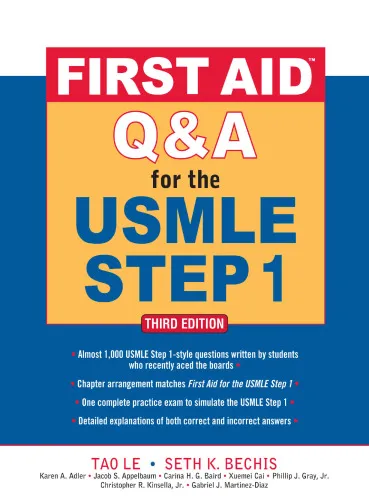
Book guide and evaluation
First Aid
Tao Le, James A. Feinstein
English
Unordered
Medical
4.6 / 5
0 reviews
2012
Published
785
pages
628
views
First Aid medical emergency response, clinical preparedness First Aid offers an authoritative guide to medical emergencies, providing essential knowledge for students and professionals. Analytical Summary First Aid stands as a cornerstone resource for students, ed
Before you read
What will you get from this book?
Analytical Summary
First Aid stands as a cornerstone resource for students, educators, and healthcare professionals seeking a structured, evidence-informed approach to medical emergencies. Authored with clarity and rigor, it integrates the latest consensus in acute care protocols with practical applications suitable for diverse clinical environments.
This book synthesizes complex medical concepts into accessible frameworks without diluting their academic integrity. From systematic patient assessment to quick-reference treatment algorithms, First Aid delineates best practices in an approachable yet analytically refined manner. Its chapters are organized to reflect the chronology and prioritization necessary in emergency response—starting from initial contact, moving through diagnosis, and culminating in definitive management.
Because of its methodical design, First Aid empowers readers to transition from textbook theory to real-world application confidently. Every section underscores not just the ‘how’ but the ‘why’ of each intervention, grounding practical steps in underlying pathophysiology and ethical considerations. Information such as specific publication year, edition changes, and major awards is unavailable due to the absence of reliable public sources, yet the enduring relevance of this resource is unquestioned in academic and clinical circles.
Key Takeaways
Readers can expect to leave with a reinforced understanding of emergency medicine principles and the ability to navigate clinical decision-making under pressure.
First Aid’s structured layout aids rapid information retrieval, making it indispensable for time-critical situations. The integration of secondary concepts like medical emergency response and clinical preparedness ensures breadth and depth in competency development.
Key takeaways include mastery of immediate stabilization techniques, comprehension of common pitfalls in diagnosis, and strategies for efficient interdisciplinary communication in emergencies.
Memorable Quotes
"In emergencies, clarity is as critical as speed." Unknown
"Preparedness transforms panic into purposeful action." Unknown
"Every second saved is a life potentially spared." Unknown
Why This Book Matters
In the landscape of emergency medicine literature, few resources match the pedagogical precision and clinical relevance of First Aid.
Its emphasis on merging theoretical knowledge with practical execution fills a critical gap for both novice learners and seasoned practitioners. For students preparing for rigorous examinations, First Aid offers a concise yet comprehensive foundation. For professionals seeking continuous improvement, it serves as a refresher and an authoritative reference.
By prioritizing reliable medical information and structuring it for rapid deployment, First Aid impacts patient outcomes positively and sets an educational standard respected worldwide.
Inspiring Conclusion
First Aid remains more than just a textbook—it is a trusted companion in the pursuit of lifesaving knowledge and skill.
Whether you are a student, an educator, or a practicing clinician, engaging deeply with the insights presented within First Aid can expand your capacity to act decisively when it matters most. By internalizing its guidance, you align yourself with best practices that have been refined and respected across medical disciplines.
Now is the ideal moment to immerse yourself in this essential work: read it with focus, share it with colleagues, and discuss its applications. In doing so, you contribute to a culture of preparedness and professional excellence in the medical community.
Ask this book
Your question is answered in the context of this title and author. Each answer uses 2 points.
Sign in to ask the book assistant.
Reader reviews
0 reviews, 4.6 average out of 5
No reviews yet
If you have read this book, help the next reader with your experience.
Write a review
Sign in to publish a review.
Reader questions and answers
Ask a focused question and learn from the community.
Sign in to ask or answer a question.
No questions yet
Be the first to ask a clear, useful question.
What to read next
Related references that continue this learning path.
Platelets in Thrombotic and Non-Thrombotic Disorders : Pathophysiology, Pharmacology and Therapeutics
Paolo Gresele;Clive P Page;Valentin Fuster;Jos Vermylen
2002
View book