
Book guide and evaluation
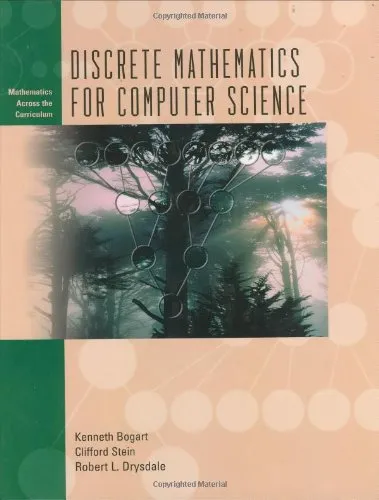
Final DRAFT 2004 --- Discrete Mathematics for Computer Science
Kenneth Bogart,Clifford Stein,Robert L. Drysdale
English
Beginner
Mathematics
4.4 / 5
0 reviews
2004
Published
344
pages
382
views
Introduction to 'Final DRAFT 2004 --- Discrete Mathematics for Computer Science' Welcome to the world of discrete mathematics, a fundamental building block for aspiring computer scientists. 'Final DRAFT 2004 --- Discrete Mathematics for Computer Science' is a c
Before you read
What will you get from this book?
Introduction to 'Final DRAFT 2004 --- Discrete Mathematics for Computer Science'
Welcome to the world of discrete mathematics, a fundamental building block for aspiring computer scientists. 'Final DRAFT 2004 --- Discrete Mathematics for Computer Science' is a comprehensive resource that delves into the mathematical concepts foundational to the domain of computer science. This book serves as both a guide and reference, ensuring readers gain a thorough understanding of discrete structures and their application in computing.
Summary of the Book
Discrete mathematics encompasses distinct and unconnected values, which are crucial for computing where data is often represented discretely. This book covers a range of topics including sets, relations, graphs, mathematical reasoning, and combinatorics, meticulously explored through clear explanations and robust examples. Each chapter is designed to build upon previous concepts, reinforcing the reader's understanding through problem-solving and practical applications. By the end of this book, readers are equipped with the mathematical tools to tackle complex problems in computer science.
Key Takeaways
- Understand the importance and application of sets, functions, and relations within computing.
- Gain a solid grasp of graphs and trees, including their crucial role in algorithms and data structures.
- Master counting principles like permutations and combinations, essential for cryptography and network theory.
- Learn the principles of mathematical logic and proofs, including induction and contradiction, providing a foundation for algorithm design and validation.
Famous Quotes from the Book
"In mathematics, the art of proposing a question must be held of higher value than solving it." (Georg Cantor - Referenced within the context of problem-solving in discrete mathematics)
"The power of mathematics is often to change one thing into another, to change geometry into language." (Marcus du Sautoy - Emphasized in the book when discussing mathematical transformations)
Why This Book Matters
Discrete mathematics is the cornerstone of theoretical computer science and an essential skill for any aspiring computer scientist. 'Final DRAFT 2004 --- Discrete Mathematics for Computer Science' fills a significant gap by providing a structured and comprehensive approach to understanding these complex concepts. Its value lies not only in its thorough exploration of discrete structures but also in its focus on practical application, preparing readers for real-world challenges in computing. Whether you are starting your journey in computer science or looking to deepen your knowledge, this book serves as an invaluable resource in mastering the language of mathematics essential for computing.
Furthermore, the pedagogical approach of the book, with well-structured examples and exercises, fosters a deep understanding of the subject, enabling students to think analytically and apply mathematical principles effectively in various computer science domains.
Ask this book
Your question is answered in the context of this title and author. Each answer uses 2 points.
Sign in to ask the book assistant.
Reader reviews
0 reviews, 4.4 average out of 5
No reviews yet
If you have read this book, help the next reader with your experience.
Write a review
Sign in to publish a review.
Reader questions and answers
Ask a focused question and learn from the community.
Sign in to ask or answer a question.
No questions yet
Be the first to ask a clear, useful question.
What to read next
Related references that continue this learning path.
Graph Theory, Combinatorics and Algorithms: Interdisciplinary Applications
Martin Charles Golumbic,Irith Ben-Arroyo Hartman
2005
View book
50 years of Combinatorics, Graph Theory, and Computing (Discrete Mathematics and Its Applications)
Fan Chung (editor),Ron Graham (editor),Frederick Hoffman (editor),Ronald C. Mullin (editor),Leslie Hogben (editor),Douglas B. West (editor)
2019
View book