Book guide and evaluation
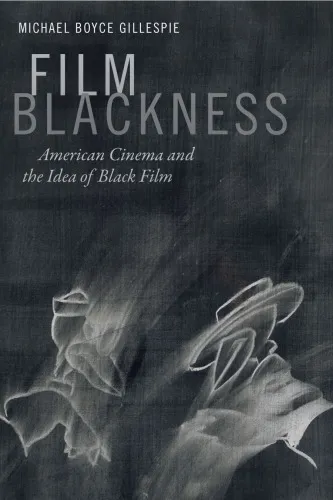
Film Blackness : American Cinema and the Idea of Black Film
Michael Boyce Gillespie
English
Advanced
Film & Cinema
4.9 / 5
0 reviews
2016
Published
244
pages
477
views
In Film Blackness Michael Boyce Gillespie shifts the ways we think about black film, treating it not as a category, a genre, or strictly a representation of the black experience but as a visual negotiation between film as art and the discursivity of race. Gillespie challenges exp
Before you read
What will you get from this book?
In Film Blackness Michael Boyce Gillespie shifts the ways we think about black film, treating it not as a category, a genre, or strictly a representation of the black experience but as a visual negotiation between film as art and the discursivity of race. Gillespie challenges expectations that black film can or should represent the reality of black life or provide answers to social problems. Instead, he frames black film alongside literature, music, art, photography, and new media, treating it as an interdisciplinary form that enacts black visual and expressive culture. Gillespie discusses the racial grotesque in Ralph Bakshi's Coonskin (1975), black performativity in Wendell B. Harris Jr.'s Chameleon Street (1989), blackness and noir in Bill Duke's Deep Cover (1992), and how place and desire impact blackness in Barry Jenkins's Medicine for Melancholy (2008). Considering how each film represents a distinct conception of the relationship between race and cinema, Gillespie recasts the idea of black film and poses new paradigms for genre, narrative, aesthetics, historiography, and intertextuality.
Michael Boyce Gillespie is Associate Professor of Film in the Department of Media and Communication Arts and the Black Studies Program at the City College of New York, City University of New York.
Reviews:
"This astonishingly comprehensive, compact book does nothing less than synthesize nearly the entirety of thought to date on black cinema, blackness in the cinema, and scholarship in this vital area of film studies. . . . Essential. Upper-division undergraduates through professionals."
— G. A. Foster, Choice
"Gillespie calibrates a series of agile and fine-grained analyses that draw upon a breadth of disciplines and methods encompassing film historiography, critical geography, debates in black film theory, questions of genre and narratology, performativity, and the business of film distribution. . . . While Film Blackness is specifically pitched to existing conversations in film and media studies, the discursivity of blackness Gillespie articulates has far-ranging implications to black cultural production across media." — Iggy Cortez, ASAP Journal
Ask this book
Your question is answered in the context of this title and author. Each answer uses 2 points.
Sign in to ask the book assistant.
Reader reviews
0 reviews, 4.9 average out of 5
No reviews yet
If you have read this book, help the next reader with your experience.
Write a review
Sign in to publish a review.
Reader questions and answers
Ask a focused question and learn from the community.
Sign in to ask or answer a question.
No questions yet
Be the first to ask a clear, useful question.
What to read next
Related references that continue this learning path.