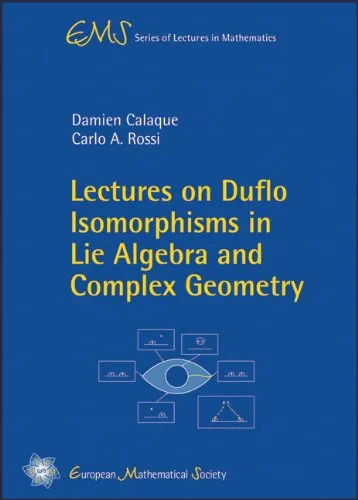
Lectures on Duflo Isomorphisms in Lie Algebra and Complex Geometry (EMS Series of Lectures in Mathematics)
Damien Calaque,Carlo A. Rossi
2011
View book
Book guide and evaluation
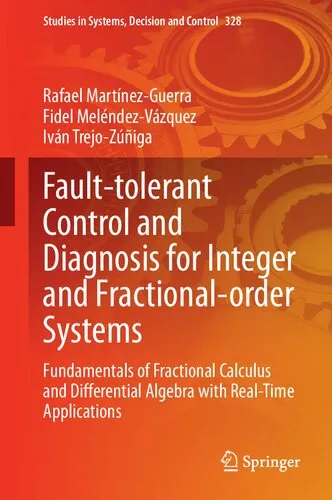
Rafael Martínez-Guerra,Fidel Meléndez-Vázquez,Iván Trejo-Zúñiga
0 reviews
Published
pages
views
Introduction to "Fault-tolerant Control and Diagnosis for Integer and Fractional-order Systems" In the rapidly evolving world of control systems and diagnostics, achieving robustness and reliability has become a cornerstone for technological innovation. "Fault-tole
Before you read
In the rapidly evolving world of control systems and diagnostics, achieving robustness and reliability has become a cornerstone for technological innovation. "Fault-tolerant Control and Diagnosis for Integer and Fractional-order Systems: Fundamentals of Fractional Calculus and Differential Algebra with Real-Time Applications" offers a multifaceted perspective bridging classical control systems with the newer and increasingly vital paradigm of fractional-order systems. This book is designed to provide researchers, students, and practicing engineers with theoretical insights and practical tools to address real-time fault detection, isolation, and reconfiguration in modern control systems.
This comprehensive volume begins by laying a solid foundation in the mathematical principles of fractional calculus and differential algebra. Fractional-order systems, often overshadowed by traditional integer-order approaches, are explored in detail to show their potential for solving complex control engineering problems. By blending these advanced mathematical techniques with state-of-the-art fault-tolerant control (FTC) strategies, the book creates a rich framework for understanding and mitigating failures in both linear and nonlinear systems.
The first section delves into the fundamentals of fractional calculus, an area that has gained significant momentum due to its ability to model natural phenomena with greater accuracy than classical integer-order methods. Readers are introduced to core concepts, from fractional derivatives and integrals to their applications in dynamic system modeling.
Subsequent chapters tackle key topics in fault diagnosis and tolerance. These include techniques for real-time fault detection, fault isolation, and decision-making mechanisms on how and when to reconfigure controllers to maintain system stability and performance. The book also contrasts fractional-order approaches with traditional integer-order diagnostics to reveal advantages like extended system memory, higher accuracy, and robustness.
Following the theoretical concepts, the book offers clear implementation methods enriched with numerical simulations and case studies. These real-world examples cover a range of applications, including robotics, aerospace, energy systems, and industrial processes, ensuring the material is pragmatic and accessible.
Closing the book is an exploration of real-time applications of fault-tolerant techniques, seamlessly merging theory with implementation using high-performance computing platforms and tools. The authors expertly integrate these methods with current advancements, ensuring this book is a forward-looking guide for emerging technologies.
"The integration of fractional-order calculus with modern control theory is not merely an enhancement—it is a necessity for systems that demand precision under uncertainty."
"A system's resilience lies not in its immunity to faults but in its capacity to adapt, learn, and recover from them."
"The interplay of mathematics and engineering is where innovation thrives, and in fractional-order systems, this interplay finds its most elegant expression."
As systems become more complex and interconnected, ensuring their safety and reliability under fault conditions is no longer optional—it is essential. The rise of fractional-order systems heralds a new era in control engineering, where enhanced precision and robustness are achievable despite the nonlinearity and uncertainty inherent in modern technologies. This book not only introduces these cutting-edge concepts but also equips readers with the tools to implement them effectively.
Furthermore, the integration of real-time applications makes this text a valuable resource for those tackling real-world engineering challenges. Whether you are a researcher exploring the possibilities of fractional systems, a professor developing an advanced course, or an industrial professional looking to enhance operational reliability, this book provides answers and inspires action.
In conclusion, "Fault-tolerant Control and Diagnosis for Integer and Fractional-order Systems" is more than just a textbook. It is a gateway to the future of resilient system design, blending the theoretical with the practical to unlock new possibilities in automation, control, and diagnostics. By addressing key challenges and offering innovative solutions, this book ensures its place as a cornerstone in the evolving landscape of control engineering.
Your question is answered in the context of this title and author. Each answer uses 2 points.
0 reviews, 4.0 average out of 5
Sign in to publish a review.
Ask a focused question and learn from the community.
Related references that continue this learning path.
Damien Calaque,Carlo A. Rossi