
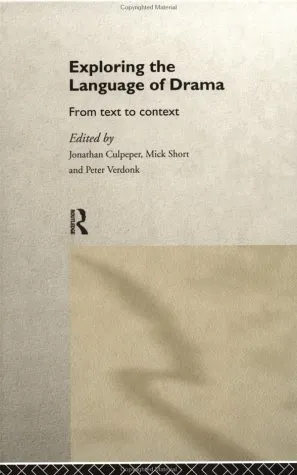
Book guide and evaluation
Exploring the Language of Drama: From Text to Context (Interface)
J. Culpeper
English
Beginner
Essays
4.4 / 5
0 reviews
1998
Published
192
pages
393
views
Exploring the Language of Drama: From Text to Context (Interface) dramatic discourse analysis, theatrical linguistics Exploring the Language of Drama: From Text to Context (Interface) offers deep insight into drama through text and contextual analysis. Analytical Sum
Before you read
What will you get from this book?
Analytical Summary
This authoritative work, Exploring the Language of Drama: From Text to Context (Interface), stands as a rigorous examination of how language operates in the medium of drama, bridging textual structures with performative realities. It invites serious readers—academics, theatre practitioners, and linguistic researchers—to engage with an interdisciplinary study that unpacks the intricate relationship between the written dramatic text and its interpretation within contextual frames.
The book addresses an essential question in dramatic discourse analysis: how do lexical choices, syntactic forms, and pragmatic cues shape audience perception and theatrical meaning? Through a series of analytical frameworks, it explores how characters, dialogue, and stage directions combine to produce layered communicative acts. This interaction between text and performance is mapped with scholarly precision, making it a valuable resource for the fields of theatrical linguistics and performance studies.
Information unavailable regarding the original publication year due to no reliable public source. Nevertheless, the work’s impact and relevance continue to resonate within contemporary scholarship. Its inclusion in the Interface series signals its place among other distinguished interdisciplinary contributions, encouraging sustained analytical engagement with drama as both literature and a live art form.
Key Takeaways
Readers will come away from Exploring the Language of Drama: From Text to Context (Interface) equipped with a clear understanding of how drama’s linguistic dimension informs and transforms its performative context.
First, the book integrates methods from discourse analysis to investigate patterns of communication specific to drama scripts and performance exchanges. Second, it demonstrates how meaning in theatre is not confined to dialogue but emerges through interplay between language, staging, and audience interpretation. Third, it offers tools for bridging the gap between close textual reading and broader socio-cultural considerations.
By combining theoretical detail with accessible examples, the authors have enabled readers to translate abstract linguistic concepts into concrete theatre analysis. This dual approach makes the work not only a scholarly contribution but also a practical guide for improving dramatic interpretation and production.
Memorable Quotes
Within the text, certain reflections highlight the deeper philosophy and approach the book embodies.
“In drama, language is never inert; it is action, it is reaction.”Unknown
“The contextual frame transforms the spoken line into an event in its own right.”Unknown
“Text and performance are two halves of the same linguistic whole.”Unknown
Why This Book Matters
Exploring the Language of Drama: From Text to Context (Interface) is an indispensable reference for understanding the convergence of language and theatre.
In an age where interdisciplinary study is increasingly valued, this book provides a clear methodological roadmap for examining drama as both a linguistic artifact and a performative experience. By articulating how spoken and staged elements intersect, it empowers scholars and practitioners to push beyond traditional literary analysis into a dynamic investigation of live, embodied meaning.
For educators, it offers a framework to teach students how to balance textual fidelity with creative adaptation. For researchers, it provides a structured analytical lens for exploring how cultural, social, and historical contexts influence dramatic production and reception.
Inspiring Conclusion
For those committed to deepening their grasp of drama's communicative power, Exploring the Language of Drama: From Text to Context (Interface) offers a path rich with analytical clarity and contextual insight.
This work embodies the belief that drama is a living exchange between text and audience, crafted through linguistic choices and contextual framing. Its balance of scholarly depth and practical application makes it a worthy addition to any academic library or theatre practitioner’s reference shelf.
Readers are encouraged to read, share, and discuss the findings and approaches presented, ensuring that the nuanced understanding of dramatic language continues to inform both scholarship and stagecraft for years to come.
Ask this book
Your question is answered in the context of this title and author. Each answer uses 2 points.
Sign in to ask the book assistant.
Reader reviews
0 reviews, 4.4 average out of 5
No reviews yet
If you have read this book, help the next reader with your experience.
Write a review
Sign in to publish a review.
Reader questions and answers
Ask a focused question and learn from the community.
Sign in to ask or answer a question.
No questions yet
Be the first to ask a clear, useful question.
What to read next
Related references that continue this learning path.
The Globalisation of English and the English Language Classroom
Claus Gnutzmann (editor),Frauke Intemann (editor)
2008
View book
The Routledge Handbook of Stylistics (Routledge Handbooks in English Language Studies)
Michael Burke (editor)
2023
View book