
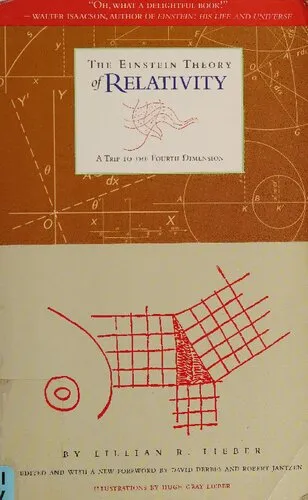
The Einstein Theory of Relativity : A Trip to the Fourth Dimension
Lillian R. Lieber,Hugh Gray Lieber,David Derbes,Robert Jantzen
2008
View book
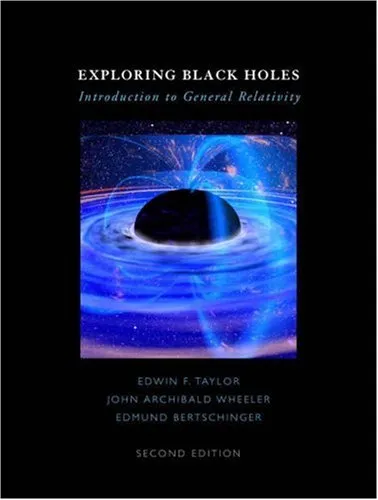
Book guide and evaluation
Edwin F. Taylor,John Archibald Wheeler,Edmund Bertschinger
0 reviews
Published
pages
views
Welcome to the journey through the vast and mysterious universe with Exploring Black Holes: Introduction to General Relativity (2nd Edition), a comprehensive guide crafted by the distinguished authors Edwin F. Taylor, John Archibald Wheeler, and Edmund Bertschinger. This book
Before you read
Welcome to the journey through the vast and mysterious universe with Exploring Black Holes: Introduction to General Relativity (2nd Edition), a comprehensive guide crafted by the distinguished authors Edwin F. Taylor, John Archibald Wheeler, and Edmund Bertschinger. This book serves as an entryway into understanding one of the most intriguing phenomena in the cosmos: black holes. It masterfully bridges the gap between complex theoretical physics and comprehensible concepts accessible to learners and enthusiasts alike.
This second edition of Exploring Black Holes, building on the robust foundation established by its predecessor, delves deeper into the enigmatic world of black holes and the principles of general relativity. Designed for those with a foundational understanding of physics, the book begins with a thorough overview of Einstein's groundbreaking theory of general relativity and its implications on our understanding of space-time. It meticulously guides the reader through critical concepts such as the Schwarzschild radius, the event horizon, and the singularity, elucidating how these elements form the core of black hole theory.
The book progresses by examining black holes from various perspectives—both theoretically and observationally. The authors utilize a mix of qualitative descriptions, mathematical formalism, and thought experiments to paint a vivid picture of what happens as matter and light interact with these cosmic phenomena. Notably, the book emphasizes an experiential approach, encouraging readers to think critically about the physical and geometrical implications of general relativity.
"In the heart of a black hole lies the key to our universe's greatest secrets, waiting for the brave and the curious to unlock them."
"To explore a black hole is to venture into the limits of our understanding of physics, where the familiar rules of nature warp and twist."
"General relativity teaches us that space-time is a dynamic, flexible fabric, capable of being stretched, compressed, and torn."
The quest to explore black holes extends beyond pure academic interest; it touches on the very foundation of how we comprehend the universe. Exploring Black Holes: Introduction to General Relativity (2nd Edition) is significant because it affords students and readers an opportunity to engage with complex ideas in a meaningful and digestible way. Furthermore, black holes stand at the intersection of quantum mechanics and general relativity, two fundamental theories that have yet to be fully reconciled. This book successfully acts as a catalyst for curiosity, inspiring burgeoning physicists and keen learners to delve deeper into the mysteries of the universe.
Moreover, understanding black holes fosters a greater appreciation for the intricacies of our universe and the ongoing scientific efforts to decipher them. By embracing the challenge of learning about black holes, readers can gain profound insights into gravity, time, and space, ultimately enriching their knowledge base and appreciation for scientific discovery.
In conclusion, Exploring Black Holes: Introduction to General Relativity (2nd Edition) is a crucial tool for any aspiring physicist or enthusiast wishing to deepen their understanding of one of science’s most captivating fields.
Your question is answered in the context of this title and author. Each answer uses 2 points.
0 reviews, 4.6 average out of 5
Sign in to publish a review.
Ask a focused question and learn from the community.
Related references that continue this learning path.
Lillian R. Lieber,Hugh Gray Lieber,David Derbes,Robert Jantzen

![Cover of Relativity Visualized [elem txt]](https://s3.refhub.ir/images/thumb/Relativity_Visualized__elem_txt_16493.webp)