
Zachary Nazarene Bisenio
2025/11/24
5 / 5
I have to admit. This is the best book I've ever read on AI. That's the challenge of today: how to explain the models to people who have no idea about the model. Thank you to the authors of this book.
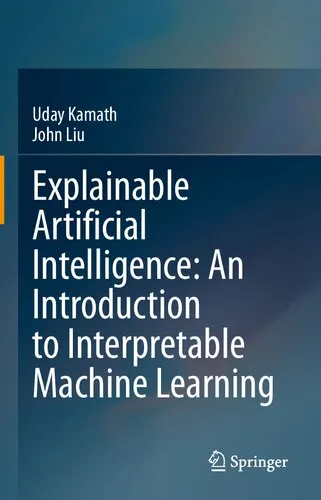
Book guide and evaluation
Kamath,Liu
1 reviews
Published
pages
views
Introduction to "Explainable Artificial Intelligence - An Introduction to XAI" Artificial Intelligence (AI) has significantly reshaped industries, ranging from healthcare and finance to logistics and entertainment. However, as AI systems grow in complexity, they often act
Before you read
Artificial Intelligence (AI) has significantly reshaped industries, ranging from healthcare and finance to logistics and entertainment. However, as AI systems grow in complexity, they often act as "black boxes"—producing outcomes without offering clear insights into their decision-making processes. This challenge has birthed the critical field of Explainable AI (XAI), which aims to bridge the gap between AI systems and human understanding.
Written by Kamath and Liu, "Explainable Artificial Intelligence - An Introduction to XAI" is a comprehensive book that delves into the theoretical, technical, and practical aspects of XAI. By addressing core concepts, methodologies, and real-world applications, this book serves as a vital resource for professionals, researchers, and students who wish to understand AI's inner workings. Packed with insights, this book explores how explainability not only strengthens AI's reliability but also boosts trust and adoption in various fields.
The book is structured into multiple sections, spanning foundational knowledge, key methodologies, ethical considerations, and practical tools for implementing XAI systems. It begins by introducing the reader to the evolution of AI and outlines the importance of transparency in machine learning models. As AI solutions become integral to high-stakes decision-making—such as loan approvals, medical diagnoses, and autonomous driving—understanding the "why" behind a model's output becomes indispensable.
The authors take a deep dive into prominent XAI techniques such as LIME (Local Interpretable Model-agnostic Explanations), SHAP (SHapley Additive exPlanations), and counterfactual reasoning. Each method is explained with step-by-step clarity, along with examples that make even complex algorithms accessible. Special emphasis is placed on balancing accuracy and explainability—ensuring that AI is both effective and understandable.
Furthermore, ethical implications of opaque AI systems are discussed, including issues surrounding bias, accountability, and privacy. Real-world case studies from healthcare, finance, and autonomous systems are explored, illustrating how XAI techniques can impact diverse industries. The book closes by looking at emerging research areas and the future of explainable AI.
"Explainability is not just a technical objective; it is a moral obligation in a world increasingly driven by algorithmic decisions."
"An unexplained AI decision is akin to blindfolded intuition—strong perhaps, but wholly unreliable."
"Transparency fosters trust, and trust is the cornerstone of technology adoption."
As AI becomes more prevalent in our daily lives, the stakes for explainability and transparency have never been higher. Uninterpreted models risk perpetuating societal biases, undermining trust, and even legal repercussions when accountability is compromised. "Explainable Artificial Intelligence - An Introduction to XAI" addresses these critical issues head-on, serving as a thoughtful primer for AI practitioners and policymakers alike.
This book is vital as it simplifies intricate XAI techniques without diluting their practicality. Its balance of theory and real-world applications makes it an indispensable resource for bridging the gap between AI design and responsible implementation. Whether you're a data scientist, business leader, or ethics advocate, this book equips you with the knowledge to make AI systems work for and not against their users.
Your question is answered in the context of this title and author. Each answer uses 2 points.
1 reviews, 5.0 average out of 5
2025/11/24
5 / 5
I have to admit. This is the best book I've ever read on AI. That's the challenge of today: how to explain the models to people who have no idea about the model. Thank you to the authors of this book.
Sign in to publish a review.
Ask a focused question and learn from the community.
Related references that continue this learning path.
Jianlong Zhou,Fang Chen
Valliappa Lakshmanan,Marco Tranquillin,Firat Tekiner