

Book guide and evaluation
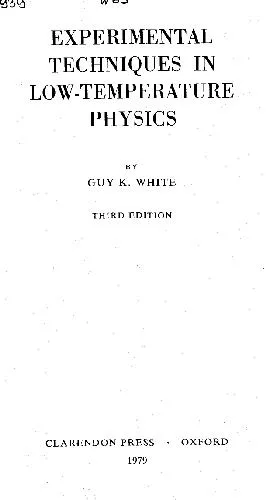
Experimental Techniques in Low-Temperature Physics
Guy K. White
English
Beginner
Physics
4.8 / 5
0 reviews
1987
Published
168
pages
161
views
Introduction to "Experimental Techniques in Low-Temperature Physics" The field of low-temperature physics is an intriguing and essential domain within modern science, with applications ranging from quantum computing to space exploration. "Experimental Techniques in
Before you read
What will you get from this book?
Introduction to "Experimental Techniques in Low-Temperature Physics"
The field of low-temperature physics is an intriguing and essential domain within modern science, with applications ranging from quantum computing to space exploration. "Experimental Techniques in Low-Temperature Physics" serves as a comprehensive guide, offering both theoretical insights and practical methodologies for researchers, students, and enthusiasts diving into the complexities of cryogenics. This book has been crafted to provide hands-on knowledge and address the challenges unique to conducting experiments at extremely low temperatures. Whether you're an experienced physicist or a curious beginner, the book delivers valuable content that bridges the gap between theoretical principles and experimental execution.
Detailed Summary of the Book
The book begins by laying a robust foundation in the physics of low-temperature phenomena, preparing the reader with the required theoretical background. As per the book's focus, low-temperature physics is not simply a branch of science—it is a realm where the classical laws of physics intermingle with quantum mechanics in extraordinary ways. Throughout the chapters, various techniques used to achieve and maintain cryogenic environments are discussed, along with guidelines on handling and measuring physical properties critical at such temperatures.
From vacuum technologies to thermometry and cryogenic instrumentation, the book delves into the nuts and bolts of experimental setups. A significant portion is dedicated to understanding the behavior of materials, devices, and even fluids at cryogenic conditions. In addition, it provides practical advice on troubleshooting and improving the reliability of experiments.
A notable feature of "Experimental Techniques in Low-Temperature Physics" is its emphasis on real-world applications. The book explores state-of-the-art equipment and methodologies that are continually evolving in the field, ensuring the content remains relevant no matter the level of technological advancements. The application of such techniques in the realms of condensed matter physics, superconductivity, and even advanced manufacturing industries is discussed extensively, further underscoring the practical utility of this resource.
Key Takeaways
- Detailed discussions on the physics and principles underlying low-temperature phenomena.
- Practical guidelines for using and maintaining critical cryogenic equipment.
- Insights into troubleshooting technical challenges in low-temperature experiments.
- Applications of cryogenic techniques in modern technology, such as quantum mechanics and superconductors.
- The importance of safety measures and best practices in handling and managing laboratory cryogenics.
Famous Quotes from the Book
"In the cold world of cryogenics, nothing remains static—materials transform, properties evolve, and even the tiniest physical interactions can be observed and harnessed."
"To understand nature's laws at their extremes, one must embrace simplicity in design and absolute precision in execution."
"Experimental techniques are the bridge between imagination and scientific reality—they allow us to make the intangible tangible."
Why This Book Matters
Low-temperature physics represents a fascinating intersection of classical and quantum mechanics, offering opportunities to explore fundamental questions about the universe while developing practical technologies for the future. "Experimental Techniques in Low-Temperature Physics" is more than just an instructional manual—it is a roadmap for aspiring physicists and engineers seeking to unlock the potential of cryogenic science.
This book addresses a critical gap in the literature by focusing on the experimental side of cryogenics rather than purely theoretical concepts. It not only educates readers about the principles behind achieving cryogenic temperatures but also empowers them to tackle real-world challenges in research and industry. Its relevance spans across various disciplines, including material science, condensed matter physics, chemistry, and even aerospace technology.
The contribution of this book lies in its ability to inspire innovation and curiosity. By emphasizing on-the-ground techniques and universally applicable strategies, it ensures that researchers are equipped with tools and knowledge critical to advancing the field of low-temperature physics. For anyone passionate about pushing the boundaries of what science can achieve, this book is an invaluable companion on the journey of discovery.
Ask this book
Your question is answered in the context of this title and author. Each answer uses 2 points.
Sign in to ask the book assistant.
Reader reviews
0 reviews, 4.8 average out of 5
No reviews yet
If you have read this book, help the next reader with your experience.
Write a review
Sign in to publish a review.
Reader questions and answers
Ask a focused question and learn from the community.
Sign in to ask or answer a question.
No questions yet
Be the first to ask a clear, useful question.
What to read next
Related references that continue this learning path.


Modern Computer Vision with PyTorch: A Practical Roadmap From Deep Learning Fundamentals to Advanced Applications and Generative AI, 2nd Edition
V Kishore Ayyadevara,Yeshwanth Reddy
2023
View book