
Book guide and evaluation
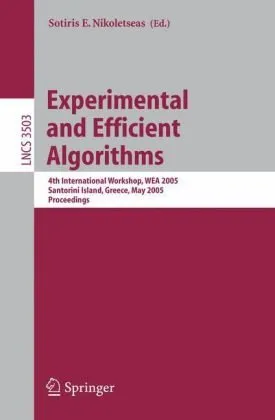
Experimental and Efficient Algorithms: 4th International Workshop, WEA 2005, Santorini Island, Greece, May 10-13, 2005. Proceedings
Christos H. Papadimitriou (auth.),Sotiris E. Nikoletseas (eds.)
English
Beginner
Software Engineering
4.8 / 5
0 reviews
2005
Published
636
pages
139
views
Introduction to "Experimental and Efficient Algorithms: 4th International Workshop, WEA 2005" The book "Experimental and Efficient Algorithms: 4th International Workshop, WEA 2005, Santorini Island, Greece, May 10-13, 2005. Proceedings" serves as an essential volume that b
Before you read
What will you get from this book?
Introduction to "Experimental and Efficient Algorithms: 4th International Workshop, WEA 2005"
The book "Experimental and Efficient Algorithms: 4th International Workshop, WEA 2005, Santorini Island, Greece, May 10-13, 2005. Proceedings" serves as an essential volume that brings together pioneering research in algorithms, focusing on experimental and efficient solutions to computational problems. This collection of papers, presented at the renowned WEA 2005 conference, highlights critical developments in algorithm design, optimization, and implementation, emphasizing real-world applications of theoretical concepts. The book not only caters to scholars and researchers but also appeals to enthusiasts seeking to deepen their understanding of algorithm efficiency and experimentation.
The workshop held on the idyllic Santorini Island brought together some of the finest minds in computer science. The contributions compiled in this book address a diverse array of topics, from approximation algorithms and graph theory to combinatorial optimization and experimental algorithmics. Whether it is about solving problems in networks, data organization, or computational geometry, the discussions provide keen insights into efficient methodologies and innovative experimental approaches.
This book is an indispensable resource that captures the dynamism and interdisciplinarity of the algorithmic research community. The contributions underline the growing importance of analyzing and comparing algorithm performance practically, beyond asymptotic theoretical bounds, creating a bridge between theory and application.
Detailed Summary of the Book
"Experimental and Efficient Algorithms" is structured as a collection of peer-reviewed papers submitted to WEA 2005, presenting innovative findings across a range of algorithmic disciplines. The book delves into experimental designs, providing tangible results from real-world applications, complemented with comprehensive theoretical insights.
One focal area is the development of approximation algorithms, essential for addressing NP-hard problems where exact solutions are infeasible within polynomial time. The contributors explore strategies to find near-optimal solutions with provable guarantees, balancing computational efficiency and output quality.
Another highlighted domain is combinatorial optimization, presenting groundbreaking techniques to optimize resources, workflows, or tasks. Techniques for graph algorithms play a pivotal role in this book, with discussions on shortest paths, network flows, and spanning trees tailored for both abstract theoretical analysis and practical applications in computer science fields such as network design, transportation, and database systems.
This book also tackles new challenges in experimental algorithmics by focusing on implementation aspects. The contributors delve into benchmarks, testing paradigms, runtime analysis, and empirical evaluation, all aimed at advancing algorithmic experimentation and enhancing its significance in solving complex computational problems.
Key Takeaways
- The importance of experimentation in verifying the theoretical performance of algorithms.
- How efficient algorithms help bridge the gap between abstract theoretical benchmarks and practical, real-world applications.
- A deeper understanding of how optimization, approximation, and graph-based solutions can address practical problems in networks, logistics, and data processing.
- Techniques and methodologies to design, evaluate, and implement algorithms that are not only theoretically sound but also efficient in practice.
- Insights into emerging trends in algorithms research, reflecting the cutting-edge advancements showcased at WEA 2005.
Famous Quotes from the Book
"In computational sciences, efficiency and accuracy often define the practicality and usability of algorithms." – A Contributor at WEA 2005
"Algorithms are not just mathematical constructs; they are tools that bridge theory and application, driving innovation across domains." – WEA 2005 Proceedings
"Experimental algorithmics puts computational theory to the test, creating a necessary synergy whereby proofs meet performance." – WEA 2005 Editor
Why This Book Matters
"Experimental and Efficient Algorithms" stands out as a vital contribution to the field of algorithm research and practice. It thrives on its focus on experimentation and efficiency – two key pillars that define the usability of algorithms in real-world scenarios.
By emphasizing experimental validation, the book addresses an inherent limitation in traditional theoretical algorithm research: the lack of practical performance analysis. As computational resources grow and applications become more dynamic, the role of experimentation in refining theoretical insights becomes crucial. This book is a landmark in cementing that shift toward performance-driven algorithm development.
Another reason behind the book’s enduring relevance is the breadth and depth of its content. It speaks to professionals across a spectrum of disciplines, from computer scientists working in theoretical analysis to practitioners seeking efficient solutions to operational challenges. Furthermore, it inspires the next generation of researchers to think critically about bridging the gap between abstract constructs and tangible systems.
Ultimately, "Experimental and Efficient Algorithms" is much more than a collection of conference proceedings; it is a testament to the collaborative nature of algorithmic science. It highlights how pooling ideas across different regions and schools of thought can lead to innovations that shape the future of computation.
Ask this book
Your question is answered in the context of this title and author. Each answer uses 2 points.
Sign in to ask the book assistant.
Reader reviews
0 reviews, 4.8 average out of 5
No reviews yet
If you have read this book, help the next reader with your experience.
Write a review
Sign in to publish a review.
Reader questions and answers
Ask a focused question and learn from the community.
Sign in to ask or answer a question.
No questions yet
Be the first to ask a clear, useful question.
What to read next
Related references that continue this learning path.


Modern Computer Vision with PyTorch: A Practical Roadmap From Deep Learning Fundamentals to Advanced Applications and Generative AI, 2nd Edition
V Kishore Ayyadevara,Yeshwanth Reddy
2023
View book