
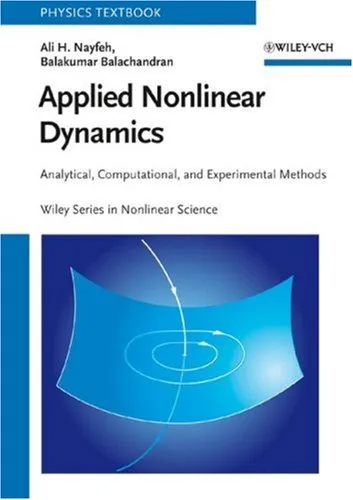
Applied Nonlinear Dynamics: Analytical, Computational, and Experimental Methods
Ali H. Nayfeh,Balakumar Balachandran
1995
View book
Book guide and evaluation
J. C. Cajas,L. Martínez-Suástegui,C. Treviño (auth.),Jaime Klapp,Abraham Medina (eds.)
0 reviews
Published
pages
views
Introduction to Experimental and Computational Fluid Mechanics "Experimental and Computational Fluid Mechanics" is an insightful and comprehensive book that delves into fundamental and advanced aspects of fluid mechanics using both experimental investigations and computati
Before you read
"Experimental and Computational Fluid Mechanics" is an insightful and comprehensive book that delves into fundamental and advanced aspects of fluid mechanics using both experimental investigations and computational techniques. Designed for researchers, engineers, and students, this book beautifully combines theoretical principles, cutting-edge technologies, and practical applications to provide a thorough understanding of fluid flow in various systems. Authored by notable experts in the field, the book is an essential guide to exploring the synergy between computational fluid dynamics (CFD) and experimental approaches.
Fluid mechanics, as a domain, is critical to understanding the behavior of liquids and gases in motion, and its relevance spans across industries such as aerospace, automotive, energy, and environmental sciences. This book serves as a valuable resource to address the diverse challenges that arise in real-world fluid systems, leveraging both experimental setups and advanced numerical simulations to derive reliable and meaningful solutions. By encompassing detailed methodologies, case studies, and theoretical concepts, "Experimental and Computational Fluid Mechanics" is a treasure trove of knowledge for anyone involved in fluid dynamic research or industry applications.
This book offers a comprehensive roadmap to understanding fluid mechanics by integrating experimental and computational aspects effectively. It carefully explores:
Each chapter is meticulously structured to balance theoretical exposition with practical guidance. Thought-provoking case studies and examples ensure clarity and relevance, while further reading suggestions offer an opportunity for readers to delve deeper into specific topics of interest.
Readers of "Experimental and Computational Fluid Mechanics" will gain the following key insights:
Here are a few memorable quotes from the book that encapsulate its essence:
"Fluid mechanics is not simply a science; it is the art of understanding the world's most beautiful flows."
"The interplay of computational models and experimental data forms the backbone of innovation in fluid dynamics."
"Every turbulence observed in nature is a story waiting to be decoded by science."
The importance of "Experimental and Computational Fluid Mechanics" lies in its ability to marry theory with practicality, forming a resource that is not only educational but also transformative. In today's world, where innovations in aerodynamics, clean energy, and climate modeling are highly desirable, this book equips readers with the knowledge and tools necessary to lead advancements in these critical areas.
By combining methodologies from both experimental and computational domains, it eradicates the silos that traditionally limited progress in fluid mechanics research. Furthermore, its emphasis on interdisciplinary applications ensures that the knowledge imparted is versatile and far-reaching. Whether you are a student embarking on fluid mechanics for the first time or an experienced professional refining your expertise, this book provides the depth, clarity, and inspiration needed to succeed.
Ultimately, "Experimental and Computational Fluid Mechanics" is not just a repository of knowledge—it is a catalyst for innovation, a guide for discovery, and a testament to the boundless nature of fluid dynamics.
Your question is answered in the context of this title and author. Each answer uses 2 points.
0 reviews, 4.0 average out of 5
Sign in to publish a review.
Ask a focused question and learn from the community.
Related references that continue this learning path.
Ali H. Nayfeh,Balakumar Balachandran
Weinong W. Chen (auth.),Tom Proulx (eds.)
Daniel Knorr,Andrew Schoch,Joseph L. Lenhart (auth.),Vijay Chalivendra,Bo Song,Daniel Casem (eds.)