

Atom - A Single Oxygen Atoms Journey from the Big Bang to Life on Earth...and Beyond
Lawrence M. Krauss
2001
View book

Book guide and evaluation
Martin A. Nowak,Sarah Coakley
0 reviews
Published
pages
views
Introduction to "Evolution, Games, and God: The Principle of Cooperation" "Evolution, Games, and God: The Principle of Cooperation" is a remarkable interdisciplinary exploration of the role that cooperation plays in both human evolution and the broader biological world. Writte
Before you read
"Evolution, Games, and God: The Principle of Cooperation" is a remarkable interdisciplinary exploration of the role that cooperation plays in both human evolution and the broader biological world. Written by Martin A. Nowak, a renowned biologist and mathematician, and Sarah Coakley, a distinguished theologian, this book bridges biology, theology, game theory, and philosophy. It challenges the traditional notion that evolution is purely driven by competition and survival of the fittest, instead positing that cooperation is an equally fundamental principle of evolutionary progress.
Through theoretical insights, real-world examples, and rigorous intellectual dialogue, the authors demonstrate how cooperation can emerge and thrive in both biological systems and human society. The narrative covers concepts as diverse as evolutionary dynamics, altruism, kin selection, and the theological implications of cooperative behavior in the natural world. This book invites readers to expand their understanding of evolution while addressing profound existential questions about morality, the nature of human relationships, and humanity's place in the cosmos.
The book begins by introducing the foundation of evolutionary theory and revisiting the Darwinian framework. While natural selection has long been seen as a mechanism that rewards selfish and competitive behavior, Nowak and Coakley highlight the importance of cooperative strategies. Through the lens of modern evolutionary biology and game theory, they explain how cooperation can emerge as a stable and advantageous strategy in various interactions, from microbial colonies to human societies.
The narrative delves into key ideas such as "direct reciprocity" and "indirect reciprocity," concepts from game theory that describe how mutual benefit and reputation can sustain cooperation over time. The authors discuss the evolutionary tension between selfishness and altruism, examining how cooperative traits are passed on through mechanisms like kin selection, group selection, and multilevel selection.
In addition, theological perspectives are seamlessly woven into the book’s fabric, posing questions about the nature of generosity, morality, and divine intention. Coakley explores the compatibility of evolutionary theory with notions of purpose or higher meaning, emphasizing that cooperation provides a framework for understanding human morality from both scientific and theological perspectives. Throughout the book, the authors engage with philosophical and ethical challenges, addressing debates about the naturalistic fallacy, the limits of evolution in explaining human behavior, and the place of spirituality in scientific narratives.
"Evolution is not just the survival of the fittest. It is also the survival of the most cooperative."
"Cooperation is humanity’s greatest gift—and its greatest challenge."
"Science and theology are not enemies; they are partners in uncovering truths about the world."
"Evolution, Games, and God: The Principle of Cooperation" is more than just a scientific treatise—it is a call for reevaluating our understanding of human nature and the broader natural world. It transcends academic boundaries by offering a message of hope: that cooperation, in a time of division and environmental crises, may hold the key to solving our most pressing challenges.
This book matters because it bridges disciplines, enabling scientists, theologians, and lay readers to engage in a thoughtful dialogue about the fundamental principles of life. It encourages readers to think critically about the relationship between biology and ethics, and it offers a framework for applying cooperative strategies to big-picture problems like climate change, healthcare, and social inequality.
By emphasizing the profound implications of cooperation, the authors provide not only an intellectual framework but also a moral imperative to cultivate kindness, collaboration, and an acknowledgment of our shared humanity. This vision is urgently needed in today's polarized world, where understanding and unity can pave the way for a better future.
Your question is answered in the context of this title and author. Each answer uses 2 points.
0 reviews, 4.5 average out of 5
Sign in to publish a review.
Ask a focused question and learn from the community.
Related references that continue this learning path.
Lawrence M. Krauss


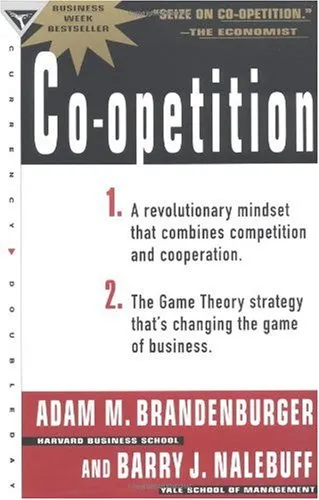
Adam M. Brandenburger,Barry J. Nalebuff