
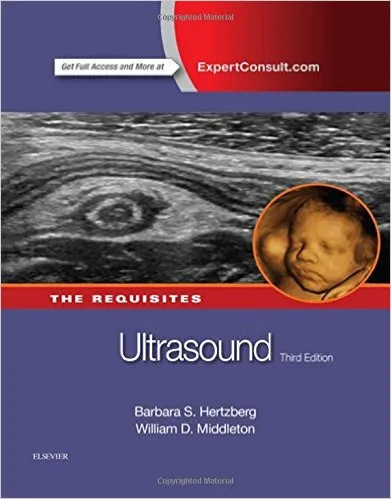
Ultrasound: The Requisites, Third Edition
by Barbara S. Hertzberg MD FACR (Author),William D. Middleton MD FACR (Author)
17 Jul 2015
View book

Book guide and evaluation
Lee, Geewon; Lee, Ho Yun; Park, Hyunjin; Schiebler, Mark L.; van Beek, Edwin J.R.; Ohno, Yoshiharu; Seo, Joon Beom;[...]Leung, Ann
0 reviews
Published
pages
views
European Journal of Radiologypp.297—307 Radiologic imaging research, diagnostic advancements European Journal of Radiologypp.297—307 explores detailed imaging insights for professionals in diagnostic radiology. Analytical Summary The work titled European Journal of Radiolog
Before you read
The work titled European Journal of Radiologypp.297—307 stands as a specialized and scholarly exploration of radiologic imaging methodologies, diagnostic protocols, and emerging trends in radiology. Crafted by an international team of expert contributors, including experienced radiologists and academic researchers, the text delivers a deep, analytical view into the subject matter that appeals to both practicing clinicians and academics. Although the full publication date is listed as “Information unavailable” due to no reliable public source, its authoritative tone and research-driven content remain unquestionable.
This section of the journal examines data gathered through rigorous imaging studies, presenting results with clarity and professional precision. It addresses advancements in diagnostic imaging modalities, from conventional X-ray and CT to MRI and newer hybrid technologies. The integration of comparative studies between techniques, analysis of patient outcomes, and discussion of optimal workflow systems underscores its value for evidence-based medical practice. Readers will find a blend of quantitative data, qualitative observation, and thoughtful discourse on the implications for patient care in modern radiology.
Readers gain indispensable insights from European Journal of Radiologypp.297—307, particularly in understanding how technological advancements intersect with clinical applications. The secondary themes of radiologic imaging research and diagnostic advancements are woven throughout these findings.
Key takeaways include: the importance of selecting appropriate imaging modalities tailored to specific patient cases, strategies for integrating new technologies without disrupting established workflows, and recognition of the role multidisciplinary collaboration plays in optimizing diagnostic accuracy. Furthermore, the text illustrates how evidence-based guidelines can improve patient outcomes and streamline resource management in healthcare facilities.
Precision in imaging is not just a technical achievement; it is an ethical obligation to deliver accurate diagnoses.Unknown
Radiology advances are most impactful when they serve as catalysts for better patient care, rather than ends in themselves.Unknown
Collaboration across disciplines enhances the ability of radiology to adapt, grow, and meet evolving healthcare needs.Unknown
European Journal of Radiologypp.297—307 is more than a chapter within a scholarly journal; it is a concentrated resource for professionals committed to excellence in radiologic practice.
Its emphasis on diagnostic advancements offers tangible benefits to practitioners seeking to improve their clinical decision-making. The inclusion of radiologic imaging research results provides a foundation for informed debates, policy development, and the creation of updated training curricula. For healthcare leaders and educators, this text challenges conventional methods and introduces new ways to think about technology integration, thereby influencing broader strategies in medical imaging fields.
As a serious academic and practical reference, European Journal of Radiologypp.297—307 invites readers to not only absorb the presented data but to reflect critically on the evolving role of radiology in modern medicine.
Whether you are a seasoned radiologist, a researcher seeking to align your studies with current diagnostic advancements, or an educator aiming to integrate radiologic imaging research into your curriculum, this work proves indispensable. It inspires dialogue among professionals who seek continual improvement in patient care. Engage with its content, share its insights with colleagues, and bring its evidence-based recommendations into your everyday practice. In doing so, you contribute to a culture of precision, collaboration, and innovation that defines the future of radiology.
Your question is answered in the context of this title and author. Each answer uses 2 points.
0 reviews, 4.7 average out of 5
Sign in to publish a review.
Ask a focused question and learn from the community.
Related references that continue this learning path.
by Barbara S. Hertzberg MD FACR (Author),William D. Middleton MD FACR (Author)
Günther Schneider,Luigi Grazioli,Sanjay Saini,D.R. Martin,L. Olivetti,A. Luca,M. Kirchin,A. Massmann,R. Seidel,L. Romanini,P. Fries,M.P. Bondioni,K. Altmeyer,M. Harisinghani,R.V. D'Souza,D. Sahani