
Book guide and evaluation
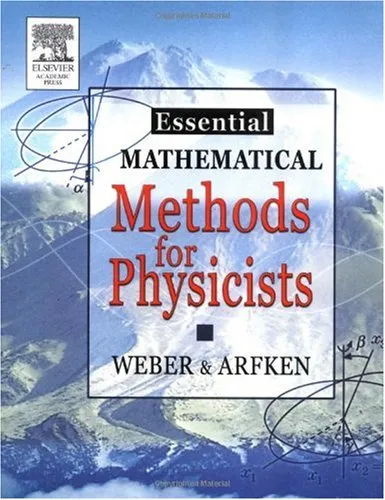
Essential Mathematical Methods for Physicists: and Engineers
Hans J. Weber,Frank Harris,George B. Arfken
English
Beginner
Mathematics
4.6 / 5
0 reviews
2003
Published
959
pages
440
views
Introduction to "Essential Mathematical Methods for Physicists: and Engineers" Mathematics is the common language of science, and in the realms of physics and engineering, its importance cannot be overstated. The book "Essential Mathematical Methods for Physicists: and Eng
Before you read
What will you get from this book?
Introduction to "Essential Mathematical Methods for Physicists: and Engineers"
Mathematics is the common language of science, and in the realms of physics and engineering, its importance cannot be overstated. The book "Essential Mathematical Methods for Physicists: and Engineers" is a comprehensive resource designed to provide students, researchers, and professionals with the mathematical tools and techniques essential for understanding and solving complex problems in these disciplines.
Written by Hans J. Weber, Frank Harris, and George B. Arfken, this book serves as a bridge between theoretical concepts and their practical applications. Designed with clarity and rigor, it covers a broad spectrum of topics ranging from introductory linear algebra to advanced calculus, differential equations, Fourier analysis, and complex variables. Whether you're a student preparing for exams, an engineer tackling real-world challenges, or a physicist delving deeper into theoretical frameworks, this text offers everything needed to succeed.
Detailed Summary of the Book
"Essential Mathematical Methods for Physicists: and Engineers" aims to deliver a clear and concise guide to the mathematical techniques most commonly used in physics and engineering. The book starts with foundation-building chapters on vectors, matrices, and linear algebra, ensuring readers are well-equipped with the basics. From there, it progresses logically into more advanced subjects such as partial differential equations, special functions, and Green's functions.
A substantial portion of the book is dedicated to techniques that are pivotal for solving both ordinary and partial differential equations, which are often used to describe real-world phenomena in physics and engineering. Additionally, computational methods, essential in today's scientific landscape, are introduced with examples to show their applicability in tackling complex problems. The book emphasizes methods such as Fourier and Laplace transforms, which are fundamental in processing signals, analyzing systems, or modeling physical processes.
By blending theoretical explanations with practical problem-solving exercises, this book equips readers with the tools to handle challenges that arise across engineering domains, quantum mechanics, electromagnetism, thermodynamics, and more.
Key Takeaways
- A comprehensive introduction to linear algebra, calculus, and differential equations.
- Detailed coverage of advanced techniques such as variational methods, special functions, and integral equations.
- Emphasis on practical applications, bridging the gap between theory and real-world use cases.
- Step-by-step problem-solving approaches to build both skill and confidence.
- Clearly structured chapters that allow for systematic self-study or as a supplementary text in academic courses.
Famous Quotes from the Book
"The art of applying mathematics lies not merely in its abstract beauty, but in connecting it to the physical and practical world."
"Every problem in physics or engineering can be approached mathematically, but often mastery lies in choosing the right method."
"Mathematics serves as the backbone of our understanding; without its precision, physics and engineering would remain mere speculation."
Why This Book Matters
In a world driven by technology and scientific innovation, the demand for professionals who understand and utilize mathematical techniques has never been higher. This book holds immense importance for several reasons:
- Foundational Resource: It provides students and early-career researchers with a foundational understanding to excel in their fields.
- Bridging Theory and Application: By seamlessly integrating theory with practical problem sets, the book helps readers see the real-world relevance of mathematical methods.
- Universal Applicability: The techniques covered have applications across multiple domains, including quantum mechanics, electrical engineering, and fluid dynamics.
- Lifelong Reference: Even for seasoned professionals, this book serves as a go-to resource for refreshing core concepts or tackling new challenges.
Ultimately, "Essential Mathematical Methods for Physicists: and Engineers" is not just a textbook; it is a guide to understanding the language of the universe and leveraging it to innovate, solve problems, and push the boundaries of knowledge.
Ask this book
Your question is answered in the context of this title and author. Each answer uses 2 points.
Sign in to ask the book assistant.
Reader reviews
0 reviews, 4.6 average out of 5
No reviews yet
If you have read this book, help the next reader with your experience.
Write a review
Sign in to publish a review.
Reader questions and answers
Ask a focused question and learn from the community.
Sign in to ask or answer a question.
No questions yet
Be the first to ask a clear, useful question.
What to read next
Related references that continue this learning path.
Introduction to Relativistic Continuum Mechanics
G. Ferrarese,D. Bini (auth.),G. Ferrarese,D. Bini (eds.)
2008
View book
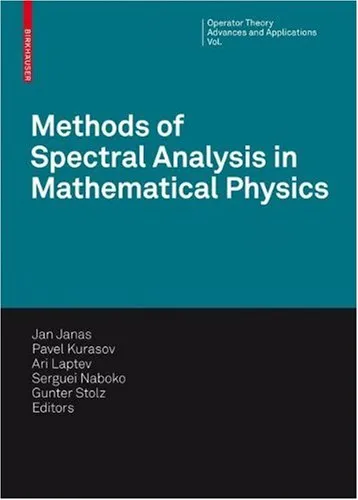
Methods of spectral analysis in mathematical physics: Conference, OTAMP 2006, Lund, Sweden
Jan Janas,Pavel Kurasov,Ari Laptev,Sergei Naboko,Günter Stolz
2008
View book