

Book guide and evaluation
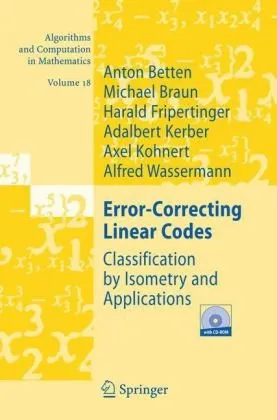
Error-Correcting Linear Codes: Classification by Isometry and Applications
Anton Betten,Michael Braun,Harald Fripertinger,Adalbert Kerber,Axel Kohnert,Alfred Wassermann (auth.)
English
Beginner
Mathematics
5.0 / 5
0 reviews
2006
Published
818
pages
405
views
Introduction Welcome to the comprehensive world of Error-Correcting Linear Codes as unveiled in our seminal work, "Error-Correcting Linear Codes: Classification by Isometry and Applications." This book represents a significant leap forward in the field of coding theory, em
Before you read
What will you get from this book?
Introduction
Welcome to the comprehensive world of Error-Correcting Linear Codes as unveiled in our seminal work, "Error-Correcting Linear Codes: Classification by Isometry and Applications." This book represents a significant leap forward in the field of coding theory, emphasizing the classification of linear codes through isometry and exploring the intricate applications that span various domains.
Detailed Summary of the Book
In recent years, the theory of error-correcting codes has become the cornerstone of reliable digital communication. Our book begins with a thorough introduction to the fundamentals of error-correcting codes, establishing a strong foundation in linear algebra and coding theory. We delve into unique methods for classifying linear codes up to isometry, an approach that reveals equivalent structures and elucidates the symmetry properties of codes.
The chapters are meticulously structured to build upon each concept progressively. We explore the mathematical foundations before advancing to sophisticated classifications, unraveling concepts like orbits, automorphism groups, and invariants that are indispensable in classifying linear codes. Our investigation finds tangible applications in various fields, including cryptography, data transmission, and information theory. Each application is illustrated with practical examples and diagrams for a more profound understanding.
Key Takeaways
- Comprehensive exploration of the mathematical underpinnings of error-correcting codes.
- Innovative approaches to code classification through isometry, offering new perspectives on code equivalence.
- Practical applications in real-world scenarios, bridging the gap between theoretical constructs and practical implementations.
- A systematic guide to the classification of linear codes, aiding both academic inquiry and applied research.
Famous Quotes from the Book
"The elegance of a code is reflected in its resilience under errors, much like the elegance of mathematics is in its ability to solve the unsolvable."
"When codes dance to the symmetry of isometry, they reveal the symmetry hidden in the chaos of errors."
Why This Book Matters
This book is crucial for both researchers and practitioners in the realm of coding theory and its applications. Understanding error-correcting codes is imperative for developing robust communication systems, ensuring data integrity, and enhancing security protocols. By focusing on the classification of these codes through isometry, we provide new insights and a fresh perspective that challenges existing paradigms in the field.
In academia, our book serves as a comprehensive resource, offering detailed explanations and extensive exercises that encourage further exploration and research. For industry professionals, the practical applications detailed in our work highlight the importance and utility of error-correcting codes in everyday technologies. By bridging the gap between theoretical foundations and practical implications, our book empowers readers to apply these concepts in innovative ways.
Ultimately, "Error-Correcting Linear Codes: Classification by Isometry and Applications" is more than just a scholarly text; it is a beacon for those seeking to understand and harness the power of error-correction in the digital age. It stands as a testament to the profound impact of mathematics on modern technology, and we invite you to explore its pages and unlock its secrets.
Ask this book
Your question is answered in the context of this title and author. Each answer uses 2 points.
Sign in to ask the book assistant.
Reader reviews
0 reviews, 5.0 average out of 5
No reviews yet
If you have read this book, help the next reader with your experience.
Write a review
Sign in to publish a review.
Reader questions and answers
Ask a focused question and learn from the community.
Sign in to ask or answer a question.
No questions yet
Be the first to ask a clear, useful question.
What to read next
Related references that continue this learning path.

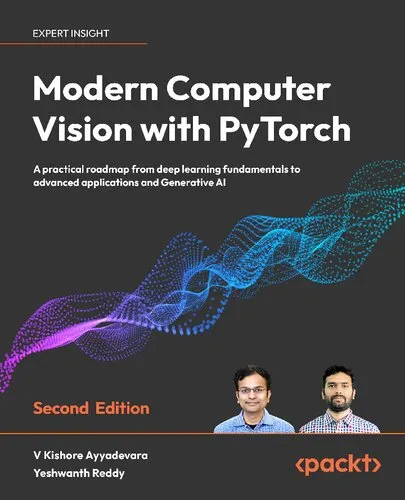
Modern Computer Vision with PyTorch: A Practical Roadmap From Deep Learning Fundamentals to Advanced Applications and Generative AI, 2nd Edition
V Kishore Ayyadevara,Yeshwanth Reddy
2023
View book