
Programming Kubernetes: Developing Cloud-Native Applications
Michael Hausenblas,Stefan Schimanski
2019
View book
Book guide and evaluation
Patricia Anne Scott
0 reviews
Published
pages
views
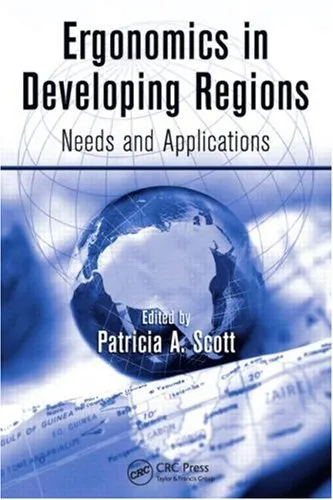
Introduction to 'Ergonomics in Developing Regions: Needs and Applications' Welcome to 'Ergonomics in Developing Regions: Needs and Applications,' a pioneering exploration curated to bridge the gap between ergonomics and the unique challenges posed in developing
Before you read
Welcome to 'Ergonomics in Developing Regions: Needs and Applications,' a pioneering exploration curated to bridge the gap between ergonomics and the unique challenges posed in developing regions. This book sheds light on a critical yet underrepresented area where the science of human-centered design meets culturally and economically diverse populations. It serves as both a theoretical framework and a practical guide, highlighting the importance of ergonomics in empowering industries, improving working conditions, and contributing to sustainable growth worldwide.
The dynamic nature of developing economies often presents a complex interplay of socioeconomic challenges, cultural nuances, and limited access to resources. Against this backdrop, this book emphasizes the role of ergonomics in fostering safety, productivity, and well-being, paving the way for transformative solutions tailored to regional needs. Whether you are an ergonomics professional, policymaker, researcher, or student, the knowledge and perspectives presented here hold significant potential to cultivate a lasting positive impact.
This book explores how the principles of ergonomics can be applied to solve real-world challenges in developing regions. It integrates theoretical insights with case studies, offering practical methodologies for adapting ergonomic practices to low-resource environments. The content is divided into several key themes, including:
The book drives home the significance of interdisciplinary collaboration and inclusivity in ergonomic design processes, charting a path towards solving some of the most pressing problems in developing economies.
"Ergonomics is not merely a science of design; it is an enabler of human dignity, health, and wealth creation, even in the humblest of environments."
"In resource-limited settings, ergonomic solutions are not an expense but an investment in the people who build the future."
The importance of 'Ergonomics in Developing Regions: Needs and Applications' lies in its ability to acknowledge and address the often-overlooked ergonomics challenges faced by developing regions. Traditional ergonomic practices, largely developed in industrialized nations, may not always align with the realities of low-resource environments. This book serves to change that narrative by providing a roadmap tailored to diverse socioeconomic contexts, thereby unlocking opportunities for impactful change.
Beyond theoretical discussions, this book features actionable insights illustrated through case studies that are directly applicable to real-world scenarios. In doing so, it empowers both local and global stakeholders to harness the transformative potential of ergonomic design, ultimately fostering healthier workspaces, resilient communities, and sustainable growth.
With its rich interdisciplinary approach, this book aspires to inspire innovation and collaboration, making it an essential resource for anyone committed to creating meaningful change in developing regions.
Your question is answered in the context of this title and author. Each answer uses 2 points.
0 reviews, 4.0 average out of 5
Sign in to publish a review.
Ask a focused question and learn from the community.
Related references that continue this learning path.
Michael Hausenblas,Stefan Schimanski

Christoph Fehling,Frank Leymann,Ralph Retter,Walter Schupeck,Peter Arbitter (auth.)