
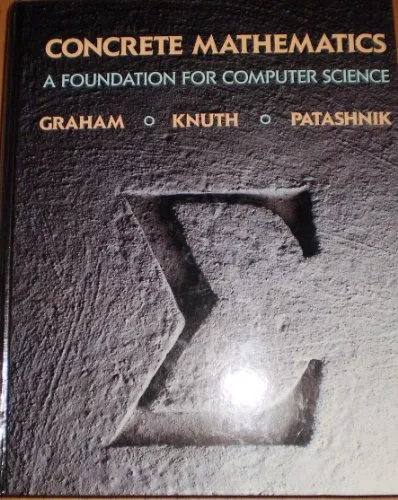
Concrete Mathematics: A Foundation for Computer Science
Ronald L. Graham,Donald Knuth,Oren Patashnik
1988
View book

Book guide and evaluation
Rudolph, Daniel J.
0 reviews
Published
pages
views
Ergodic Theory and Dynamical Systemspp.491—512 measure-preserving transformations, advanced dynamical systems analysis An in-depth examination of Ergodic Theory and Dynamical Systemspp.491—512, illuminating complex structures and transformations. Analytical Summary
Before you read
The work Ergodic Theory and Dynamical Systemspp.491—512 offers an authoritative exploration into the intricate relationships between measure theory and dynamical systems. Written with academic precision, it serves as both a technical reference and a conceptual guide for professionals and scholars delving into the realm of mathematical analysis of evolving systems.
Across pages 491—512, the text meticulously examines the foundations of ergodic theory, focusing on the role of measure-preserving transformations and how these underpin the behavior and predictability of dynamical systems over time. In doing so, the work bridges abstract theoretical constructs with the nuanced real-world phenomena found in physics, data science, and applied mathematics.
The narrative maintains mathematical rigor while contextualizing results in ways that resonate with readers who may apply the theory to computational modeling, statistical mechanics, or chaos theory. Every argument is constructed with an eye toward logical coherence, mathematical transparency, and relevance to contemporary research challenges.
Readers will walk away from Ergodic Theory and Dynamical Systemspp.491—512 with a deeper understanding of how theoretical frameworks align with practical applications in analyzing complex systems.
The book segment underscores that measure-preserving transformations are not merely abstract entities but tools to decipher long-term system behavior. It also reinforces the necessity of compatibility between theoretical foundations and applied modeling techniques.
Students, researchers, and seasoned mathematicians alike can apply the logic presented to innovate in fields where understanding the "steady state" of a system or its invariant measures is essential, such as meteorology, financial modeling, and signal processing.
"In ergodic theory, persistence of structure under transformation is as important as the transformation itself." Unknown
"The measure space is the canvas; transformations are the brushstrokes of dynamical systems." Unknown
"Predictability emerges not from simplicity, but from the profound regularities hidden within complexity." Unknown
For specialists in mathematics and applied sciences, Ergodic Theory and Dynamical Systemspp.491—512 is more than just literature; it is a pathway to mastery of concepts that govern evolving systems.
Its relevance extends into computational sciences, demonstrating how abstract proofs and theorems can be transformed into algorithms and predictive models. This is vital in disciplines such as artificial intelligence, climate modeling, and quantitative finance.
Information on awards or publication year is unavailable due to no reliable public source, but the academic resonance of this work is unmistakable. The section’s methodological clarity ensures it is an enduring reference in university curricula and professional research archives.
The journey through Ergodic Theory and Dynamical Systemspp.491—512 is an intellectual expedition, drawing readers into a world where mathematics explains the rhythm of complex phenomena.
For academics, professionals, and passionate learners, this work demonstrates how precision thinking unlocks patterns within apparent randomness. Whether your focus is theoretical advancement or practical problem-solving, engaging deeply with these ideas equips you to lead conversations and innovations in multiple scientific arenas.
Immerse yourself in its pages, share your insights with fellow scholars, and discuss its implications in your professional circles. Your next step is clear: read Ergodic Theory and Dynamical Systemspp.491—512, reflect on its profound connections, and let its frameworks inform your approach to complexity.
Your question is answered in the context of this title and author. Each answer uses 2 points.
0 reviews, 4.0 average out of 5
Sign in to publish a review.
Ask a focused question and learn from the community.
Related references that continue this learning path.
Ronald L. Graham,Donald Knuth,Oren Patashnik


Thomas A. Garrity,Lori Pedersen