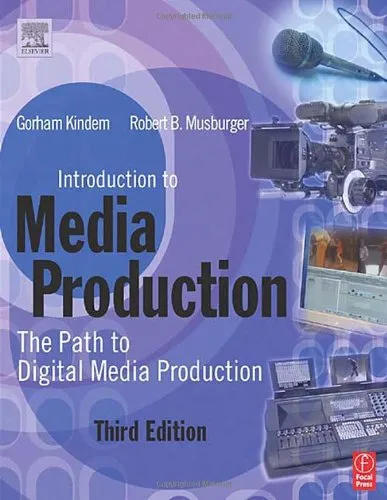
Introduction to media production: the path to digital media production
Robert B. Musburger,Gorham Kindem
2004
View book

Book guide and evaluation
Britta Lesniak
0 reviews
Published
pages
views
Epic Television – Music and Sound in Ramayan and Mahabharat Indian television soundscapes, epic narrative music analysis Explore 'Epic Television – Music and Sound in Ramayan and Mahabharat' and uncover the rich soundscapes shaping India's iconic epics. Analytical Su
Before you read
"Epic Television – Music and Sound in Ramayan and Mahabharat" is a meticulous study of how sound and music contribute to the storytelling power of two of India's most influential televised epics. Drawing on historical context, musicological insight, and media theory, this work unpacks the sonic strategies that elevated the serial adaptations of these ancient narratives into cultural phenomena.
The Ramayan and Mahabharat productions that aired on Indian television in the late 20th century transformed public engagement with traditional epic literature. They were remarkable not just for their visual enactments, but for the deliberate and layered sound design that accompanied them. From the resonant tones of the dhol to the haunting strains of the shehnai and the commanding voiceovers, sound worked in tandem with imagery to immerse audiences in moral and mythic worlds.
This book situates those sonic elements within broader traditions of Indian performing arts, while also examining how television as a mass medium altered the reception of these sounds. It addresses questions of authenticity, adaptation, and innovation, making it a valuable resource for scholars of music, media, and South Asian cultural studies.
Readers will come away with a nuanced understanding of the integral role of sound in televised epic narratives, alongside insights into the production processes and cultural contexts that informed them.
Learn how music in "Ramayan" and "Mahabharat" television series acted not merely as background but as a narrative driver, signaling emotional shifts, character arcs, and thematic resonance.
Discover the interplay between traditional musical forms and the demands of modern broadcast media, highlighting the adaptation process that balanced heritage and audience expectations.
Understand the socio-political moment in which these series aired, and how the soundscapes contributed to national conversations about identity, history, and cultural continuity.
“Sound is the invisible character that shapes the way audiences feel the story.”Unknown
“In epic television, silence itself can be as powerful as a symphony.”Unknown
“The music in these series was not an accessory; it was the breath of the narrative.”Unknown
For academics, sound designers, and media historians, "Epic Television – Music and Sound in Ramayan and Mahabharat" offers a rare, deeply contextualized examination of televised soundscapes as cultural texts.
In the scholarly landscape, studies that bridge ethnomusicology and television analysis remain scarce. This book fills that gap by focusing on a unique confluence of ancient narrative tradition and modern mass communication.
Information about specific production credits, awards, and publication year is unavailable due to lack of reliable public sources, underscoring the importance of careful archival work in future research.
Its relevance is heightened in the current media environment, where adaptation and reinterpretation of classic narratives continue to spark debates on authenticity and innovation.
"Epic Television – Music and Sound in Ramayan and Mahabharat" invites readers to not only appreciate the artistry behind these legendary productions, but to engage in meaningful dialogue about the role of music and sound in shaping narrative media.
By revisiting the televised Ramayan and Mahabharat with a critical ear, we reconnect with the textures of sonic storytelling that continue to influence both creative practitioners and audiences. Whether you are a scholar seeking deeper understanding, a media professional aiming to refine your craft, or a cultural enthusiast drawn to the rich heritage of Indian epics, this book offers a pathway into a complex and rewarding field of study.
Take the next step: read, share, and discuss the insights found in "Epic Television – Music and Sound in Ramayan and Mahabharat" to expand the conversation on how sound brings stories to life.
Your question is answered in the context of this title and author. Each answer uses 2 points.
0 reviews, 4.0 average out of 5
Sign in to publish a review.
Ask a focused question and learn from the community.
Related references that continue this learning path.
Robert B. Musburger,Gorham Kindem

Jon Wiederhorn,Katherine Turman