Loading
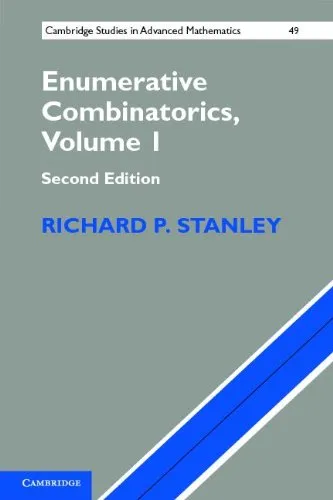
Cover of Enumerative Combinatorics: Volume 1
English Beginner Mathematics

Enumerative Combinatorics: Volume 1

Richard P. Stanley

Richard P. Stanley

5.0 / 5

1 reviews

2011

Published

642

pages

489

views

Introduction to Enumerative Combinatorics: Volume 1 Welcome to the fascinating world of combinatorial mathematics, where the art of counting elevates beyond arithmetic into a vast mathematical landscape. "Enumerative Combinatorics: Volume 1" by Rich

About this book

Introduction to Enumerative Combinatorics: Volume 1

Welcome to the fascinating world of combinatorial mathematics, where the art of counting elevates beyond arithmetic into a vast mathematical landscape. "Enumerative Combinatorics: Volume 1" by Richard P. Stanley is a pioneering work that sets the stage for understanding the principles of counting, organizing, and arranging in mathematics. Within this classic text, you will discover the intricacies of combinatorial structures, novel techniques, and profound results that have become indispensable tools for mathematicians and scientists alike.

Detailed Summary of the Book

The book spans a meticulously curated exploration of the primary methods used in enumerative combinatorics. "Enumerative Combinatorics: Volume 1" extensively covers topics such as permutations, combinations, partitions, and generating functions. It begins with elementary concepts and gradually progresses to more sophisticated techniques, making it suitable for both beginners and those who seek a deeper understanding of the subject.

Each chapter is designed to build upon the previous, providing readers with a cohesive learning experience. The initial chapters introduce basic counting principles, including the Pigeonhole Principle and inclusion-exclusion strategy. Following that, the text delves into partition theory, Catalan numbers, and Stirling numbers, offering insights into their applications in various mathematical and real-world contexts.

A distinguishing feature of this volume is its emphasis on generating functions — a powerful tool for solving recurrence relations and modeling complex counting problems. Through well-crafted examples and exercises, the book demonstrates how generating functions serve as elegant solutions to otherwise intractable problems.

Key Takeaways

  • Gain a thorough understanding of fundamental counting techniques and their applications.
  • Comprehend the use of generating functions in solving complex enumeration problems.
  • Learn how to apply the principles of permutations, combinations, and partitions in various fields.
  • Explore advanced concepts such as Catalan numbers and Stirling numbers.
  • Develop problem-solving skills through rigorous exercises and well-structured explanations.

Famous Quotes from the Book

"In mathematics, enumerative combinatorics is both an art and a science. It requires the artist's ability to craft patterns and structures, alongside the scientist's skill to decipher the underlying principles."

Richard P. Stanley

Why This Book Matters

"Enumerative Combinatorics: Volume 1" is not merely a textbook; it is a gateway into a rich and dynamic branch of mathematics. Its importance is underscored by its frequent citation and adoption in academic curricula worldwide. Richard P. Stanley's clear and detailed exposition equips both students and researchers with the tools needed to tackle a broad range of problems in mathematics and computer science.

This first volume lays a strong foundation for its successor, assisting readers in developing a comprehensive understanding of the field. As combinatorics continues to influence diverse disciplines such as cryptography, computational biology, and algorithm design, mastering these concepts is vital for anyone aiming to contribute to cutting-edge technological and scientific advancements.

Ask this book

Your question is answered in the context of this title and author. Each answer uses 2 points.

Sign in to ask the book assistant.

Reader reviews

1 reviews · 5.0 average out of 5

amirhossein87

2025/01/28

5 / 5

In mathematics, a combination is a selection of items from a set that has distinct members, such that the order of selection does not matter (unlike permutations). For example, given three fruits, say an apple, an orange and a pear, there are three combinations of two that can be drawn from this set: an apple and a pear; an apple and an orange; or a pear and an orange. More formally, a k-combination of a set S is a subset of k distinct elements of S. So, two combinations are identical if and only if each combination has the same members. (The arrangement of the members in each set does not matter.) If the set has n elements, the number of k-combinations, denoted by
C
(
n
,
k
)
{\displaystyle C(n,k)} or
C
k
n
{\displaystyle C_{k}^{n}}, is equal to the binomial coefficient

Write a review

Sign in to publish a review.

Reader questions and answers

Ask a focused question and learn from the community.

Sign in to ask or answer a question.

No questions yet

Be the first to ask a clear, useful question.

Related references that continue this learning path.