
Book guide and evaluation
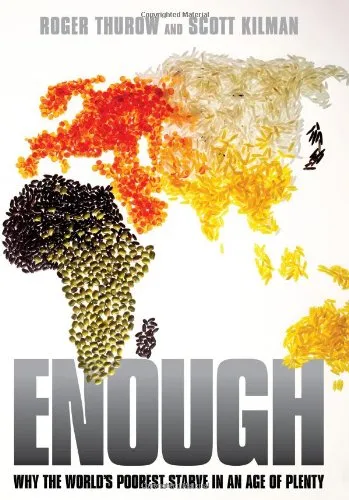
Enough: Why the World's Poorest Starve in an Age of Plenty.
Roger Thurow,Scott Kilman
English
Beginner
Data Science
4.4 / 5
0 reviews
2009
Published
337
pages
221
views
Introduction to Enough: Why the World's Poorest Starve in an Age of Plenty Enough: Why the World's Poorest Starve in an Age of Plenty, written by journalists Roger Thurow and Scott Kilman, is a gripping, eye-opening exploration of one of the most pressing
Before you read
What will you get from this book?
Introduction to Enough: Why the World's Poorest Starve in an Age of Plenty
Enough: Why the World's Poorest Starve in an Age of Plenty, written by journalists Roger Thurow and Scott Kilman, is a gripping, eye-opening exploration of one of the most pressing dilemmas of our time: global hunger. In an age where technological advancements and agricultural innovations have created plenty, millions of people still endure crushing hunger and malnutrition. This book is both a call to action and an investigation into why this paradox exists.
Drawing on years of on-the-ground reporting, Thurow and Kilman dissect the socioeconomic, political, and environmental factors that perpetuate starvation, especially in the developing world. The book presents compelling stories from individuals, communities, and nations, shining a light on the systemic failures and misguided aid efforts that have entrenched hunger over decades. Yet, the authors also highlight solutions — practices and policies that could eradicate hunger, provided there is the collective will to implement them.
With powerful anecdotes, a wealth of research, and a balance of critique and optimism, Enough distinguishes itself as a guide to understanding both the causes of and solutions to world hunger. It challenges readers to confront their own roles in a world of inequality and to imagine a future where no one goes hungry, not for a lack of resources, but because humanity chooses compassion and efficiency over complacency.
Detailed Summary of the Book
At its core, Enough explores how the promises of the 20th century Green Revolution failed to fully materialize for the world’s poorest farmers. While nations with resources and infrastructure reaped the benefits of agricultural innovation, many developing countries were left behind due to poorly designed policies, corruption, and systemic neglect.
The book delves into various aspects of this global crisis. It examines the impact of Western food aid programs, which, though well-intentioned, often undermined local agricultural systems. Through vivid storytelling, it critiques the distribution of subsidized food, which, in some instances, flooded local markets and pushed local farmers out of business. The authors also explore the relationship between agricultural practices, malnutrition, and poverty, demonstrating how hunger is both a consequence and cause of economic stagnation.
One key section of the book documents the failures of global institutions, highlighting how political interests and bureaucratic inefficiencies have resulted in decades of squandered opportunities. The stories of smallholder farmers in Africa are particularly moving, portraying how they often get caught in a vicious cycle of droughts, crop failures, and market failures.
However, Thurow and Kilman do not focus solely on the failures. They dedicate significant portions of the book to solutions, such as empowering smallholder farmers with better seeds, fertilizers, and farming techniques. They discuss the importance of building infrastructure, improving market access, and creating trade policies that do not disproportionately benefit wealthier nations at the expense of poorer ones. In doing so, the authors offer a vision of change and a path toward eliminating global hunger, one that requires international commitment and grassroots empowerment.
Key Takeaways
- The paradox of global hunger lies in the fact that there is enough food to feed the world, yet millions starve due to systemic flaws in distribution and policy.
- Western food aid, while well-meaning, often has unintended consequences that harm local economies and farmers.
- Empowering smallholder farmers with resources, techniques, and decision-making power is crucial to addressing global hunger sustainably.
- Hunger is not just a humanitarian issue but also a cause and consequence of global economic instability.
- The fight against hunger requires stronger partnerships between governments, NGOs, and the private sector, with a focus on long-term solutions instead of temporary fixes.
Famous Quotes from the Book
"Hunger is the great cause of our time. It is solvable, but only if the world musters the will to confront it."
"The people who grow food are, far too often, the same people who go hungry."
"The battle of our age is not famine versus plenty, but indifference versus action."
Why This Book Matters
Enough is not just a book about hunger; it is a book about hope and justice. It illustrates how hunger is often the result of human actions or inactions — systems, policies, and priorities that can be changed. By exposing the root causes of global hunger, the authors inspire readers to think critically about the structural changes necessary to end it once and for all.
In a world where many feel disconnected from the suffering of others, this book serves as a moral compass. It reminds us that hunger is not inevitable and that the resources, knowledge, and tools to combat it already exist. What remains to be seen is whether humanity has the collective resolve to act.
For policy-makers, activists, scholars, and anyone who is contemplative about their role in global issues, Enough is a clarion call to awaken from apathy and work toward a just and equitable future. This book truly matters because it proves that, in an age of plenty, starvation is no longer a question of scarcity, but of our shared humanity.
Ask this book
Your question is answered in the context of this title and author. Each answer uses 2 points.
Sign in to ask the book assistant.
Reader reviews
0 reviews, 4.4 average out of 5
No reviews yet
If you have read this book, help the next reader with your experience.
Write a review
Sign in to publish a review.
Reader questions and answers
Ask a focused question and learn from the community.
Sign in to ask or answer a question.
No questions yet
Be the first to ask a clear, useful question.
What to read next
Related references that continue this learning path.


Modern Computer Vision with PyTorch: A Practical Roadmap From Deep Learning Fundamentals to Advanced Applications and Generative AI, 2nd Edition
V Kishore Ayyadevara,Yeshwanth Reddy
2023
View book