
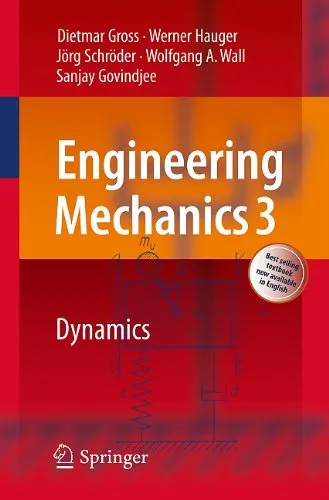
Book guide and evaluation
Engineering Mechanics 3: Dynamics
Dietmar Gross,Werner Hauger,Jörg Schröder,Wolfgang Wall,Sanjay Govindjee (auth.)
English
Beginner
Classical Mechanics
4.5 / 5
0 reviews
2011
Published
369
pages
529
views
Introduction to "Engineering Mechanics 3: Dynamics" Embark on an in-depth exploration of the principles and applications of dynamics in this comprehensive text, 'Engineering Mechanics 3: Dynamics'. Covering fundamental as well as advanced concepts, this book serves as an e
Before you read
What will you get from this book?
Introduction to "Engineering Mechanics 3: Dynamics"
Embark on an in-depth exploration of the principles and applications of dynamics in this comprehensive text, 'Engineering Mechanics 3: Dynamics'. Covering fundamental as well as advanced concepts, this book serves as an essential resource for students, educators, and professionals in the field of engineering mechanics.
Detailed Summary of the Book
Dynamics, one of the key subjects in engineering mechanics, is focused on studying and analyzing systems under the influence of forces and motion. 'Engineering Mechanics 3: Dynamics' is crafted to deliver an exhaustive understanding of dynamics from the basics to more intricate concepts. It is constructed progressively, beginning with kinematics, which concerns the motion of particles and rigid bodies, and gradually transitions into kinetics, where the causes of motion are examined.
The book meticulously navigates through Newton's laws of motion, providing a robust framework for problem-solving. Readers are introduced to the concepts of work and energy, impulse and momentum, and detail-oriented analyses of vibrations. With elaborate explanations and mathematical rigor, the book ensures a deep comprehension of the dynamics of particles, rigid bodies, and complex, multi-degree-of-freedom systems.
An impressive feature of this book is its integration of real-world applications, affording readers a practical perspective of how dynamics principles are applied in engineering practice. Through careful exposition coupled with illustrative examples, the authors ensure that engineering students build a cohesive understanding of the subject.
Key Takeaways
- Comprehensive coverage of kinematics and kinetics of particles and rigid bodies.
- Detailed explanations of Newton’s laws of motion and their applications in engineering scenarios.
- Understanding the principles of work, energy, impulse, and momentum.
- Practical examples illustrating the implementation of dynamics in engineering.
- Integration of advanced topics like vibrations and multi-degree-of-freedom system analysis.
Famous Quotes from the Book
"The study of dynamics is pivotal not only in understanding motion but in designing systems that leverage forces efficiently."
"In every machinery lies an orchestra of dynamics, playing silently yet profoundly, ensuring robust performance and reliability."
Why This Book Matters
'Engineering Mechanics 3: Dynamics' stands as an authoritative text indispensable for the scholarship and practical application of dynamic systems in engineering. Its diversity in content supports both introductory and expert comprehension, making this a versatile reference book.
What distinguishes this volume is its dedication to not only teach but actively engage the reader in critical thinking and problem-solving. By systematically incorporating examples from the real engineering world, it bridges the gap between theory and practice, preparing readers not just to excel academically but also professionally.
The book is not just for educational purposes; it is crafted to be a companion throughout one's engineering career. As such, it has become a staple text for academia, highly recommended due to its clarity, precision, and comprehensive coverage. Whether you are a student forging your career in engineering or a seasoned professional looking to revisit the fundamentals, this book is an invaluable asset.
Ask this book
Your question is answered in the context of this title and author. Each answer uses 2 points.
Sign in to ask the book assistant.
Reader reviews
0 reviews, 4.5 average out of 5
No reviews yet
If you have read this book, help the next reader with your experience.
Write a review
Sign in to publish a review.
Reader questions and answers
Ask a focused question and learn from the community.
Sign in to ask or answer a question.
No questions yet
Be the first to ask a clear, useful question.
What to read next
Related references that continue this learning path.
Mathematical methods of classical mechanics: with 269 illustrations
Arnolʹd, Vladimir Igorevich;Weinstein, Alan;Vogtmann, Karen
2010
View book