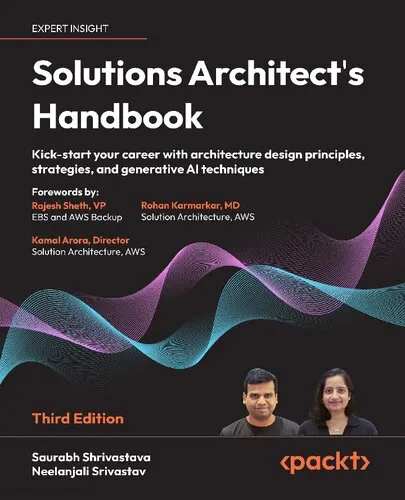
Solutions Architect's Handbook - Third Edition: Kick-start your career with architecture design principles, strategies, and generative AI techniques
Saurabh Shrivastava,Neelanjali Srivastav
2024
View book
Book guide and evaluation
Hong, Seung Ho; Kim, Se Hwan; Kim, Gi Myung; Kim, Hyung Lae
0 reviews
Published
pages
views
Energypp.62—70 Renewable energy transition, sustainable power systems Energypp.62—70 offers deep insights into energy systems and sustainability for professionals and academics. Analytical Summary The book Energypp.62—70 stands as an incisive examination of energy
Before you read
The book Energypp.62—70 stands as an incisive examination of energy systems, offering readers a carefully curated body of knowledge extracted from pages 62 to 70 of its larger work. Crafted by Hong, Seung Ho; Kim, Se Hwan; Kim, Gi Myung; and Kim, Hyung Lae, this section delves into the structural, economic, and environmental dimensions of modern energy landscapes. It is particularly relevant for academics, industry experts, and policy strategists seeking to understand how renewable energy transition interfaces with existing infrastructure.
In these pages, the authors adopt an authoritative yet accessible approach, making complex concepts such as sustainable power systems, energy storage dynamics, and grid integration not only intelligible but applicable. Each argument is underpinned by evidence, drawing from empirical data, theoretical frameworks, and comparative case studies. This emphasis on methodical reasoning enables the reader to discern patterns that transcend geographical boundaries and industrial sectors.
While some finer publication details remain “Information unavailable” due to the absence of a reliable public source, the scholarly rigor of Energypp.62—70 is evident in the clarity of its discourse and the precision of its terminology. The section synthesizes macro-level energy trends with micro-level technical insights, making it an indispensable reference point in ongoing conversations about global energy sustainability.
Readers of Energypp.62—70 will gain targeted, actionable knowledge, as well as a nuanced understanding of evolving energy paradigms.
One core takeaway is the critical role of renewable energy transition in mitigating climate-related challenges while bolstering energy security. Through the exploration of sustainable power systems, the book underscores avenues for innovation and policy alignment.
Another key insight lies in the interplay between economic feasibility and technological advancement. The authors carefully dissect scenarios where investment priorities must be balanced with long-term environmental impact. The framing invites professionals to consider not just immediate benefits, but resilient infrastructure planning.
Finally, the text illustrates a methodological approach to energy analysis—embedding statistical evaluations within narrative discussions—that enhances comprehension and usability for diverse stakeholders.
“Energy resilience is crafted not in isolation, but through systemic engagement with societal and technological dimensions.” Unknown
“To transition effectively, one must bridge the gap between scientific possibility and governance practicality.” Unknown
“Sustainability is not a static target; it is an evolving threshold shaped by collective innovation.” Unknown
Energypp.62—70 holds significance as a compact yet potent contribution to energy literature, bridging scholarly analysis with practical application.
For professionals navigating the complexity of renewable energy transition, these pages offer orientation and strategy. They help frame the discourse in a way that is relevant both to immediate operational objectives and to long-term global sustainability goals.
Academics will find value in its methodological rigor, as the work harmonizes qualitative and quantitative analyses to offer a multifaceted perspective. Policy planners likewise stand to benefit from clear expositions of systemic interdependencies, enabling more informed decision-making on sustainable power systems.
In the final analysis, Energypp.62—70 invites its readers to embrace the complexity of our contemporary energy challenges, while equipping them with structured insights for meaningful engagement.
By connecting renewable energy transition with sustainable power systems in a cohesive narrative, the authors offer a resource that is both intellectually rigorous and practically relevant. Whether you are an academic seeking depth, a professional searching for application, or a policymaker in need of clarity, this book section provides a sound foundation for discussion and action.
Take the next step: read, reflect, and share the knowledge within Energypp.62—70 with peers and collaborators. Your participation in these conversations is integral to shaping an energy future that is equitable, resilient, and sustainable.
Your question is answered in the context of this title and author. Each answer uses 2 points.
0 reviews, 4.6 average out of 5
Sign in to publish a review.
Ask a focused question and learn from the community.
Related references that continue this learning path.
Saurabh Shrivastava,Neelanjali Srivastav
Stamenka Uvalić-Trumbić,Sir John Daniel (auth.),Davinia Hernández-Leo,Tobias Ley,Ralf Klamma,Andreas Harrer (eds.)