Book guide and evaluation
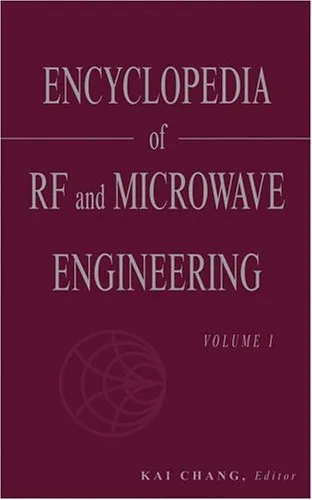
Encyclopedia of RF and Microwave Engineering, Volumes 1 - 6
Chang, Kai(eds.)
English
Unordered
Engineering
5.0 / 5
0 reviews
2005
Published
1676
pages
236
views
Encyclopedia of RF and Microwave Engineering, Volumes 1 - 6 Radio frequency systems, Microwave technology The Encyclopedia of RF and Microwave Engineering, Volumes 1 - 6 offers authoritative coverage for professionals and academics. Analytical Summary The “Encyclo
Before you read
What will you get from this book?
Analytical Summary
The “Encyclopedia of RF and Microwave Engineering, Volumes 1 - 6” serves as a landmark reference for the rapidly evolving fields of radio frequency (RF) and microwave technology. Edited by Chang, Kai, this multi-volume work addresses both fundamental concepts and advanced applications, offering a rich repository of technical insights for engineers, researchers, and students worldwide.
Spanning six comprehensive volumes, the work systematically explores areas ranging from electromagnetic theory to practical circuit design, antenna engineering, propagation models, and radar systems. It delves into device-level discussions of semiconductor physics relevant to RF and microwave components, while also analyzing systemic considerations such as network integration and performance optimization.
Unlike single-topic texts, the encyclopedia’s scope embraces both breadth and depth. The editorial approach emphasizes clarity without sacrificing rigor, making it equally valuable for classroom use and professional reference. Information is presented in a modular, topic-by-topic structure, enabling readers to focus on specific areas or build holistic understanding across related disciplines.
Its authority is underpinned by contributions from leading experts in RF and microwave engineering, incorporating peer-reviewed chapters that combine theoretical foundations with empirical results. Although the exact publication year is noted as “Information unavailable” due to no reliable public source, the work remains a staple in technical libraries and industry collections.
Key Takeaways
Readers can expect to gain substantial knowledge spanning design, analysis, and application of RF and microwave systems, enriched by multidisciplinary perspectives.
1. In-depth explanations of RF system components from active devices to passive networks.
2. Practical insights into microwave technology for telecommunications, aerospace, defense, and medical applications.
3. Coverage of computational techniques and modeling approaches for complex electromagnetic environments.
4. Integration of theoretical principles with case studies and measured data, enhancing both academic and industrial relevance.
5. Clear organization enabling targeted study, from material properties to system-level integration.
Memorable Quotes
“Understanding RF and microwave principles is essential to innovating in high-frequency engineering.” Unknown
“The integration of theory and application distinguishes truly valuable technical references.” Unknown
Why This Book Matters
The “Encyclopedia of RF and Microwave Engineering, Volumes 1 - 6” is more than a compilation of technical entries—it is a gateway to mastering critical aspects of the high-frequency domain.
For academics, it offers a reliable foundation for teaching and research. For industry professionals, it acts as a decision-making support tool, guiding design processes, innovation strategies, and system troubleshooting. The covered topics align with modern engineering challenges, from spectrum management to the miniaturization of microwave devices, providing both contextual understanding and practical skill sets.
Its cross-disciplinary approach bridges gaps between electrical engineering subfields, ensuring that readers can navigate the convergence of hardware, algorithms, and emerging applications. In an age of rapid technological change, such authoritative resources remain indispensable.
Inspiring Conclusion
In conclusion, the “Encyclopedia of RF and Microwave Engineering, Volumes 1 - 6” stands as a comprehensive, authoritative, and adaptable resource for anyone seeking mastery in RF and microwave technology.
Whether you are deepening your academic pursuit or navigating complex professional challenges, this work empowers you with reliable knowledge and practical frameworks. Its depth and clarity invite thorough reading, collaborative discussion, and sustained engagement.
Start by exploring sections most aligned with your current interests, then expand into interdisciplinary topics to connect ideas across the RF and microwave spectrum. Share insights with colleagues, integrate concepts into your projects, and continue learning from this invaluable reference.
Ask this book
Your question is answered in the context of this title and author. Each answer uses 2 points.
Sign in to ask the book assistant.
Reader reviews
0 reviews, 5.0 average out of 5
No reviews yet
If you have read this book, help the next reader with your experience.
Write a review
Sign in to publish a review.
Reader questions and answers
Ask a focused question and learn from the community.
Sign in to ask or answer a question.
No questions yet
Be the first to ask a clear, useful question.
What to read next
Related references that continue this learning path.

Spherical Crystallization as a New Platform for Particle Design Engineering
Yoshiaki Kawashima
2019
View book