
Book guide and evaluation
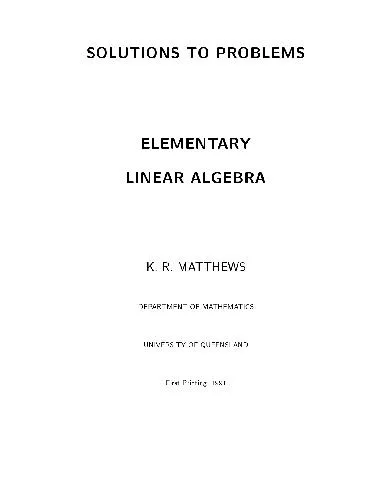
Elementary linear algebra: solutions to problems
Matthews K.R.
English
Beginner
Algebra
4.8 / 5
0 reviews
1991
Published
106
pages
477
views
Introduction Welcome to the comprehensive guide that not only aids in solving linear algebra problems but also enhances your understanding of the subject. "Elementary Linear Algebra: Solutions to Problems" is crafted meticulously to serve as an indispensable companion for stud
Before you read
What will you get from this book?
Introduction
Welcome to the comprehensive guide that not only aids in solving linear algebra problems but also enhances your understanding of the subject. "Elementary Linear Algebra: Solutions to Problems" is crafted meticulously to serve as an indispensable companion for students, educators, and professionals who engage with linear algebra.
Summary of the Book
The book "Elementary Linear Algebra: Solutions to Problems" provides detailed solutions to a wide array of linear algebra problems, spanning from basic concepts to more advanced topics. The book is organized into distinct chapters, each addressing a particular aspect of linear algebra such as vector spaces, matrix theory, determinants, eigenvalues and eigenvectors, inner product spaces, and linear transformations.
For every problem posed, the book offers a step-by-step solution that elucidates the methodology and underlying principles. This approach is intended not just to solve the problem at hand, but to reinforce the reader’s grasp of linear algebraic techniques and logical reasoning. Through clarity and precision, the book demystifies complex topics, making them accessible and engaging for learners at various levels. Whether you're encountering linear algebra for the first time or delving deeper for further study, this collection serves as both a textbook and a reference guide.
Key Takeaways
- Comprehensive step-by-step solutions for problems, enhancing learning and retention.
- Coverage of fundamental to advanced concepts in linear algebra, supporting a broad learning scope.
- Enhances conceptual understanding through detailed explanations and problem-solving strategies.
- Serves as a practical reference for coursework, self-study, and professional application.
Famous Quotes from the Book
“Understanding the elegance of linear algebra is akin to discovering a new dimension in mathematics that underpins the world around us.”
“Solving problems in linear algebra is not merely about finding the right answer, but about exploring the depth of mathematical possibilities.”
Why This Book Matters
Linear algebra is a cornerstone of modern mathematics and has profound implications in various fields such as computer science, engineering, physics, and economics. This book matters because it bridges the gap between theoretical abstract mathematical concepts and real-world applications. By providing solutions to real problems, it empowers learners to apply mathematical knowledge practically.
Moreover, the book is designed to foster a deeper understanding of mathematical theories by demonstrating their application in problem-solving. It plays a crucial educational role, encouraging critical thinking and analytical skills that are vital in today’s data-driven world. As industries increasingly rely on data and algorithms, a solid foundation in linear algebra becomes indispensable, and this book is your guide to building that foundation.
In conclusion, "Elementary Linear Algebra: Solutions to Problems" is more than just a problem-solving manual; it is an essential resource that cultivates a profound appreciation and mastery of linear algebra, equipping readers with the skills to excel academically and professionally.
Ask this book
Your question is answered in the context of this title and author. Each answer uses 2 points.
Sign in to ask the book assistant.
Reader reviews
0 reviews, 4.8 average out of 5
No reviews yet
If you have read this book, help the next reader with your experience.
Write a review
Sign in to publish a review.
Reader questions and answers
Ask a focused question and learn from the community.
Sign in to ask or answer a question.
No questions yet
Be the first to ask a clear, useful question.
What to read next
Related references that continue this learning path.
Lectures on Duflo Isomorphisms in Lie Algebra and Complex Geometry (EMS Series of Lectures in Mathematics)
Damien Calaque,Carlo A. Rossi
2011
View book
Introduction to Non-Abelian Class Field Theory, An: Automorphic Forms of Weight 1 and 2-Dimensional Galois Representations
Toyokazu Hiramatsu,Seiken Saito
2017
View book