
Book guide and evaluation
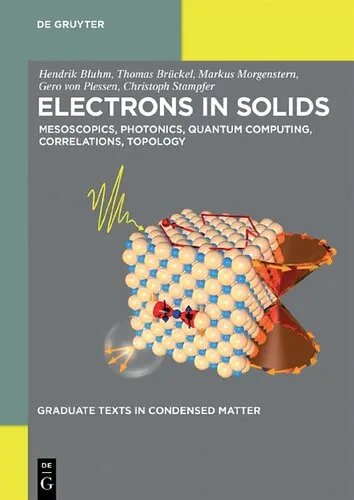
Electrons in Solids: Mesoscopics, Photonics, Quantum Computing, Correlations, Topology
H. Bluhm,T. Brückel,M. Morgenstern,G. von Plessen,C. Stampfer
English
Beginner
Physics
4.8 / 5
0 reviews
2019
Published
408
pages
154
views
Introduction Welcome to Electrons in Solids: Mesoscopics, Photonics, Quantum Computing, Correlations, Topology, a comprehensive exploration into the fascinating world of condensed matter physics and its interdisciplinary branches. This book serves as a guiding light for st
Before you read
What will you get from this book?
Introduction
Welcome to Electrons in Solids: Mesoscopics, Photonics, Quantum Computing, Correlations, Topology, a comprehensive exploration into the fascinating world of condensed matter physics and its interdisciplinary branches. This book serves as a guiding light for students, researchers, and science enthusiasts alike, shedding clarity on some of the most complex and rapidly evolving fields in modern physics. Through seamlessly integrating foundational knowledge with the most cutting-edge advancements, this text bridges the gap between theoretical principles and practical breakthroughs, making it an invaluable resource for anyone passionate about understanding the behavior of electrons in solid-state systems.
The book spans a breadth of topics, such as mesoscopic systems, photonic structures, the implications of quantum mechanics for computing, electron correlations, and the intriguing principles of topology. With the constant evolution of technology and the increasing importance of quantum mechanics and nanotechnology, a clear understanding of these concepts is no longer optional—it is essential. Our aim is to spark curiosity while equipping readers with a rich perspective that combines academic rigor with real-world applications.
Summary of the Book
Electrons in Solids is structured to guide readers from fundamental concepts to advanced emerging theories. Each chapter is meticulously organized to start from the basics, such as crystal structures and electronic band theory, gradually progressing toward the nuances of mesoscopic systems, photonics, and quantum computing. The book examines key phenomena like quantum interference, electron localization, and topological insulators, balancing theoretical models with experimental techniques.
The section on mesoscopics delves deep into topics such as weak localization, universal conductance fluctuations, and mesoscopic interference effects in quantum systems. Meanwhile, the chapter on photonics highlights the behavior of electrons interacting with light in nano-engineered materials, essential for innovations in optical computing and telecommunications. Quantum computing is explored not just as a technical challenge, but as a revolutionary paradigm shift—examining qubits, entanglement, and the future of quantum processing.
The treatment of correlations explores the intricate dance of electron-electron interactions, giving rise to phenomena like high-temperature superconductivity and magnetism. Finally, the exploration of topology wraps the book up with a glimpse into the elegant mathematical ideas that underlie topological insulators and emerging quantum phases, cementing this field’s importance in both physics and materials science.
Key Takeaways
- Gain an in-depth understanding of how electrons behave in mesoscopic systems, including quantum effects observable at the nanoscale.
- Understand the fundamental principles of photonics and its implications for future technologies, such as silicon photonics and quantum communications.
- Explore the revolutionary field of quantum computing, including how electron qubits are created, manipulated, and utilized for breakthrough computations.
- Learn the role of electron-electron interactions in complex materials and how these interactions lead to exotic phases of matter.
- Delve into the fascinating and highly mathematical realm of topology, helping to explain crucial phenomena such as quantized Hall effects and topological insulators.
- Develop both theoretical insight and practical knowledge, linking cutting-edge research to real-world applications.
Famous Quotes from the Book
"Mesoscopic systems demonstrate that quantum mechanics is not confined to isolated atoms or laboratories—it walks hand-in-hand with technology as we engineer on the nanoscale."
"Photonics is the language of light and electrons, driving innovations not only in telecommunications but also in shaping how humans interact with data."
"Topology teaches us that beauty in physics often lies not in the objects themselves, but in their invariants—unwavering and universal truths."
Why This Book Matters
In an era where science is becoming increasingly interdisciplinary, Electrons in Solids links diverse areas of physics, engineering, and mathematics into a coherent narrative. Whether you are a student starting your journey in solid-state physics, a researcher seeking insights into quantum systems, or an enthusiast passionate about cutting-edge technology, this book provides a solid foundation to advance your understanding.
The emphasis on both theoretical rigor and experimental relevance ensures that readers not only grasp the core ideas but also appreciate their impact on real-world applications—ranging from semiconductors to quantum computers and beyond. Moreover, by tackling ambitious topics like topology, it positions readers at the forefront of modern research, preparing them to engage in fields that shape the technological trajectory of the future.
Ultimately, this book matters because it doesn't just present knowledge; it inspires curiosity, fosters analytical thinking, and ignites a deeper appreciation for the elegance of condensed matter physics in the grand tapestry of science.
Ask this book
Your question is answered in the context of this title and author. Each answer uses 2 points.
Sign in to ask the book assistant.
Reader reviews
0 reviews, 4.8 average out of 5
No reviews yet
If you have read this book, help the next reader with your experience.
Write a review
Sign in to publish a review.
Reader questions and answers
Ask a focused question and learn from the community.
Sign in to ask or answer a question.
No questions yet
Be the first to ask a clear, useful question.
What to read next
Related references that continue this learning path.

Modern Computer Vision with PyTorch: A Practical Roadmap From Deep Learning Fundamentals to Advanced Applications and Generative AI, 2nd Edition
V Kishore Ayyadevara,Yeshwanth Reddy
2023
View book