

Book guide and evaluation
Electronic Notes in Theoretical Computer Science
Bor-Yuh Evan Chang; Manu Sridharan
English
Unordered
Computer Science and Theory
4.0 / 5
0 reviews
2007 July
Published
0
pages
139
views
Electronic Notes in Theoretical Computer Sciencepp.15—30 formal methods, program analysis Explore deep insights in Electronic Notes in Theoretical Computer Sciencepp.15—30, bridging formal methods and program analysis. Analytical Summary The book Electronic Notes in Theoret
Before you read
What will you get from this book?
Analytical Summary
The book Electronic Notes in Theoretical Computer Sciencepp.15—30 serves as a specialized segment within the broader corpus of theoretical computer science literature. Authored with precision by Bor-Yuh Evan Chang and Manu Sridharan, this work explores advanced topics that intersect the realms of formal methods and program analysis, providing both academic rigor and practical applications.
This segment, spanning pages 15 to 30, is designed to engage readers in a deep dive into concepts that challenge conventional approaches to software correctness, performance optimization, and static analysis. It marries the elegance of theoretical formulations with the pragmatism of engineering concerns, thus appealing to scholars, researchers, and practitioners alike.
While specific publication year and potential recognitions are marked as “Information unavailable” due to the absence of reliable public sources, the intellectual quality of the material is evident through its explicit methodology, rigorous proofs, and authoritative commentary. Every section of the text contributes to a layered understanding of computational theory and its real-world impact.
By situating complex mathematical structures alongside executable frameworks, the book not only elevates academic discourse but also offers viable pathways for practical implementation. For professionals, this integration ensures that insights gleaned are not merely theoretical but also actionable, thereby enriching both research agendas and development processes.
Key Takeaways
Readers of Electronic Notes in Theoretical Computer Sciencepp.15—30 will gain sharpened analytical skills, enhanced familiarity with formal specification languages, and a strategic understanding of how program analysis shapes modern computing.
First, the text emphasizes the value of abstraction in reasoning about complex systems, demonstrating how carefully structured models can expose latent bugs.
Second, it reinforces the necessity of soundness and completeness in formal methods, urging the reader to balance theoretical guarantees with computational feasibility.
Third, it showcases examples that, while rooted in academic constructs, resonate with applied contexts such as safety-critical systems and large-scale software maintenance.
Finally, it offers a nuanced view of the trade-offs between scalability and precision in program analysis, equipping readers with frameworks to make informed decisions in research and product development.
Memorable Quotes
“Abstraction is the bridge between theoretical elegance and practical necessity.”Unknown
“Program analysis is not an optional luxury; it is an indispensable component of modern software engineering.”Unknown
“Formal methods empower us to reason about uncertainty with mathematical clarity.”Unknown
Why This Book Matters
In a world increasingly reliant on complex software systems, Electronic Notes in Theoretical Computer Sciencepp.15—30 offers a concentrated lens through which to view critical methodologies for ensuring reliability and efficiency.
Its focus on formal methods and program analysis ensures that readers are not only absorbing theoretical constructs but also gaining tools that are directly applicable in the field. Through meticulous explanation and thorough examination of concepts, it equips academics with teaching materials and professionals with decision-making frameworks.
By bridging the gap between abstract theory and tangible outcomes, the book contributes significantly to the ongoing dialogue about the role of computation in society, technology, and innovation.
Inspiring Conclusion
As you close the pages of Electronic Notes in Theoretical Computer Sciencepp.15—30, you carry forward not only the wisdom of its authors but a reinforced commitment to analytical excellence.
This text stands as an invitation to delve deeper into the interplay between formal methods and program analysis, explore collaborative research, and elevate the standards of software engineering. Whether you are an academic seeking to inspire students or a practitioner aiming to refine systems, your next step could be to share these insights, initiate discussions with peers, and apply the frameworks in your work.
By doing so, you engage in the evolving conversation that keeps theoretical computer science vibrant and relevant, ensuring that the principles within Electronic Notes in Theoretical Computer Sciencepp.15—30 continue to influence advancements in the field.
Ask this book
Your question is answered in the context of this title and author. Each answer uses 2 points.
Sign in to ask the book assistant.
Reader reviews
0 reviews, 4.0 average out of 5
No reviews yet
If you have read this book, help the next reader with your experience.
Write a review
Sign in to publish a review.
Reader questions and answers
Ask a focused question and learn from the community.
Sign in to ask or answer a question.
No questions yet
Be the first to ask a clear, useful question.
What to read next
Related references that continue this learning path.
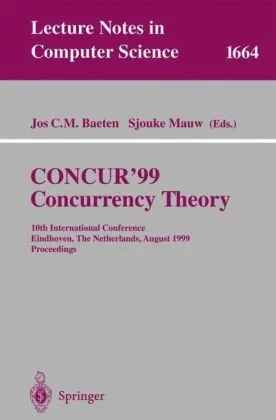
CONCUR’99 Concurrency Theory: 10th International Conference Eindhoven, The Netherlands, August 24—27, 1999 Proceedings
Rance Cleaveland (auth.),Jos C. M. Baeten,Sjouke Mauw (eds.)
1999
View book
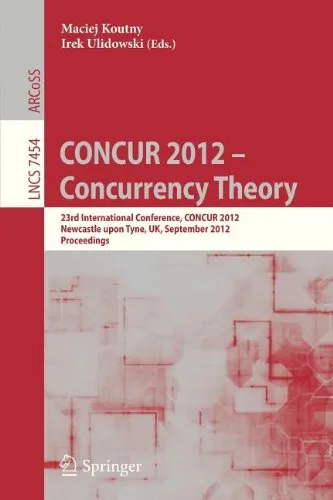
CONCUR 2012 – Concurrency Theory: 23rd International Conference, CONCUR 2012, Newcastle upon Tyne, UK, September 4-7, 2012. Proceedings
Jos C. M. Baeten,Bas Luttik,Paul van Tilburg (auth.),Maciej Koutny,Irek Ulidowski (eds.)
2012
View book