
Software Testing Techniques: Finding the Defects that Matter
Scott Loveland,Geoffrey Miller,Prewitt Jr.,Richard,Michael Shannon
2004
View book
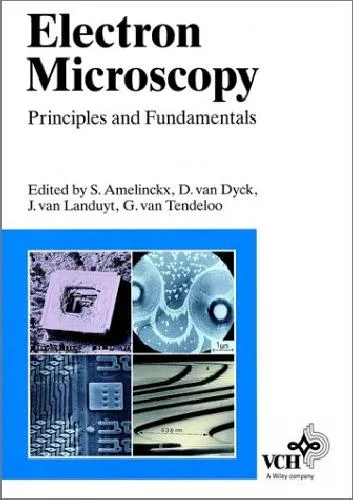
Book guide and evaluation
S. Amelinckx, et al.
0 reviews
Published
pages
views
Welcome to the intricate and fascinating world of electron microscopy with "Electron Microscopy: Principles and Fundamentals". This book serves as a cornerstone for students, researchers, and professionals who delve into the microscopic realms surpassing the limits of light
Before you read
Welcome to the intricate and fascinating world of electron microscopy with "Electron Microscopy: Principles and Fundamentals". This book serves as a cornerstone for students, researchers, and professionals who delve into the microscopic realms surpassing the limits of light microscopy. Authored by S. Amelinckx et al., this comprehensive text breaks down complex concepts into digestible content, making electron microscopy accessible and approachable for all readers.
The journey in "Electron Microscopy: Principles and Fundamentals" guides readers through the essentials of electron microscopy, beginning with its foundational principles and extending into its varied applications. The book addresses the physics of electron beams, detailing how they differ fundamentally from light rays. This sets the stage for understanding the capabilities and limits of electron microscopes, which are explored in both theoretical and practical contexts.
Critical components of the electron microscope, including the electron gun, lenses, and detectors, are meticulously dissected to provide a clear picture of their function and significance. Further chapters delve into technical aspects such as electron diffraction, resolution, and contrast mechanisms, empowering readers with the knowledge to interpret and manipulate microscopic images effectively.
This text bridges the gap between theory and application, with various chapters dedicated to scanning electron microscopy (SEM) and transmission electron microscopy (TEM), two primary forms of electron microscopy, each with their unique methodologies and usage scenarios.
"Electron microscopy opens a window into a world unseen by the naked eye, revealing the intricacies of the very small that define the very large."
"In the shadows of an electron's path lie the secrets of matter, waiting to be illuminated by the discerning eye of a meticulous scientist."
"Electron Microscopy: Principles and Fundamentals" stands out as a seminal text in the field of electron microscopy, providing both breadth and depth in its coverage. It empowers readers not only with technical knowledge but with the inquisitive spirit of exploration. By demystifying complex processes and presenting them in an organized and thoughtful manner, the book becomes an invaluable resource for anyone committed to expanding their understanding of the microscopic world.
This book serves as a vital tool for academic growth and professional advancement in scientific fields like materials science, physics, chemistry, and biology, where electron microscopy plays a pivotal role. The knowledge gleaned here propels innovation, enabling discoveries that challenge our conventions and expand our horizons.
Your question is answered in the context of this title and author. Each answer uses 2 points.
0 reviews, 4.5 average out of 5
Sign in to publish a review.
Ask a focused question and learn from the community.
Related references that continue this learning path.
Scott Loveland,Geoffrey Miller,Prewitt Jr.,Richard,Michael Shannon

Weinong W. Chen (auth.),Tom Proulx (eds.)

Sanichiro Yoshida (auth.),Helena Jin,Cesar Sciammarella,Cosme Furlong,Sanichiro Yoshida (eds.)
Rudolf P. Huebener (auth.)