

Book guide and evaluation
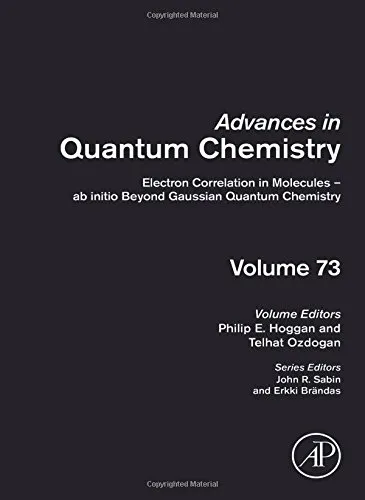
Electron correlation in molecules -- ab initio beyond Gaussian quantum chemistry
Hoggan, Philip E.;Ozdogan, Telhat
English
Beginner
Physics
4.4 / 5
0 reviews
2016
Published
421
pages
165
views
Welcome to "Electron Correlation in Molecules -- Ab Initio Beyond Gaussian Quantum Chemistry" This book is an in-depth exploration of electron correlation in molecular systems, focusing on advanced methodologies that extend beyond traditional Gaussian-based quantum chemical ap
Before you read
What will you get from this book?
Welcome to "Electron Correlation in Molecules -- Ab Initio Beyond Gaussian Quantum Chemistry"
This book is an in-depth exploration of electron correlation in molecular systems, focusing on advanced methodologies that extend beyond traditional Gaussian-based quantum chemical approaches. Authored by experts in the field, Philip E. Hoggan and Telhat Ozdogan, the work provides a fresh perspective on understanding electron interactions, offering groundbreaking insights into computational chemistry.
Detailed Summary of the Book
The study of electron correlation is central to grasping the quantum mechanical behavior of molecules. In this book, we delve into concepts and techniques that enable chemists and physicists to solve Schrödinger's equation with accuracy far beyond common Gaussian quantum chemistry frameworks. Traditional Gaussian-based methods, while useful, introduce limitations when addressing complex electron interactions in larger systems. This book builds a bridge between Gaussian methods and alternative approaches like explicitly correlated wave functions, density matrix renormalization group (DMRG), coupled-cluster theory, and others. Aiming to advance both theory and computational practice, this text serves as a unique resource for academics and professionals exploring the frontier of computational molecular chemistry.
From introducing fundamental principles of quantum mechanics to discussing recent algorithmic progress, the book offers a balanced mix of theory and application. Topics such as multi-reference correlation methods and new basis function designs are treated comprehensively, making this work suitable for researchers targeting high-accuracy solutions to demanding chemical problems.
Key Takeaways
- The book explains why Gaussian quantum chemistry, while prolific, may fail for highly correlated systems and shows how to overcome these limitations.
- It introduces emerging computational techniques and how they improve on traditional methods in terms of reliability and efficiency.
- Specific focus is given to real-world application areas such as reaction mechanisms, excited-state chemistry, and substrate-metal interactions.
- The text fosters a deeper understanding of highly correlated electronic systems, enabling readers to utilize advanced methodologies like DMRG or full configuration interaction (Full CI).
- A valuable resource for improving electronic structure calculations for molecules of biological, chemical, and material interest.
Famous Quotes from the Book
"The essence of chemistry lies in understanding how electrons interact within and between molecules. This book is our attempt to push the boundaries of what is computationally achievable."
"Gaussian functions should not constrain our imagination—an open mind creates new opportunities to solve old problems."
Why This Book Matters
Quantum chemistry is an ever-evolving field, driven by a quest for deeper accuracy and greater computational efficiency. While Gaussian-based models have dominated the field for decades, there is a growing recognition that they are insufficient for some of the more challenging electronic structure problems. "Electron Correlation in Molecules -- Ab Initio Beyond Gaussian Quantum Chemistry" delivers a timely response to this gap in knowledge. By mapping out the limitations of existing methods and proposing alternative frameworks, the authors provide a roadmap for a new era of computational chemistry.
This book is particularly significant as it combines rigorous theoretical discussion with practical insights. It empowers its audience—scholars, advanced students, and researchers alike—to advance their studies and tackle ambitious problems in molecular science. Moreover, the book helps lay the foundation for future developments in quantum chemistry, focusing on imaginative and innovative ways to address the electron correlation problem.
Highly recommended for anyone with a deep interest in electronic structure theory, this text is not only a technical guide but also a thought-provoking journey into what lies beyond conventional quantum chemical methodologies. The authors skillfully challenge norms while pointing toward a more capable and versatile computational future.
Ask this book
Your question is answered in the context of this title and author. Each answer uses 2 points.
Sign in to ask the book assistant.
Reader reviews
0 reviews, 4.4 average out of 5
No reviews yet
If you have read this book, help the next reader with your experience.
Write a review
Sign in to publish a review.
Reader questions and answers
Ask a focused question and learn from the community.
Sign in to ask or answer a question.
No questions yet
Be the first to ask a clear, useful question.
What to read next
Related references that continue this learning path.


Modern Computer Vision with PyTorch: A Practical Roadmap From Deep Learning Fundamentals to Advanced Applications and Generative AI, 2nd Edition
V Kishore Ayyadevara,Yeshwanth Reddy
2023
View book