

A Comprehensive Introduction to Differential Geometry, Vol. 3, 3rd Edition
Michael Spivak
1999
View book
Book guide and evaluation
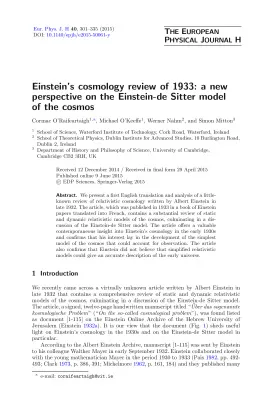
O’Raifeartaigh C.,O’Keeffe M.,Nahm W.,Mitton S.
0 reviews
Published
pages
views
Introduction Welcome to a deep exploration of one of the most pivotal moments in modern cosmology, as recounted in the book "Einstein’s Cosmology Review of 1933: A New Perspective on the Einstein-de Sitter Model of the Cosmos." This book delves into the uncharted territori
Before you read
Welcome to a deep exploration of one of the most pivotal moments in modern cosmology, as recounted in the book "Einstein’s Cosmology Review of 1933: A New Perspective on the Einstein-de Sitter Model of the Cosmos." This book delves into the uncharted territories of early 20th-century cosmological thought, bringing into focus the intellectual giants of the era, Albert Einstein and Willem de Sitter. Through their groundbreaking work, they laid the cornerstone of what we today understand as modern cosmology.
In 1933, the landscape of cosmological understanding was radically transformed when Einstein revisited his earlier models of the universe alongside Willem de Sitter. The book meticulously examines this transformative period, providing an insightful narrative into the development of the Einstein-de Sitter model, a universe model characterized by a flat, expanding universe with a constant rate of expansion. This model represented a fundamental shift from earlier static universe theories.
Through detailed analysis of Einstein's papers and his correspondence with de Sitter, the authors illuminate the intellectual journey that led to the acceptance of the expanding universe concept. The book profiles how their collaboration and exchange of ideas paved the way for the cosmological models that would define the scientific zeitgeist of the mid-20th century. This work not only impacted the scientific community but also influenced how humanity viewed its place in the cosmos.
Beyond simply providing historical context, the book also discusses the technical aspects and underlying mathematics of the model, offering readers not only a historical perspective but also a deep dive into the technical foundations of modern cosmology.
"The expansion of our understanding parallels the expansion of the universe itself – each discovery leading to vast new questions." – Chapter 3
"To stand on the shoulders of giants is to see farther than any individual genius could alone." – Chapter 7
This book is crucial for those interested in the history and development of scientific ideas, particularly in the field of cosmology. By meticulously detailing the evolution of the Einstein-de Sitter model, the authors offer scholars, historians, and scientific enthusiasts a comprehensive view of a turning point in scientific thought. Understanding this historical context allows for a greater appreciation of current cosmological models and the scientific process itself, which is based on revision, collaboration, and the constant quest for deeper knowledge.
Moreover, this book serves as a testament to the enduring legacy of Albert Einstein and Willem de Sitter, whose insights continue to resonate through the corridors of scientific inquiry, underscoring the importance of cooperation in scientific discovery.
Your question is answered in the context of this title and author. Each answer uses 2 points.
0 reviews, 4.8 average out of 5
Sign in to publish a review.
Ask a focused question and learn from the community.
Related references that continue this learning path.
Michael Spivak

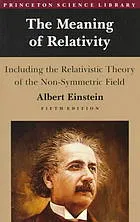
Einstein, Albert;Greene, Brian